

Working Capital Calculator: Current Ratio & Liquidity
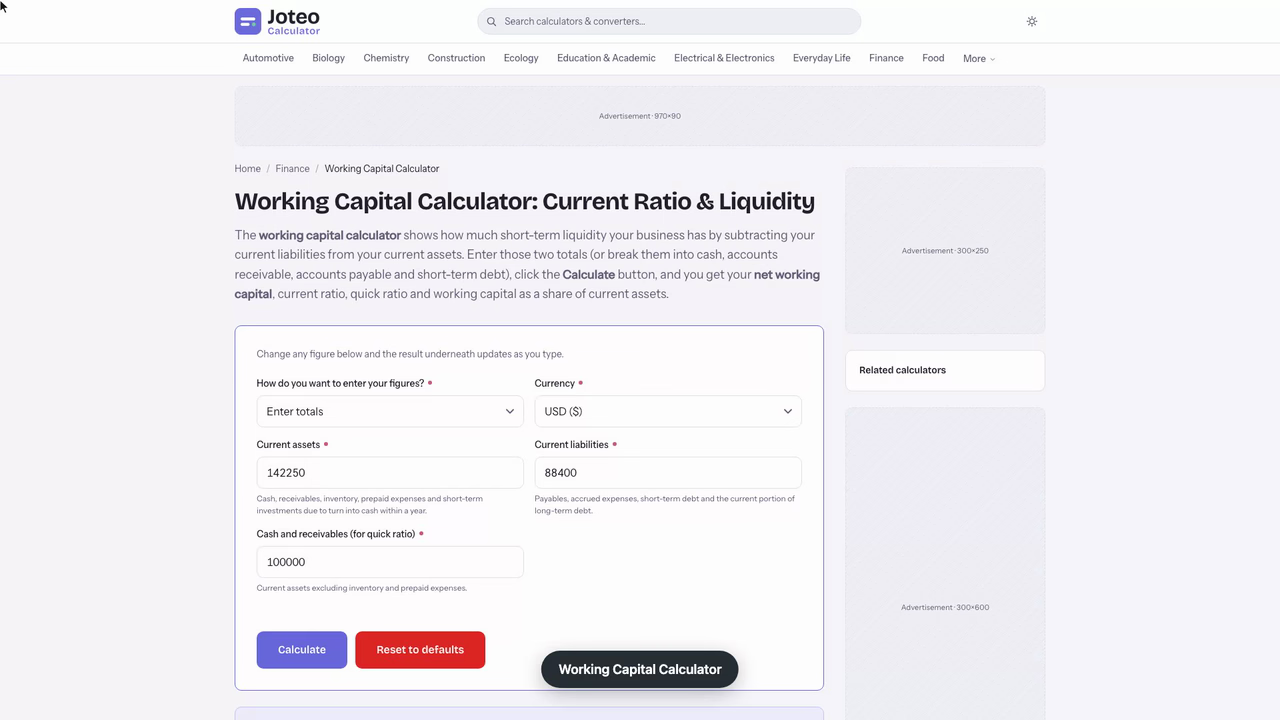
The working capital calculator shows how much short-term liquidity your business has by subtracting your current liabilities from your current assets. Enter those two totals (or break them into cash, accounts receivable, accounts payable and short-term debt), click the Calculate button, and you get your net working capital, current ratio, quick ratio and working capital as a share of current assets. Also try the Financial Leverage Ratio Calculator.
Working Capital Calculator inputs and result
Working capital
—
- Current ratio
- —
- Quick ratio
- —
- Working capital as % of current assets
- —
- Liquidity verdict
- —
Table of contents
Who wrote and checked this page


Use this free working capital calculator to subtract your current liabilities from your current assets and see how much liquidity your business has to operate on. Enter two totals from your balance sheet, and you get the dollar cushion, your current ratio and a quick check on whether your assets cover your liabilities.
How the Working Capital Calculator Works
Whether you run a business or handle its finance, the tool needs only two inputs: total current assets and total current liabilities. Everything else is derived from them, so treat the output as the start of a working capital analysis rather than a verdict.
Enter your current assets
Add up what you can turn into cash within about twelve months, using the latest balance sheet:
- Cash and equivalents
- Accounts receivable
- Inventory and prepaid expenses
- Short-term investments
Enter your current liabilities
Total your short-term obligations, everything due within a year:
- Accounts payable and accrued expenses
- Short-term debt
- Current portion of long-term debt
- Deferred revenue
Read your net working capital
The calculator subtracts current liabilities from current assets to give net working capital, then adds the current ratio and working capital as a share of all assets. A tier verdict such as "thin" or "healthy" is only a first read of your financial health, because payment timing, asset quality and industry all matter.
Working Capital Formula and Worked Example
The working capital formula uses just two balance sheet lines, where \(CA\) is current assets and \(CL\) is current liabilities:
$$WC = CA - CL$$
$$\text{Current ratio} = \frac{CA}{CL}$$
How to calculate working capital step by step
Take a small distributor with these balances:
| Line item | Amount |
|---|---|
| Cash | $41,300 |
| Accounts receivable | $58,700 |
| Inventory | $36,450 |
| Prepaid expenses | $5,800 |
| Total current assets | $142,250 |
| Accounts payable | $52,120 |
| Accrued expenses | $14,380 |
| Short-term debt | $12,400 |
| Current portion of long-term debt | $9,500 |
| Total current liabilities | $88,400 |
Working capital is $142,250 − $88,400 = $53,850, and the ratio is $142,250 ÷ $88,400 = 1.61.
What the current ratio adds
Working capital is a dollar amount, while the current ratio, sometimes called the working capital ratio, divides current assets by current liabilities to show the same cushion as a multiple. Many small firms aim for 1.5 to 2.0, and below 1.0 means a working capital deficit. Far above 2.0 can point to idle cash or slow-moving inventory, so compare against industry benchmarks.
A Bakery Owner Checks Her Current Ratio Before a $24,000 Flour Order
A wholesale bakery has a chance to supply a regional cafe chain, but the order means buying $24,000 of flour and packaging up front. Before signing, the owner wants to know whether her working capital survives it, because her bank's loan covenant requires a current ratio of at least 1.25.
She pulls her latest balance sheet. Current assets: cash $18,740, receivables $46,215, inventory $22,860, so $87,815 in total. Current liabilities: payables $31,480, accrued expenses $8,925, a $15,000 short-term loan and $6,240 of long-term debt due this year, so $61,645. Entering those two totals, the calculator returns $26,170 of net working capital and a current ratio of 1.42. That clears the 1.25 covenant with room to spare.
Now the sensitivity rerun. She buys the ingredients on 30-day supplier credit, so assets and liabilities both rise by $24,000: current assets become $111,815 and current liabilities $85,645. Working capital is unchanged at $26,170, which looks reassuring, but the ratio drops to 1.31. Solving for the breakpoint, she could add about $43,000 of payables-funded stock before touching 1.25.
| Scenario | Working capital | Current ratio | Quick ratio |
|---|---|---|---|
| Today | $26,170 | 1.42 | 1.05 |
| After the $24,000 order | $26,170 | 1.31 | 0.76 |
Beyond the headline working capital figure and the current ratio, the number to watch is the last column. The quick ratio falls from 1.05 to 0.76 because flour is not cash, so she would depend on cafe invoices being paid on time to meet her supplier bills. She cross-checks by hand: ($18,740 + $46,215) ÷ $85,645 = 0.76. Her decision is to take the order but negotiate 45-day terms with the cafe chain, so receivables convert before her payables fall due. A calculator's answer should not stand alone here: the covenant test is a snapshot, and a slow-paying customer would break it within one cycle.
Short-Term Liquidity: Quick Ratio and Cash Conversion Cycle
Working capital and the current ratio treat every current asset alike, so two companion measures sharpen the picture.
The quick ratio strips out inventory
The quick ratio, also called the acid-test ratio, counts only the liquid part of current assets, cash and receivables, against current liabilities: ($41,300 + $58,700) ÷ $88,400 = 1.13. That is thinner than 1.61, showing how much coverage depends on selling stock, which matters most in manufacturing and less in retail, where inventory turns quickly.
Cash conversion cycle and turnover
The cash conversion cycle measures timing across your operating cycle: days inventory outstanding plus days sales outstanding minus days payable outstanding, or stock days plus collection days minus supplier days. Working capital turnover divides revenue by average working capital, the mean of opening and closing balances, to show sales per dollar of capital employed.
Reading NWC: Negative Working Capital and Liquidity Risk
An NWC below zero is not always a crisis. Subscription firms and retailers collect from customers before paying suppliers, so negative working capital can be by design. It becomes liquidity risk when seasonality, slow collections or overtrading push obligations past what you can pay, and lenders may test covenants against it. Watch operating cash flow too, since cash flow and point-in-time snapshots can disagree. Startups chasing growth often run lean, so investors comparing stocks, and any lender, judge the working capital trend over several periods rather than one profit-era snapshot. See also our Apc Calculator.
Improving Your Liquidity Buffer
Rerun the example after paying $20,000 of payables from cash: working capital stays $53,850, but the ratio climbs to 1.79 because both sides shrink. A bigger liquidity buffer comes from converting current assets to cash faster or trimming current liabilities, and a line of credit arranged early helps. An accountant should confirm the assets and liabilities you enter before you rely on them. You might also find our Levered Free Cash Flow Calculator useful.
Speed up accounts receivable
Invoice immediately and offer early payment discounts to shorten collection time, turning receivables into cash and lifting working capital quality.
Negotiate accounts payable payment terms
Ask suppliers for longer payment terms to lower what you owe in the short run, but avoid stretching payables so far that relationships suffer.
FAQs around Working Capital Calculator
1. What is working capital?
Working capital, also called net working capital, is current assets minus current liabilities. It measures the short-term liquidity left after the obligations due within a year are covered.
2. How do you calculate working capital?
Subtract total current liabilities from total current assets, both taken from the same balance sheet date. Divide current assets by current liabilities to get the current ratio.
3. What is a good working capital ratio?
A current ratio between about 1.2 and 2.0 is generally considered healthy, with many small businesses aiming for 1.5 to 2.0. Below 1.0 signals a working capital deficit, and far above 2.0 can mean idle cash or slow-moving inventory. Benchmarks vary by industry.
4. Can working capital be negative?
Yes. Negative working capital means current liabilities exceed current assets. It is a warning sign for most firms, though subscription and retail models that collect cash before paying suppliers can run negative by design.
5. What is the difference between the current ratio and the quick ratio?
The current ratio divides all current assets by current liabilities. The quick ratio counts only cash and receivables, leaving out inventory and prepaid expenses that cannot be turned into cash quickly.
6. How can I improve my working capital?
Speed up collections with prompt invoicing and early payment discounts, negotiate longer supplier payment terms, hold less slow-moving inventory, and arrange a line of credit before you need one.
7. How often should I calculate working capital?
Monthly or quarterly is common, so you can watch the trend. A shrinking figure over several periods can be an early warning even while it is still positive.
8. Is working capital the same as cash flow?
No. Working capital is a snapshot of current assets and liabilities at one date, while cash flow tracks money moving in and out over a period.
Report an issue with this page
Spotted a wrong result or unclear explanation? Report an issue or read our editorial policy.