

Free EMV Calculator: Earned Media Value Calculator
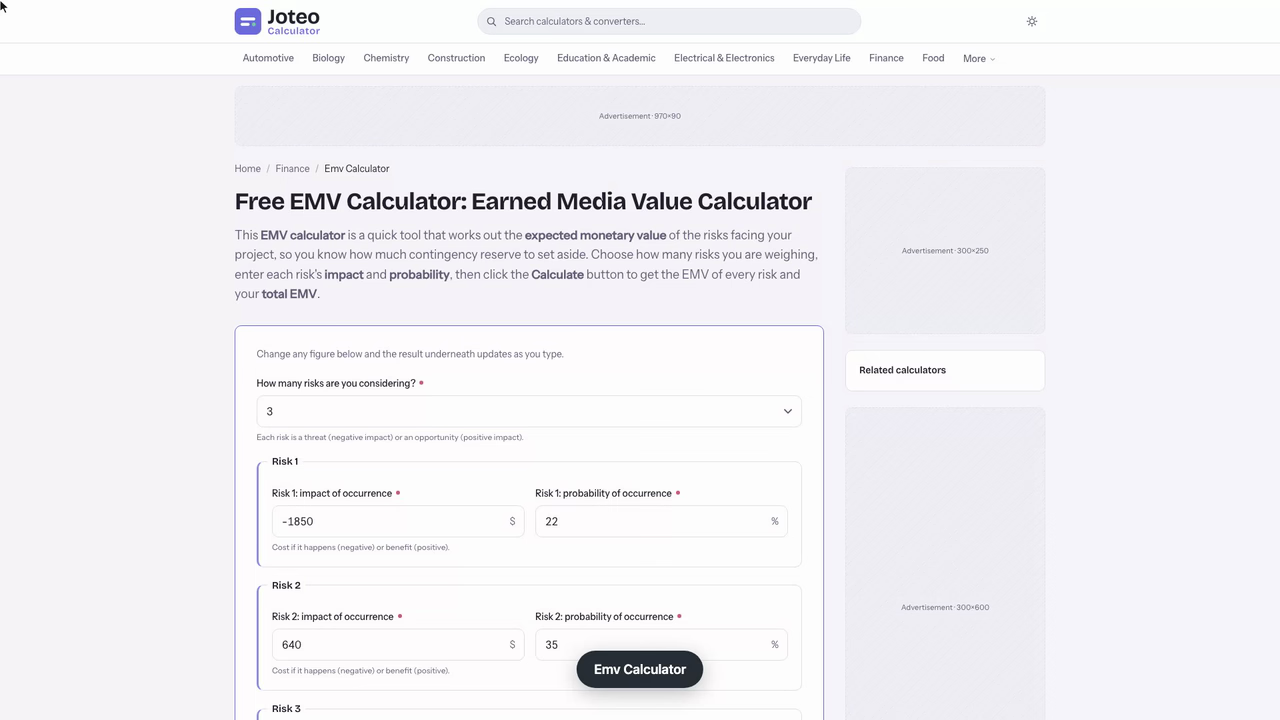
This EMV calculator is a quick tool that works out the expected monetary value of the risks facing your project, so you know how much contingency reserve to set aside. Choose how many risks you are weighing, enter each risk's impact and probability, then click the Calculate button to get the EMV of every risk and your total EMV. Also try the Dart Rate Calculator.
Emv Calculator inputs and result
Total EMV (contingency reserve)
—
- EMV of risk 1
- —
- EMV of risk 2
- —
- EMV of risk 3
- —
- EMV of risk 4
- —
- EMV of risk 5
- —
- EMV of risk 6
- —
- EMV of risk 7
- —
- EMV of risk 8
- —
- EMV of risk 9
- —
- EMV of risk 10
- —
Table of contents
Who wrote and checked this page


Use this EMV calculator to turn the impressions, engagements and reach of a post or campaign into a dollar figure you can report. Any earned media value calculator answers one question: what would the same exposure have cost as paid ads? Enter your impressions, CPM and engagements, then compare the result with your campaign cost. That shows whether your influencer marketing earned more attention than the money you put in.
What Is Earned Media Value and Why Marketers Track It
Earned media value (EMV) is the monetary value of exposure a brand gains without buying it: organic reach, brand mentions, media coverage and shares from creators, customers and journalists. The metric prices that organic exposure at what the same paid media would have cost, so the paid equivalent becomes a dollar value your team can report next to ad spend. Marketing and PR teams use it because likes, comments and mentions are hard to compare until they share one unit. Because the earned media is priced at paid-channel rates, a social post, a podcast mention and a news clip can sit in one report.
Benefits of Tracking EMV
The main benefit is that EMV puts a price on organic content, so paid advertising budgets and creator work are judged on one scale. It shows which posts earned the most attention per dollar, helps leaders back organic programs, and gives you a starting point for linking leads and revenue to the exposure. That speeds up decision-making when budgets are tight.
Drawbacks of Earned Media Value
EMV measures exposure, not success. Two teams can feed different CPMs into the same tracking data and reach different totals, so compare results against your own benchmark rather than another brand's. It also ignores sentiment: a viral complaint earns the same impressions as a viral recommendation. Pair it with analytics on clicks and sign-ups before you call a campaign a win.
How to Use the Free EMV Calculator
The calculator works for press clips, a single Instagram post or an entire creator campaign, and an Instagram EMV calculator follows the same logic. Gather these inputs from your platform reports, click the Calculate button and read the total value: See also our Hhi Calculator.
- Impressions or coverage views: the estimated reach of each clip or post, and for press coverage the views per article.
- CPM: what 1,000 ad impressions cost on the same platform.
- Engagements: likes, comments and organic shares, each with its own value.
- Website visitors and value per visitor: optional traffic from the coverage, priced at your cost per click, plus attributed sales if you can trace revenue.
- Campaign cost: fees and production spend, so the report can show ROI.
Followers matter only as a sanity check, since the total value comes from the audience that actually saw the content. If you manage several creators, enter each one's numbers separately and save the results, because a single blended figure hides which collaboration performed best. Rerun the calculation whenever a platform updates its reporting, and note the CPM you used each time so earlier reports stay comparable.
Earned Media Value Formula: How to Calculate EMV
To calculate earned media value, price the reach in thousands, then add the engagements. This EMV formula keeps every input visible:
$$\text{EMV} = \frac{\text{Impressions}}{1{,}000} \times \text{CPM} + \sum \left(\text{Engagements} \times \text{CPE}\right)$$
The earned media value (EMV) calculator above runs this EMV calculation for you, and you can add visitors times value per visitor when traffic is tracked.

Impressions and CPM (Cost per Mille)
Impressions count every time your content appears on screen, so use the most accurate ad impressions figure the platform gives you. CPM, or cost per mille, is the platform-specific price for 1,000 views, and it varies across paid channels: LinkedIn usually costs more than TikTok or YouTube. Use a benchmark for the audience demographics you would have targeted, and let social listening tools find mentions that never tagged your brand.
Engagements and Cost per Engagement (CPE)
Likes show light interest, comments take effort, and shares extend reach, so a fair model assigns each a different cost per engagement (CPE). Multiply each count by its CPE and add the results. Your engagement rate tells you whether the audience reacted or just scrolled.
Trust Multiplier and Content Modifiers
Some teams apply a trust multiplier because an influencer recommendation feels more credible than a banner. Sentiment and audience relevance can raise or lower the result too, and user-generated content usually deserves the same treatment as creator posts. Apply a modifier as a multiplier on CPM, such as 1.5 for a trusted endorsement, so it flows into the earned media value total, and state it in the report so readers can reproduce the number.
Earned Media Value Calculator Example: Skincare Reels Campaign
A skincare brand ran three creator Reels and recorded 468,000 impressions, with a CPM of $11.50, and these engagements. The campaign reached its audience at a total cost of $4,200.
| Component | Count | Rate | Value |
|---|---|---|---|
| Impressions | 468,000 | $11.50 CPM | $5,382.00 |
| Likes | 19,400 | $0.10 each | $1,940.00 |
| Comments | 1,260 | $0.50 each | $630.00 |
| Shares | 2,150 | $0.75 each | $1,612.50 |
| Total value | $9,564.50 |
The total value of $9,564.50 is the paid equivalent of the reach and mentions the campaign earned.

Campaign ROI and Return Multiple
Divide the total value by the campaign cost to get a return multiple of 2.28. For ROI, subtract the campaign cost, divide by cost again and you get 127.7%. If you can trace revenue to the posts, add it so the report covers more than exposure.

Running an EMV Calculation on One YouTube Review
Priya, who handles partnerships for a trail-running shoe brand, has to decide this week whether to renew a creator after one sponsored review. Finance wants a number, and the creator's fee plus shoes came to $3,150. She pulls the channel analytics: 212,700 impressions, 8,930 likes, 612 comments, 740 shares and 3,480 clicks to the product page. You might also find our Consulting Fees Calculator useful.
For the rate, she starts from the $9.40 CPM her own paid YouTube ads averaged last quarter, then applies a 1.5 trust multiplier for an endorsement, giving $14.10. She enters likes at $0.10, comments at $0.50 and shares at $0.75, and values each visitor at the $0.86 cost per click she sees in her ad account for "trail running shoes". The calculator prices the reach at $2,999.07, the engagements at $1,754.00 and the visits at $2,992.80, so the earned media value is $7,745.87: a return multiple of 2.46 and an ROI of 145.9%.
Her agency's reporting hurdle is 2.0, so the result clears it. Then she checks how fragile that is:
| Scenario | Total value | Return multiple |
|---|---|---|
| As entered (CPM $14.10, visits included) | $7,745.87 | 2.46 |
| Own CPM $9.40, no multiplier | $6,746.18 | 2.14 |
| CPM $14.10, visits left out | $4,753.07 | 1.51 |
The third row is the one I would trust. A viewer who clicks was already counted as an impression, so pricing the click as well partly double counts that viewer. Without the visits, the review misses the 2.0 hurdle, and the creator would need a fee near $2,376 (4,753.07 ÷ 2) to clear it. What stands out is that the multiplier matters less than the visits question: dropping it only moves the result from 2.46 to 2.14.
Her next step is specific: she renews at a fee the conservative EMV supports, and asks the creator for a promo code so next time sales sit beside the EMV figure instead of being guessed. The caveat is that the tally says nothing about whether viewers liked the shoes, so she reads the comments before filing the report.
EMV vs AVE: Advertising Value Equivalency Compared
Advertising value equivalency (AVE) takes what an equivalent ad would cost and multiplies it, often by three. That multiplier is arbitrary, and AVE moves with advertising prices rather than with results, so many PR teams no longer trust it to measure media coverage. EMV starts from the audience actually reached, so it responds to what the campaign delivered. Use AVE only when a client insists, and show both figures in the report.
Instagram EMV for Influencer Marketing Across Platforms
Instagram is the usual starting point, but the method works for TikTok, YouTube and LinkedIn once you swap in each platform's CPM. For influencer marketing, run every influencer separately, compare the value per post, and watch how followers translate into real reach and engagement. A brand can then see which influencer earns the most per fee, and which platform deserves the next budget.
Social media is also where the number is easiest to challenge. Price influencer posts with the CPM of paid social ads on the same network, and keep one rate per platform for the whole period so month-to-month changes reflect results, not rate changes. Track promo-code sales for each influencer beside the EMV total, not inside it, so your team can measure a reach win separately from a sales win and brand awareness lifts that never produce a click still count.
Expected Monetary Value Calculator for Project Risk
In project management, the same three letters stand for expected monetary value: the probability of occurrence multiplied by the impact of occurrence. A threat has a negative impact and an opportunity a positive one, and the sum of every risk sets the contingency reserve you add to the budget. An expected monetary value calculator suits decision-making about spend. Earned value is yet another project metric, so this page covers the marketing meaning, earned media value.
FAQs around Emv Calculator
1. How do I calculate EMV for a risk?
Multiply the probability that the risk happens by its impact in money. A 20% chance of a $5,000 overrun has an EMV of -$1,000.
2. What does a negative total EMV mean?
The threats outweigh the opportunities on average, so the negative amount is the contingency reserve you should hold back in the budget.
3. How do I enter threats and opportunities?
Enter a threat as a negative impact, such as the extra cost if it occurs, and an opportunity as a positive impact, such as the saving you would gain.
4. Where do the probabilities come from?
Use historical data from similar projects, quotes, or expert judgement, and write down the source so the estimate can be reviewed later.
5. Is expected monetary value a reliable metric?
It is only as reliable as the probability and impact estimates behind it. Treat the result as an average outcome, not a guarantee.
6. Can I use EMV to compare decisions?
Yes. Enter the outcomes of each option as risks, compare the totals, and favour the option with the better expected value, keeping in mind its worst case.
7. How many risks should I include?
List every material risk, up to ten here. Leaving out small risks is fine, but ignoring a large one distorts the total.
Report an issue with this page
Spotted a wrong result or unclear explanation? Report an issue or read our editorial policy.