

Consulting Rate Calculator: Find Your Hourly & Daily Fees
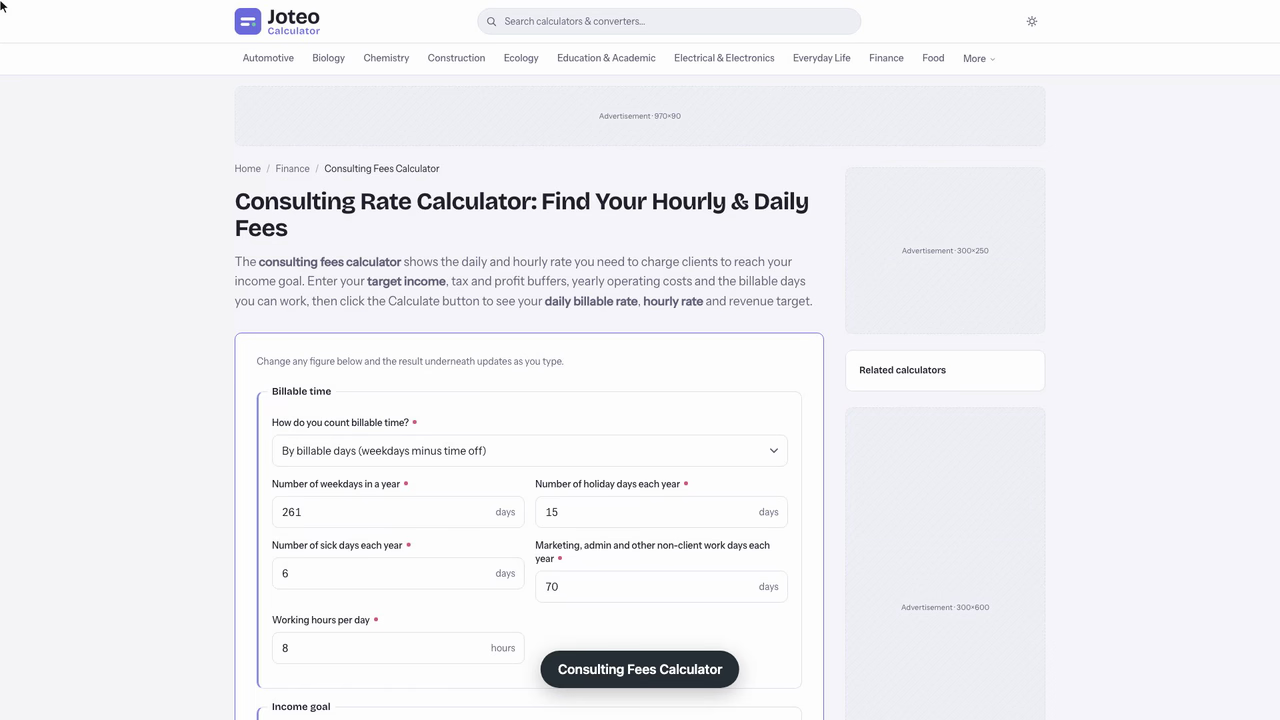
The consulting fees calculator shows the daily and hourly rate you need to charge clients to reach your income goal. Enter your target income, tax and profit buffers, yearly operating costs and the billable days you can work, then click the Calculate button to see your daily billable rate, hourly rate and revenue target. Also try the Dart Rate Calculator.
Consulting Fees Calculator inputs and result
Daily billable rate
—
- Minimum hourly rate
- —
- Recommended hourly rate (with profit buffer)
- —
- Recommended daily rate (with profit buffer)
- —
- Revenue target
- —
- Annual operating costs
- —
- Number of billable days
- —
- Billable hours per year
- —
- Projects needed per year at your average project value
- —
Table of contents
Who wrote and checked this page


Most consultants guess their price, then wonder why the work feels underpaid. This consulting fees calculator swaps the guess for arithmetic: enter the income you want, the days you can really bill and your yearly running costs, and it returns the hourly rate and day price that cover them. Think of it as a consulting rate calculator that also counts the expenses employees never see, such as marketing, equipment, software and insurance.
How the Consulting Fees Calculator Works
Behind the form, the tool makes three moves: it adds your pay goal to your yearly business costs, counts the days you can truly bill, and divides the first number by the second. The sections below unpack each move so you can test the answer against your own books before you quote clients. You enter five things:
- Target income: the pay you want from consulting before personal taxes.
- Annual operating costs: software, equipment, office space, supplies and professional fees.
- Billable days: weekdays left after holidays, sick days and non-client work.
- Working hours per day: the length of a billable day, used to split the daily figure into hours.
- Average project value: what a typical engagement pays, used as a reality check.
Target Income and Annual Operating Costs
Your desired annual income should match what an employer would pay someone with your skills, not what you earn today while undercharging. Your costs are everything the business spends to stay open, from training and education and memberships to subscriptions and a bookkeeper. In this guide's example, the pay goal is $135,000 and the yearly costs add up to $18,400.
Billable Hours and Working Hours per Day
Start with 261 weekdays, then subtract 15 holiday days, 6 sick days and 70 days of marketing, administration and other work no client pays for. That leaves 170 billable days, which at 8 hours each equal 1,360 billable hours. Many independent consultants bill between 1,000 and 1,400 hours a year, so for a solo consultant 1,360 is realistic but not cautious.
Consulting Rate Formula: From Target Income to Hourly Rate
Every consulting rate comes from one chain, whether you use this consulting rate calculator or a spreadsheet. The goal is a number that survives the tax bill, slow months and the cost of running the business, so write the chain once and you can rebuild it anywhere with any rate calculator. See also our Emv Calculator.
Revenue Target and Minimum Hourly Rate
The revenue target is the cash the business must collect. With I as the income goals you set, t the tax rate and C your costs:
$$R = \frac{I}{1 - t} + C$$
Divide R by the billable days D and the hours per day h to reach the minimum hourly rate H, the figure below which you lose money:
$$H = \frac{R}{D \times h}$$
In the worked example, $135,000 ÷ 0.78 = $173,077; adding $18,400 of costs gives R = $191,477. Spread over 170 days, the daily billable rate is $1,126, and the minimum hourly figure is $140.79.

Adding a Profit Buffer and Tax Buffer
The 22% tax buffer is already inside R. You pay both halves of self-employment tax, so buffers between 22% and 30% are common, depending on where you live and how you are structured. Then multiply the minimum by a 10% profit buffer to fund slow months: $140.79 × 1.10 = $154.87. You would quote about $155 an hour, or $1,239 a day, and still keep profit after taxes.
The Rule of 3 as a Cross-Check
The rule of 3 says to charge about three times your former salary rate: one third replaces pay, one third covers costs and one third is margin. A $135,000 salary is $64.90 an hour over 2,080 hours, so the rule points to roughly $195. Because the formula landed lower at $155, check whether your costs or utilisation rate are optimistic before you trust it. Treat the rule as a floor for specialists, not a ceiling.
Billable Days Behind Your Daily Billable Rate
Because the price divides by days, a few days move it noticeably. The table keeps every other input fixed and changes only the time spent on non-client work, which drives the billable day count.
| Non-client days | Billable days | Billable hours | Daily rate | Hourly rate |
|---|---|---|---|---|
| 50 | 190 | 1,520 | $1,008 | $125.97 |
| 70 | 170 | 1,360 | $1,126 | $140.79 |
| 90 | 150 | 1,200 | $1,277 | $159.56 |
Every 20 extra days of unpaid work lifts the minimum price by $15 to $19 an hour. Track where those days go, because that is the cheapest lever you have.

Non-Billable Time and Overhead
Non-billable time covers proposals, bookkeeping, invoicing and learning, and it often eats a third or more of the working week. Clients do not pay for it, so the rate has to recover it as overhead. Shrink that time and your price falls; leave it out of the count and your price is too low.
Setting a Daily Rate for a Six-Week Privacy Review
I'm a data-privacy consultant, and a mid-size client has just asked for a six-week policy review. Before I answer, I open the consulting fees calculator to learn what one day of my time must earn. My target income is $98,700, my operating costs are $14,260, and I use a 26% tax buffer because my state taxes are heavy.
For billable days, I start at 261 weekdays and take off 11 holidays, 4 sick days and 84 days of proposals, admin and unpaid learning. That leaves 162 days at 7.5 working hours per day, or 1,215 billable hours. The tool works out $98,700 ÷ 0.74 = $133,378, plus costs, for a revenue target of $147,638.
Dividing by hours, my minimum hourly rate is $121.51, or $911 a day. With a 12% profit buffer, the consulting fee I quote is $136.09 an hour, or $1,021 a day. As a cross-check, the rule of 3 on a $47.45 employee wage gives $142.36, so my number sits a little under it, which seems fair to me for a new client.
| Change | Minimum hourly rate | With 12% buffer |
|---|---|---|
| As entered (162 days) | $121.51 | $136.09 |
| 12 fewer billable days (150) | $131.23 | $146.98 |
| Costs up $3,000 | $123.98 | $138.86 |
The number I watch is billable days: losing 12 of them adds $9.72 an hour, more than a $3,000 jump in costs adds. The edge case is a discount. Ten percent off $136.09 is $122.48, still just above my floor, but 20% off is $108.88, which would leave the year $15,354 short of the revenue target. So the buffer is the only thing a negotiation can spend, and I won't go below $122 an hour.
My next step is a fixed fee: 30 days at $1,021 gives a $30,621 quote, which I'll send with the assumptions listed, and rerun the calculator if the scope changes.
Costs Every Consulting Fee Calculator Should Include
Every cost you miss pulls your price down, so list them all in the costs input before the rate calculator divides by your working days. Most consultants forget at least one line, and your clients will never notice the gap; you will, in your own pay. Walk through the business costs below once a year.
Benefits and Insurance
Employees receive health insurance, retirement contributions and paid leave, benefits often worth $10,000 or more. As a consultant you buy those yourself, plus professional liability insurance if your advice could expose a client to loss. Add them to your costs, not to your wish list.
The Fully Loaded Cost Approach
The fully loaded cost approach is how finance teams price an employee: pay, taxes, benefits, equipment, software and idle time together. Applied to yourself, it stops you from quoting a rate that covers only your wage.
Consulting Rates by Pricing Model: Hourly, Daily and Project
Your calculated consulting fees rate, the price per hour and per day from the rate calculator, is the floor for any fee structure; the model only changes how you present it. Compare it with published benchmark ranges for your field, update it each year for inflation, and let market demand and your expertise decide how far above the floor you sit on your services. For a first-time engagement, every consultant should remember that consulting fees must cover costs before they leave any margin. You might also find our Margin And VAT Calculator useful.
Retainer Fee, Project-Based Fee and Value-Based Pricing
- Hourly or daily: best for open-ended work; your income is capped by the hours you can sell.
- Fixed fee: best for clear deliverables; convert your hourly price into hours, then add margin for scope creep.
- Retainer fee: best for ongoing advisory services and repeat clients; the client pays for access, not hours.
- Project-based fee: multiply the hours you expect by your rate; at $4,200 per project, the $1,239 day price means about 3.4 days of effort.
- Value-based offers: price on the result delivered; value-based pricing can raise fees well above any hourly figure.
Pricing Confidence When Negotiating Proposals
Your minimum price per hour and per day from the calculator is the floor you negotiate from: quote above it and trade scope, not price. Knowing that floor gives you pricing confidence in the room, so negotiating becomes a choice about scope rather than a plea. Put the quote in your proposals with the assumptions behind it, and use time tracking to prove the hours later. That is fair compensation for you and business viability for the practice.
FAQs around Consulting Fees Calculator
1. How do I calculate my consulting fees?
Add your target income (grossed up for taxes) to your annual operating costs to get the revenue you need, then divide by your billable days for a daily rate or by billable hours for an hourly rate.
2. How many billable days does a consultant really have?
Start with the weekdays in the year (about 261), then subtract holidays, sick days and the days spent on marketing, admin and other unpaid work. Many consultants end up with far fewer than 200.
3. What is a tax buffer and why does it matter?
A tax buffer raises your revenue target so that your income is still your target after self-employment and income taxes. Common values run from roughly 20% to 30%, depending on where you live and how you are set up.
4. What is a profit buffer?
It is extra margin on top of your minimum rate, so slow months, late payments and unexpected costs do not push you below your income goal.
5. Should I charge by the hour, by the day or per project?
Hourly and daily rates suit open-ended work, a fixed project fee suits clear deliverables, and a retainer suits ongoing advice. Use your calculated rate as the floor for whichever model you pick.
6. How often should I review my consulting rates?
At least once a year, and again when your costs, experience or market demand change.
7. Does the calculator work in other currencies?
Yes. The arithmetic is the same in any currency, as long as you use one currency for every amount you enter.
Report an issue with this page
Spotted a wrong result or unclear explanation? Report an issue or read our editorial policy.