

CLTV Calculator: Find Your Combined Loan-to-Value Ratio
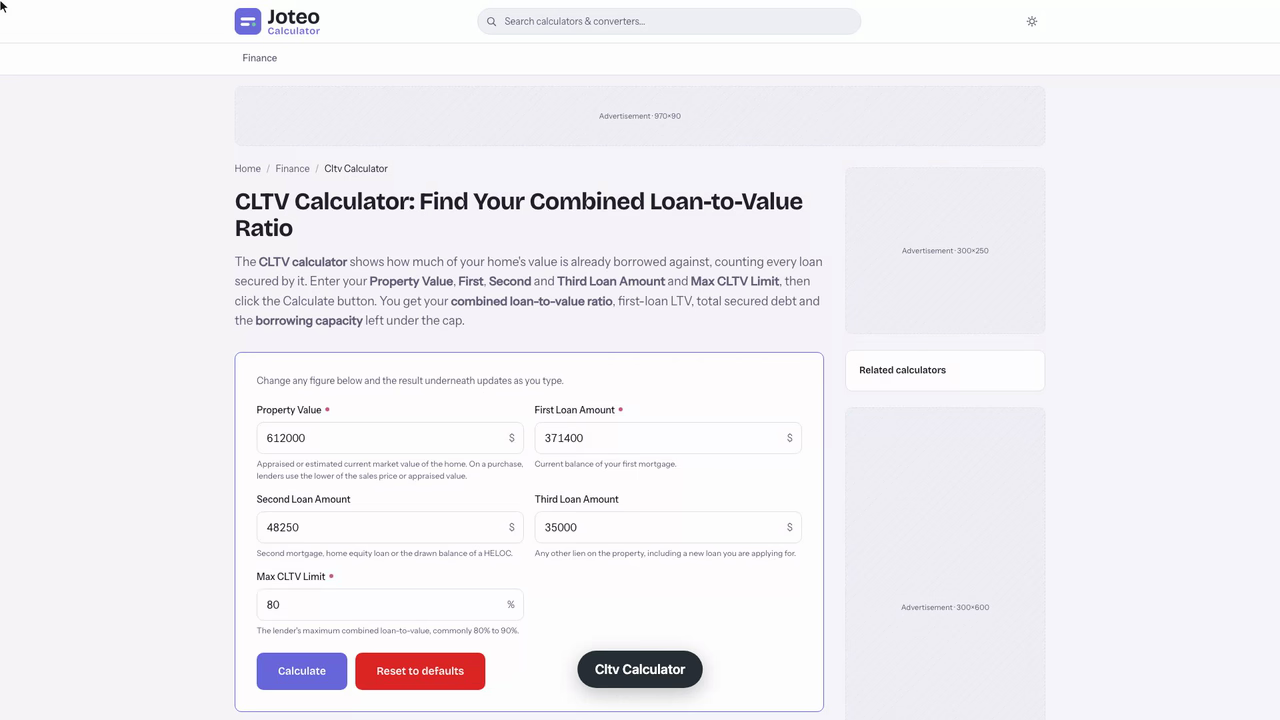
The CLTV calculator shows how much of your home's value is already borrowed against, counting every loan secured by it. Enter your Property Value, First, Second and Third Loan Amount and Max CLTV Limit, then click the Calculate button. You get your combined loan-to-value ratio, first-loan LTV, total secured debt and the borrowing capacity left under the cap. Also try the Customer Retention Rate Calculator.
Cltv Calculator inputs and result
Combined Loan-to-Value (CLTV)
—
- LTV (First Loan Only)
- —
- Total Secured Debt
- —
- Maximum Total Debt at CLTV Limit
- —
- Estimated Borrowing Capacity
- —
Table of contents
Who wrote and checked this page


Before you ask for more money against your house, you need to know how much of it is already borrowed. This CLTV calculator adds up every loan with liens on the property and shows your combined loan-to-value as a percentage, so you can see where you stand against a lender's cap and how much home equity is still within reach.
How the CLTV Calculator Works
You enter four numbers, and the tool returns a CLTV estimate plus the room left under the limit you choose. It works as a combined loan to value calculator for home equity loans and second liens:
- Your estimated home or property worth
- Your current first-loan mortgage balance
- The outstanding balance of any other loan secured by the house
- The maximum CLTV you want to test, such as 80% or 90%
If you are applying for a new loan amount, add it to the other balances to see the ratio after closing.
What Counts as Secured Loans
Include every home-secured debt: the first mortgage, a second mortgage, a home equity loan and the used part of a home equity line of credit. Unsecured debt such as a car loan stays out, because it has no claim on the property.
Reading Your Borrowing Capacity
Your borrowing capacity is the cap multiplied by the home's worth, minus what you already owe. A positive figure is how much more you could borrow; a negative one means your equity is too thin for a new loan or a cash-out refinance at that cap.
Combined Loan to Value Formula
The CLTV formula divides everything owed against the house by what it is worth today, usually its fair market value from an appraisal:
$$\text{CLTV} = \frac{\text{Total secured loan balance}}{\text{Appraised property value}} \times 100$$
Commercial loan desks sometimes call the same figure the cumulative loan to value ratio, or simply cumulative loan to value. It is the same combined loan to value ratio either way.
CLTV Ratio Calculation Example
Say a homeowner's house appraises at $612,000. They owe $371,400 on the first loan and have drawn $48,250 on a HELOC, and they want a new $35,000 loan for a roof. Here is the CLTV ratio calculation step by step:
| Step | Figure |
|---|---|
| Existing secured balances ($371,400 + $48,250) | $419,650 |
| CLTV today ($419,650 ÷ $612,000) | 68.57% |
| Room under an 80% cap ($489,600 − $419,650) | $69,950 |
| Balances after the new $35,000 loan | $454,650 |
| CLTV after closing ($454,650 ÷ $612,000) | 74.29% |
The first loan alone gives a loan to value of 60.69%, so the second and third loans add almost 14 points. At 74.29% the new loan fits under an 80% cap with $34,950 to spare.

How a HELOC and Subordinate Financing Count
Under Fannie Mae underwriting rules, the CLTV on a first loan with subordinate financing counts the drawn portion (the outstanding principal balance) of a HELOC and the unpaid principal balance of any closed-end second loan. On a purchase, the divisor is the lesser of the sales price or the appraised figure. A separate ratio, HCLTV (home equity combined loan-to-value), counts the full line limit instead.
CLTV Ratio vs LTV Ratio
The LTV ratio looks at one loan: the primary mortgage divided by the home's worth. CLTV adds every loan behind it. That difference matters most to whoever sits behind the first lien. A second lien holder gets paid only after the first is cleared, so subordinate debt carries more downside risk. A lower combined figure means more equity cushion and a lower risk of default, which is why lenders check it before approving a second loan. If you missed an interest payment and the property had to be sold, a high CLTV means the later lenders may not be repaid. Your loan-to-value ratio can look healthy while the combined number is already near a lender's cap.
Testing a Maximum CLTV Before a $52,000 Kitchen Loan
The decision on the table: can a house worth $438,700 carry a $52,000 home equity loan for a kitchen, at a credit union that caps lending at 85%? The short answer is yes on the standard CLTV, 81.22%, but only after one change to the existing credit line.
The values come from paperwork, not guesses. The home figure is the $438,700 automated valuation the credit union quoted on the phone. The first loan statement shows $286,912 still owed. The HELOC has a $40,000 limit with $17,385 drawn. I enter them in that order, then 85 as the cap.
- Existing balances: $286,912 + $17,385 = $304,297, a CLTV of 69.36%
- Room under 85%: $372,895 − $304,297 = $68,598
- After the new loan: $356,297 ÷ $438,700 = 81.22%
I recheck the division by hand, and 81.22% is the combined loan-to-value figure the credit union will start from. Under an 80% cap the same request would miss by $5,337, so the lender's limit matters more than anything I typed.
What a quick search won't tell you: some lenders size the HELOC at its full limit, not the drawn amount. Counted that way the total is $378,912, or 86.37%, and the loan fails. Two reruns show the fix:
| Scenario | Ratio | Within 85%? |
|---|---|---|
| HELOC counted at its $40,000 limit | 86.37% | No |
| Line limit cut to $20,000 | 81.81% | Yes |
| Valuation comes in at $415,000 | 85.85% | No |
The number I'd watch is the valuation, not the loan size. The deal holds only while the home is worth at least $419,173, and a full appraisal can easily land $20,000 under a phone estimate. So the next step is to ask the credit union to reduce the unused line to $20,000 before ordering the appraisal, and to keep the request at $52,000 rather than stretching toward the $68,598 of room the drawn-balance math suggests.
What Is a Good CLTV? Common CLTV Caps
There is no single number. Many home lenders cap a borrower at 80% to 90%, and some agency programs go higher. In commercial real estate and multifamily lending, 65% to 75% is a typical comfort zone, and above that a lender may ask for more collateral. Your credit score, occupancy and the loan type all move the limit.

| Threshold | What it usually means |
|---|---|
| 80% | Common cap for home equity products and the usual point where leverage starts to cost more |
| 90% | Possible for a borrower with a strong file and tighter eligibility rules |
| 95% to 97% | Reserved for specific conforming programs; Freddie Mac and Fannie Mae publish the limits |
CLTV, Mortgage Insurance and Pricing
A higher combined ratio can trigger loan-level price adjustments, which raise your interest rate or fees. Mortgage insurance rules look at equity too: PMI cancellation on a conventional loan depends on how much you have paid down, so taking new debt can delay dropping PMI.
Limits of Any CLTV Estimate
The result is only as good as the property value you enter. A lender uses its own valuation and may treat an open line differently, so treat the figure as a planning number before you apply or refinance. See also our Grp Calculator.
When Your Home Value or Appraised Value Changes
If your home value falls from $612,000 to $575,000, the same $454,650 in loans jumps from 74.29% to 79.07%. Rerun the numbers whenever you get a new appraised value, at least once a year, and before any new loan.

FAQs around Cltv Calculator
1. What is the difference between CLTV and LTV?
LTV divides a single loan, usually the first mortgage, by the property value. CLTV adds every loan secured by the property, such as a second mortgage, home equity loan or HELOC balance, before dividing, so it shows your total leverage.
2. Does CLTV include a HELOC?
Yes. The standard CLTV counts the drawn (outstanding) balance of a HELOC. Some lenders also use HCLTV, which counts the full credit line limit instead, so an unused line can still reduce how much you can borrow.
3. What CLTV do lenders usually allow?
There is no single number. Many lenders cap home equity borrowing at 80% to 90% CLTV, some agency programs go higher, and commercial and multifamily lenders often prefer 65% to 75%. Your credit score, occupancy and loan type all affect the limit.
4. How is borrowing capacity calculated from CLTV?
Multiply the property value by the maximum CLTV to get the most total debt the lender allows, then subtract what you already owe on the property. If your existing balances are already above that limit, your capacity is zero.
5. What property value should I use?
Use a recent appraisal or a realistic estimate of current market value. For a purchase, lenders divide by the lower of the sales price or the appraised value, and a lender's own valuation can differ from an online estimate.
6. How often should I check my CLTV?
Check it at least once a year and before applying for a home equity loan, HELOC, cash-out refinance or any refinance meant to drop mortgage insurance, since both your balances and your home's value change over time.
Report an issue with this page
Spotted a wrong result or unclear explanation? Report an issue or read our editorial policy.