

Real Interest Rate Calculator: Find Your Real Rate
The real interest rate calculator is a simple tool that shows what a nominal interest rate is really worth after inflation. Enter your nominal interest rate and inflation rate, click the Calculate button, and you get your real rate from the exact Fisher equation and the approximate formula, plus an optional ex ante vs ex post comparison. Also try the Nominal Interest Rate Calculator.
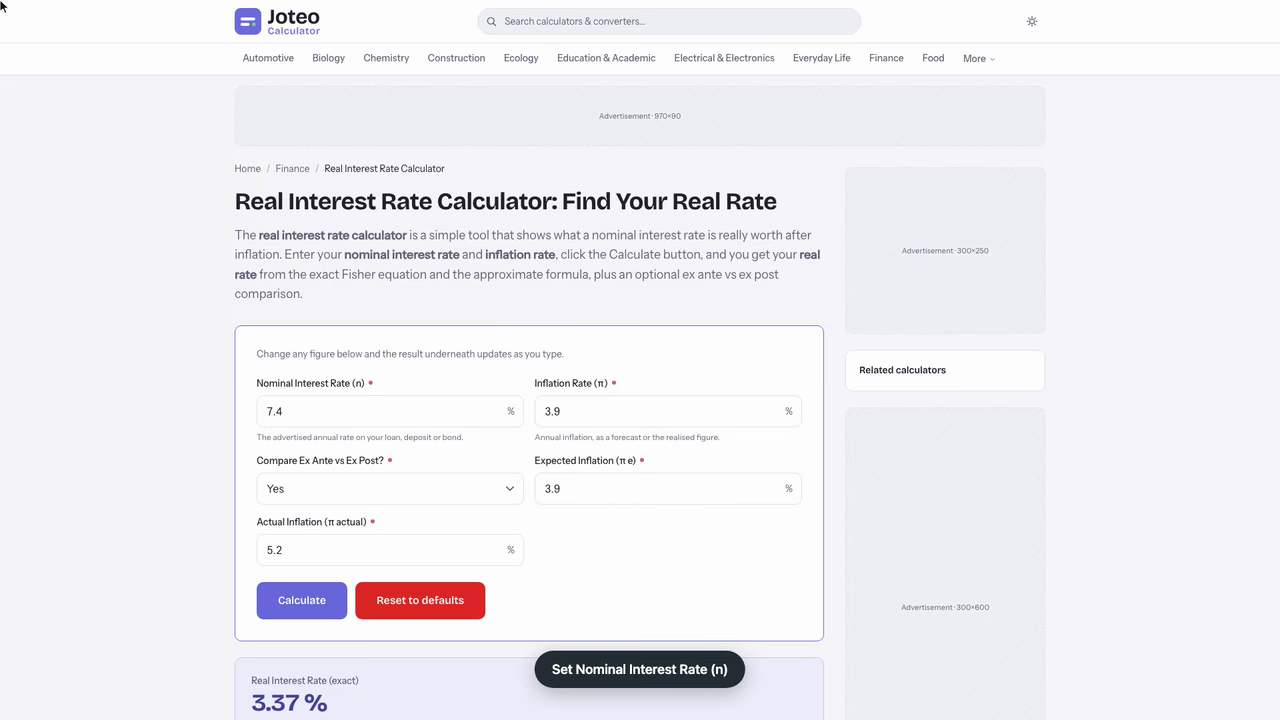
Real Interest Rate Calculator inputs and result
Real Interest Rate (exact)
—
- Real Interest Rate (approximate, n − π)
- —
- Approximation Error (percentage points)
- —
- Approximation Check
- —
- Ex Ante Real Rate (n − expected inflation)
- —
- Ex Post Real Rate (n − actual inflation)
- —
- Inflation Forecast Error (actual − expected)
- —
- Who Benefits
- —
Table of contents
Who wrote and checked this page


Use the real interest rate calculator to see what the interest on a quoted rate is worth once inflation takes its share. Enter the nominal interest rate and the change in the price level, and you get the real rate: the true interest you earn or pay, measured as the gain or loss in purchasing power on a loan, a savings account or any other investment.
The Fisher Equation Behind Your Return
Economist Irving Fisher showed that the interest you see advertised mixes two things: compensation for waiting and compensation for rising prices. The Fisher equation splits them apart, so the nominal interest rate equals the real rate plus inflation. Fisher's idea, the Fisher effect, says nominal interest rates move with expected inflation while the real rate stays steady over time. Your lender quotes the interest rate first; your purchasing power depends on the second.
Reading the Fisher Equation Step by Step
Write the nominal interest rate as \(n\), the inflation rate as \(\pi\) and the real rate as \(r\). The exact link between them is:
$$1 + r = \frac{1 + n}{1 + \pi}$$
Divide one plus the nominal rate by one plus inflation, then subtract one. The price level grows by \(\pi\) over the year, so each unit of money buys less at the end, and the result is the growth in what your money can buy after interest, in real terms.
Approximate Formula vs Exact Formula
The approximate formula is the quick version: \(r \approx n - \pi\). The exact formula above adds the cross-product term, which is why the real interest rate formula you use matters once interest rates climb. The approximation error is roughly \(r \times \pi\), so it stays under a tenth of a percentage point at low inflation but exceeds a full point when inflation reaches 20%. At 18% inflation, a 7.4% nominal rate gives −9.0% exactly but −10.6% by subtraction. Compounding of interest is the reason, and annualized rates make the gap easy to compare. Use the exact version whenever precision matters.
How to Use the Real Interest Rate Calculator
Three inputs drive the tool, and you can solve for any one of them. Work through the steps below:
- Enter the nominal interest rate quoted on your loan, mortgage or savings account.
- Enter the inflation rate, using your forecast or the realised figure, then compare it with the interest on offer.
- Click the Calculate button to see the real interest rate, the approximate result and the gap between the two.
The same result feeds other tools. Once you know it, use it as the discount rate in a present value or future value calculation, so cash flows are compared in today's purchasing power. That is how an investment is judged fairly against the interest saved on a mortgage payoff.
Worked Example of the Real Interest Rate
Say a one-year deposit pays 7.4% interest while prices rise 3.9%. The exact real interest rate is 1.074 ÷ 1.039 − 1 = 3.37%, while subtracting gives 3.50%.
| Method | Nominal rate | Inflation | Real rate |
|---|---|---|---|
| Approximate | 7.4% | 3.9% | 3.50% |
| Exact | 7.4% | 3.9% | 3.37% |
The gap is 0.13 percentage points. For a borrower the same figure is the real cost of borrowing: a loan charging 7.4% interest costs only 3.37% in real goods and services once prices rise.

Reading a Negative Real Interest Rate
Try a nominal rate of 2.1% against inflation of 4.6%. The real interest rate is −2.39%, so a saver loses purchasing power even while interest keeps the balance growing. Negative rates like this appear when deflation is absent and inflation outruns the nominal interest on the deposit; in real terms the borrower is paid to hold debt. Zero is the line to watch: above it, lenders gain, below it, they lose.
Testing a Five-Year CD's Real Rate Against 2.7% Inflation
Marisol has $18,400 maturing from a bond fund and a bank offering a five-year certificate of deposit at 5.85%. Her real question is whether that CD actually grows her purchasing power, so she opens the calculator before signing anything.
She enters 5.85 as the nominal interest rate and 2.7 as expected inflation, the figure her own budget has used since the central bank's 2% target slipped. The calculator returns an exact real rate of 3.07% and an approximate one of 3.15%. By hand, 1.0585 ÷ 1.027 − 1 gives 0.0307, so the two methods agree. Three points above zero is a comfortable margin, and it sits well above the roughly 1% real yield she had been treating as normal.
Then she tests the number. Raising inflation to 3.6% drops the exact real rate to 2.17%, and the break-even is inflation equal to 5.85%, where the real rate hits 0.00%. The input that matters most is inflation, not the CD's rate: a one-point miss costs her nearly a full point of real growth.
| Scenario | Interest rate used | Inflation | Exact real rate |
|---|---|---|---|
| Pre-tax, expected | 5.85% | 2.7% | 3.07% |
| Pre-tax, hotter inflation | 5.85% | 3.6% | 2.17% |
| After 24% tax, expected | 4.45% | 2.7% | 1.70% |
| After 24% tax, hotter inflation | 4.45% | 3.6% | 0.82% |
Here the calculator's answer should not be trusted alone. It ignores taxes, and CD interest is taxable each year. At a 24% bracket her 5.85% becomes 4.45%, which cuts the real rate to 1.70%, or 0.82% if inflation reaches 3.6%. So she keeps the CD but ladders half of it into inflation-linked bonds, rerunning the check once with the after-tax rate before she commits.
Ex Ante and Ex Post Real Interest Rates
Every loan is priced before the future is known, so the real interest rates people agree to differ from those they end up with. Economists label the two views ex ante (before) and ex post (after), and the calculator can show both side by side across the economy's changing interest conditions.
Ex Ante: Using Expected Inflation
The ex ante real rate uses expected inflation, the expected rate of inflation when the deal is struck. If lenders expect 3.9% and quote 7.4% interest, they are aiming for about 3.4% in real terms. Expected inflation is already priced into the nominal rate, so it shifts nothing on its own.
Ex Post: Using Actual Inflation
The ex post rate uses actual inflation once the year ends. If prices instead rose 5.2%, the same 7.4% deposit delivers 2.09%. That inflation surprise moves wealth between parties: borrowers repay in cheaper money, while unexpected inflation of that size leaves the saver short.

Why the Real Return Matters for Borrowers and Lenders
A high interest figure can hide a poor deal. The real return tells investors whether money in a deposit or bond keeps up with inflation in a healthy economy, and it tells a borrower what the interest on a loan truly costs. Taxes and demand for credit add more layers, and supply and demand set the nominal side.
Borrowers and Lenders When Rates Are Fixed or Variable
Fixed and variable rates give each side different outcomes once inflation moves. Variable rates follow inflation upward, so the borrower's cost tracks prices, while an annual percentage rate fixed at signing keeps the interest put and lets inflation do the work. Lenders therefore prefer fixed terms when they expect prices to fall, and borrowers prefer them when prices might rise. A strong credit score lowers the nominal interest on offer, but it never changes this inflation effect.
Monetary Policy and Central Banks
Central banks such as the Federal Reserve use monetary policy to steer interest rates against inflation and unemployment. In macroeconomics, a positive result from this calculator means a given nominal rate is tight once inflation is counted, and a negative one means it is loose, so a central bank that raises its policy interest rate faster than prices rise tightens economic conditions.
FAQs around Real Interest Rate Calculator
1. What is the real interest rate and why does it matter?
The real interest rate is the nominal interest rate adjusted for inflation. It shows how much purchasing power a lender gains or a borrower really pays, which is what drives saving and investment decisions.
2. How do you calculate the real interest rate?
Use the Fisher equation: real = (1 + nominal) / (1 + inflation) − 1. The quick approximation is nominal minus inflation. For example, 7.4% nominal against 3.9% inflation gives 3.37% exactly and 3.50% by subtraction.
3. What is the difference between the approximate and exact formula?
The approximate formula ignores the cross-product of the real rate and inflation. The gap is tiny at low rates but grows as inflation rises, so use the exact formula when inflation is high.
4. What does a negative real interest rate mean?
The nominal rate is below inflation, so money earning that rate loses purchasing power. Savers lose in real terms and borrowers repay in cheaper money.
5. What is the difference between ex ante and ex post real rates?
The ex ante real rate uses inflation expected when the deal is agreed. The ex post rate uses the inflation that actually happened, so the two differ whenever inflation surprises.
6. Who benefits when inflation is higher than expected?
Borrowers benefit because they repay in money worth less than anticipated, while lenders earn a lower real return than they planned.
7. Does the calculator include taxes?
No. Interest is often taxable, so enter an after-tax nominal rate if you want the real return you actually keep.
Report an issue with this page
Spotted a wrong result or unclear explanation? Report an issue or read our editorial policy.