

Nominal Interest Rate Calculator: Real Rate to Nominal Rate
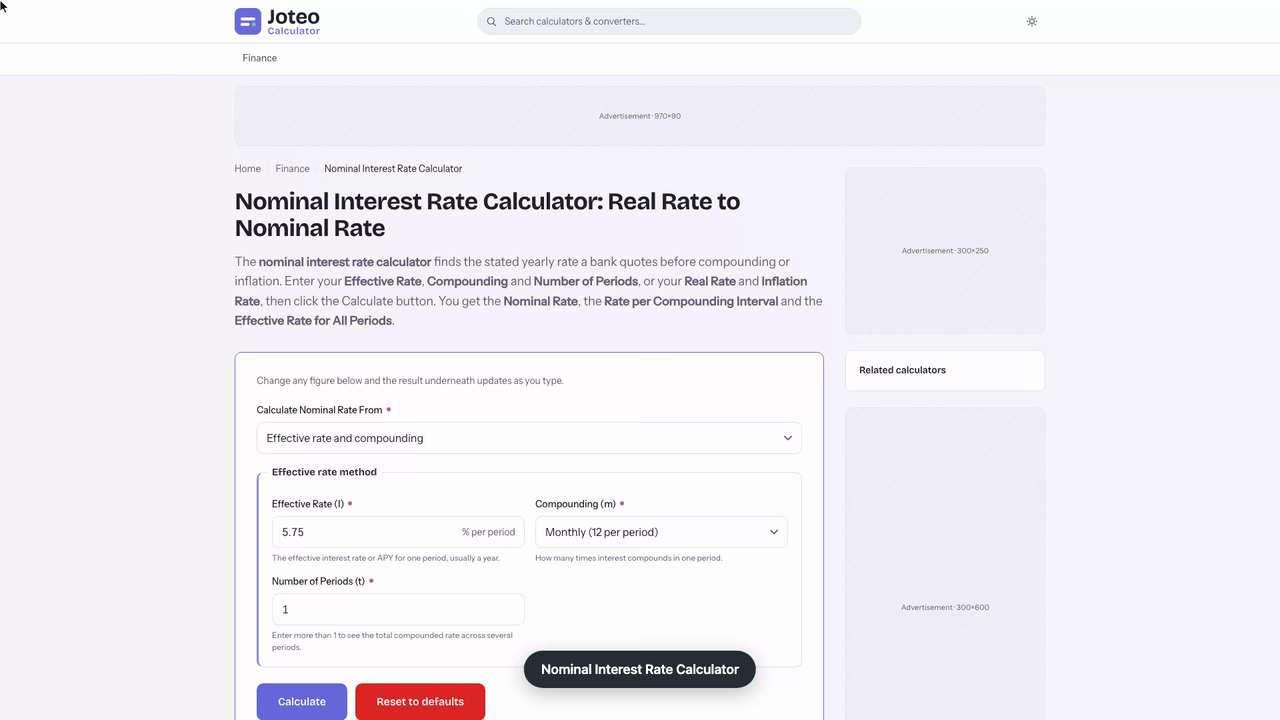
The nominal interest rate calculator finds the stated yearly rate a bank quotes before compounding or inflation. Enter your Effective Rate, Compounding and Number of Periods, or your Real Rate and Inflation Rate, then click the Calculate button. You get the Nominal Rate, the Rate per Compounding Interval and the Effective Rate for All Periods.
Nominal Interest Rate Calculator inputs and result
Nominal Rate (R)
—
- Rate per Compounding Interval (P)
- —
- Effective Rate for All Periods (i^t)
- —
- Approximate Nominal Rate (r + π)
- —
Table of contents
Who wrote and checked this page


Banks print one number on every loan offer and deposit quote, and this nominal interest rate calculator shows you what sits behind it. Enter the real return you want and the inflation you expect, or an effective annual return and how often interest compounds, and you get the nominal annual figure plus the rate per period. That number is the cost of borrowing before the price level moves, so it is the rate your monthly payments and your investment growth are actually built on.
What a Nominal Interest Rate Means
A nominal interest rate is the stated rate written into a loan agreement or printed on a financial instrument, with no adjustment for inflation or for compounding. It is the figure you see on credit cards, mortgages, savings accounts and a certificate of deposit, and it is usually quoted per year as an annual percentage rate (APR), even when interest is charged monthly.
The stated interest in a financing arrangement stays where the contract puts it:
- Fixed rates hold for the whole loan term, whatever happens to prices.
- Variable rates reset against an index, but each reset is still a nominal figure.
- Simple interest applies the rate to the principal only.
- Compound interest also charges on accrued interest, so the total interest grows faster than the quoted rate suggests.
Because the borrower repays in future dollars, a lender pricing debt or bonds builds its inflation forecast into that stated number from day one. Banks lending on credit compete on this headline figure, which is why it is the one you compare first.
Nominal Interest Rate Calculator Formula and the Fisher Equation
To calculate nominal interest rate from what you want to earn after inflation, use the Fisher equation. With \(r\) as the real rate and \(\pi\) as the expected rate of inflation (usually read from the consumer price index, or CPI):
$$i = (1 + r) \times (1 + \pi) - 1$$The rough approximation drops the cross term:
$$i \approx r + \pi$$Here is a worked example. A saver wants a target yield of 3.4% above prices and expects an inflation rate of 2.9%. The nominal interest rate calculation gives \((1.034 \times 1.029) - 1\) = 6.40%, so 6.40% is the implied nominal rate to look for. The shortcut says 6.30%.

| Input or result | Value |
|---|---|
| Real rate wanted (r) | 3.40% |
| Rate of inflation expected (π) | 2.90% |
| Nominal interest rate, exact | 6.40% |
| Approximate result (r + π) | 6.30% |
The gap between the two is \(r \times \pi\), about 0.10 percentage points here. It widens as prices climb faster, so use the exact nominal interest rate formula once inflation runs above a few percent.

Nominal Rate vs. Real Interest Rate
The real interest rate is the inflation-adjusted version of the nominal figure: it measures your rate of return in real terms, meaning in goods and services rather than dollars. Rearranged, the formula reads \(r = \frac{1 + i}{1 + \pi} - 1\). A positive real interest rate means the borrower repays more purchasing power than they received. A negative one, common when prices rise fast, quietly transfers wealth from lender to borrower. Under deflation the opposite happens, and even a low quoted rate becomes expensive. That is why macroeconomics, and anyone reading the economy, tracks real rather than nominal figures.
Expected Inflation vs. Actual Inflation
The nominal figure is locked when the deal is signed, but prices are not. Suppose the 6.40% deal above runs into actual inflation of 4.6% instead of 2.9%. The realised real interest rate falls to \((1.06399 \div 1.046) - 1\) = 1.72%, roughly half the 3.4% the saver planned on. The same logic sits under present value and future value work: discount nominal cash flows with a nominal discount figure and real cash flows with a real one, and never mix the two.
Nominal Annual Rate Check: Two Savings Quotes for an $18,640 Emergency Fund
I have $18,640 sitting in an emergency fund and two places to park it for the next year. An online bank advertises 4.37% APY, compounded daily. A local credit union quotes a 4.31% dividend rate, compounded monthly, and that is a nominal annual rate, not a yield. The question is simple: which one actually pays more? The answer is the credit union, by 0.025 percentage points, or about $4.88 over the year.
Here is how I get there. The two numbers are on different bases, so I put the online bank's 4.37% into the effective-rate field, set compounding to 12 periods a year, and leave the number of periods at 1. The tool returns a 4.285% nominal annual rate compounded monthly. That is the stated figure the credit union would have to beat, and its 4.31% does. I cross-check it the other way by hand: \((1 + 0.0431 \div 12)^{12} - 1\) = 4.396% effective, which is above 4.37%. Both directions agree.
| Scenario | Credit union effective yield | Year-one earnings on $18,640 |
|---|---|---|
| Online bank, 4.37% APY | 4.370% | $814.57 |
| Credit union, 4.31% monthly | 4.396% | $819.45 |
| Credit union, 4.31% quarterly | 4.380% | $816.46 |
The sensitivity rerun matters more than the headline. Switch the credit union to quarterly compounding and its lead shrinks to one hundredth of a point. Its rate is also variable, so the break-even is the number I write down: if the credit union's stated rate drops below 4.285%, the online bank wins.
The US Truth in Savings Act (Regulation DD) requires banks and credit unions to show an APY beside the nominal headline figure, so deposits can be compared like for like. When an offer leads with the nominal figure, as this one does, converting it is exactly the job this calculator does. The comparison also assumes the full balance stays put for twelve months; an emergency fund that gets drawn down in month four earns neither figure. With a gap this thin, I would choose on access and withdrawal rules first and treat the $4.88 as a tie-breaker.
Stated Rate from an Effective Rate and Compounding Periods
The second use of the nominal interest rate calculator runs the other way. If you know the effective interest rate (what an account actually pays over a full year) and the number of compounding periods per year \(m\), the nominal annual interest rate is:
$$r = m \times \left[(1 + i)^{1/m} - 1\right]$$Take an effective rate of 5.75%. Compounded monthly, the stated nominal figure is 5.604%. The more often interest compounds, the lower the nominal number needed to produce the same compounded rate.
| Compounding | Periods per year (m) | Nominal annual figure |
|---|---|---|
| Annually | 1 | 5.750% |
| Semiannually | 2 | 5.670% |
| Quarterly | 4 | 5.630% |
| Monthly | 12 | 5.604% |
| Daily | 365 | 5.591% |
For a span longer than one year, enter the number of periods: two years at a 5.75% effective annual yield compound to 11.83%.

Continuous Compounding
Push \(m\) toward infinity and you reach continuous compounding. The formula collapses to \(r = \ln(1 + i)\), the natural log of one plus the effective figure. For 5.75% that gives 5.591%, within a thousandth of a point of daily compounding.
APY and the Periodic Interest Rate
Savings products advertise the annual percentage yield (APY), which is the effective figure, while loans advertise a nominal annual percentage rate. Divide the nominal annual figure by \(m\) to get the periodic interest rate, the rate per compounding period actually applied: 5.604% ÷ 12 = 0.467% per month. Comparing a loan quote with a deposit quote without converting one into the other's basis is the most common way people misjudge an offer.
Why the APR Moves with the Inflation Rate
Lenders reset the nominal interest rate they quote as conditions change. In the U.S., the Federal Reserve steers a central bank policy rate through monetary policy aimed at steady inflation, and loan and deposit rates follow it. Your own credit score then adds or removes a risk premium on the credit you take. When the inflation rate is expected to rise, lenders lift their quotes to protect the real interest rate they earn, which is the formula above at work.
FAQs around Nominal Interest Rate Calculator
1. What is a nominal interest rate?
It is the stated rate on a loan, deposit or bond before any adjustment for compounding or inflation. Credit cards, mortgages and savings accounts all quote a nominal annual figure, even when interest is charged or paid monthly.
2. How do you calculate the nominal rate from an effective rate?
Use r = m × [(1 + i)^(1/m) − 1], where i is the effective rate per period and m is the number of compounding intervals. A 5.75% effective rate compounded monthly corresponds to a nominal rate of about 5.604%.
3. What is the Fisher equation?
The Fisher equation links nominal and real rates through expected inflation: (1 + nominal) = (1 + real) × (1 + inflation). A 3.4% real target with 2.9% expected inflation needs a 6.40% nominal rate.
4. Why is nominal rate = real rate + inflation only an approximation?
Adding the two ignores the cross term, real rate × inflation. At low inflation the gap is small (0.10 points in the 3.4% and 2.9% example), but it grows as inflation rises, so use the exact formula when prices are moving quickly.
5. What happens with continuous compounding?
When the number of compounding intervals grows without limit, the nominal rate becomes r = ln(1 + i). For a 5.75% effective rate that is about 5.591%, almost the same as daily compounding.
6. What is the difference between the nominal rate and the real interest rate?
The nominal rate is the number written on the contract. The real interest rate removes inflation to show what you earn or pay in purchasing power. If inflation turns out higher than expected, the nominal rate stays fixed and the real rate falls.
7. What is the rate per compounding interval?
It is the nominal rate divided by the number of compounding intervals, P = R ÷ m. A 5.604% nominal rate compounded monthly is 0.467% per month.
Report an issue with this page
Spotted a wrong result or unclear explanation? Report an issue or read our editorial policy.