

Price Per Acre Calculator: Compare Land Cost Per Acre
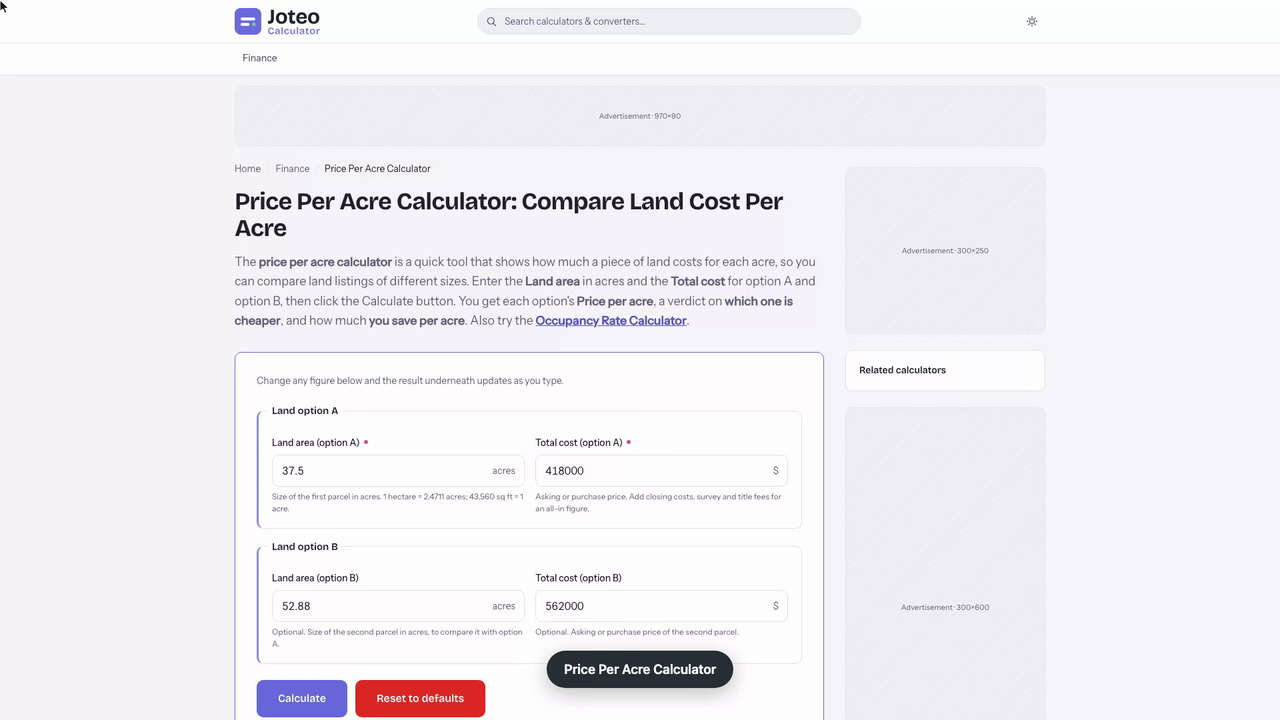
The price per acre calculator is a quick tool that shows how much a piece of land costs for each acre, so you can compare land listings of different sizes. Enter the Land area in acres and the Total cost for option A and option B, then click the Calculate button. You get each option's Price per acre, a verdict on which one is cheaper, and how much you save per acre. Also try the Occupancy Rate Calculator.
Price Per Acre Calculator inputs and result
Price per acre (option A)
—
- Price per acre (option B)
- —
- Which one is cheaper?
- —
- You save
- —
Table of contents
Who wrote and checked this page


Two land listings rarely come in the same size, so the sticker price alone can't tell you which one is the better deal. The price per acre calculator divides each option's total cost by its acreage and hands back a single figure per acre you can line up side by side, even when one seller quotes hectares and another quotes square feet. Enter two options and you'll see which parcel is cheaper, and by exactly how much.
How the Price Per Acre Calculator Works
The tool takes two numbers for each piece of land, the price and the size, and turns them into a unit price. That one figure strips out the size difference, so a small homesite and a large tract can be judged on the same scale. Use it on one listing to check a quote, or on two at once to find the better value. It works the same way as any cost per acre calculator or price-per-acre calculator: the math is simple, but doing it consistently keeps you from being swayed by a big or small headline number.
Inputs: Total Land Cost and Land Area
You enter two fields per option:
- Total land cost: the listing price or agreed purchase price, in dollars.
- Total land area: the size of the plot of land, in acres, hectares, square feet, square meters or sq mi. The tool converts the land area to acres before it divides.
For a quick comparison, use the asking price as quoted. For your true buying cost, add closing costs, a survey and title fees before you divide, as shown further down.
Outputs: Price Per Unit Area and Savings
Once both options are filled in, the tool returns:
- A dollar figure per unit of ground for option A and option B.
- A short verdict naming which option is the better buy.
- The per-acre difference, which is how much less you pay for each unit of land by picking the lower-priced option.
The Cost Per Acre Formula
Every result comes from one division. The price per acre (PPA) equals the total land cost divided by the total land area measured in acres:
$$\text{PPA} = \frac{\text{Total land cost}}{\text{Total land area}}$$
If you already know a per-acre figure and want to go the other way, the same relationship rearranges in two directions. That matters when a seller advertises $8,640 per acre and you need the whole price, or when you have a fixed budget and want to know how much ground it buys.
Rearranging the Formula for Price or Acreage
$$\text{Price} = \text{PPA} \times \text{Area} \qquad \text{Area} = \frac{\text{Price}}{\text{PPA}}$$
A 12.75 ac lot advertised at $8,640 per acre comes to \(12.75 \times 8{,}640 = \$110{,}160\). Going the other direction, $250,000 in an area where land trades at $7,325 per acre buys about \(250{,}000 \div 7{,}325 = 34.13\) acres of average ground. Use these rearranged versions as a sanity check whenever a listing quotes both a total and a rate: if the two don't reconcile, one of them is wrong.
Unit Conversions Before You Divide
Ads don't always use acres. Farm and European listings quote hectares, city lots usually come in sq ft, and older rural deeds may refer to a section (640 acres) or a quarter section. Convert everything first, then apply the formula. These are the standard unit conversions the tool uses:
| Unit | Size in acres |
|---|---|
| 43,560 square feet | 1 |
| 4,046.86 square meters | 1 |
| 1 hectare | 2.4711 |
| 1 sq mi (one section) | 640 |
| 1 quarter section | 160 |
Worked Example: Land Price Per Acre for Two Options
Say you are shopping for recreational land with room for hunting and some standing timber, and you have shortlisted two properties in the same county:
- Option A: a 37.5-acre parcel priced at $418,000.
- Option B: a 21.4-hectare farm tract priced at $562,000.
Option B costs $144,000 more, so at first glance A looks like the better buy. Dividing by size tells a different story.

Step-by-Step: Calculate Price Per Acre for Each Option
- Option A is already in acres: \(418{,}000 \div 37.5 = \$11{,}146.67\) per acre.
- Convert option B: \(21.4 \times 2.4710538 = 52.88\) ac.
- Divide: \(562{,}000 \div 52.88 = \$10{,}627.73\) per acre.
- Subtract: \(11{,}146.67 - 10{,}627.73 = \$518.94\) per acre in B's favor.
Option B has the higher total cost but the lower rate, by $518.94 on every acre. Across B's 52.88 ac, that gap is worth roughly $27,440 against paying A's rate for the same amount of ground. This is exactly why you compare two listings by unit price rather than by the headline number.
| Option | Price | Size | Price per acre |
|---|---|---|---|
| A | $418,000 | 37.5 ac | $11,146.67 per acre |
| B | $562,000 | 21.4 ha (52.88 ac) | $10,627.73 per acre |
| Gap | B costs $144,000 more | B is 15.38 ac larger | B is $518.94 per acre cheaper |
Finding Your Cost Per Usable Acre
The gross figure treats all ground as equal, but you can't build on a wetland or farm a gravel road. A second pass that divides by only the ground you can actually use often changes the margin, and sometimes the winner.
Subtracting Wetlands, Easements and Right-of-Way
Suppose a site walk shows option A has 4.2 ac of wetlands and a 1.1 ac utility easement, leaving 32.2 usable. Option B loses 2.6 ac to a county road right-of-way, leaving 50.28 usable. Re-running the division:
- Option A: \(418{,}000 \div 32.2 = \$12{,}981.37\) per usable acre.
- Option B: \(562{,}000 \div 50.28 = \$11{,}177.28\) per usable acre.
The gap widens from $518.94 to $1,804.09, because A was carrying more ground that adds nothing to what you can do with the property.

Adding Closing Costs and Title Fees
For an all-in figure, add what you pay on top of the price before dividing: the survey, legal and recording charges, and any required improvements such as a driveway. If A's extras total $9,850 and B's total $12,400, the all-in cost per usable acre is $13,287.27 for A and $11,423.90 for B. That's the number to bring to your lender when you arrange financing, since it's what each usable acre of the property really costs you.

Pricing a Goat Dairy Homestead with the Cost Per Acre Calculator
Dana and Luis want room for forty dairy goats in Maury County, Tennessee, and two parcels on a 20-minute drive from their current rental made the shortlist. The first is 14.63 acres with a barn shell, listed at $187,650. The second is advertised by an agent who works with overseas buyers, so the flyer reads 6.21 hectares at $219,400. On paper the second one costs $31,750 more, and Luis assumes it's the pricier land.
Dana opens the calculator and enters the first parcel exactly as listed: $187,650 and 14.63 in acres. For the second she leaves the area in hectares and types 6.21, letting the tool handle the conversion rather than rounding it by hand. The result panel shows the second parcel at 15.35 acres after conversion, and then the two rates side by side:
- First parcel: $12,826.38 per acre
- Second parcel: $14,297.59 per acre
So Luis was right, but not for the reason he thought. The second parcel is only about 0.7 acre bigger, and the price per acre it carries is $1,471.21 higher. Both figures sit at more than twice the USDA's 2025 Tennessee farm real estate average of $6,150 per acre, which Dana expected: small homestead tracts near a town rarely trade anywhere near the statewide farm average.
The useful number is what the second parcel would cost at the first parcel's rate. Dana multiplies 15.35 acres by $12,826.38 and gets $196,824, which is $22,576 below the asking price. That becomes the offer: $196,800 on the hectare listing, with the first parcel's per-acre price written into the cover letter as the reason. If the agent won't come down past $205,000, the couple goes back to the barn-shell parcel and spends the difference on fencing.
What a Good Price Per Acre of Land Looks Like
A result only means something next to a benchmark. Two useful reference points are national land prices and your own local market.
USDA Average Land Value Benchmarks
The USDA publishes an annual land values summary. Its 2025 national averages are a broad starting point for ground used in agriculture:
| Land type (USDA 2025) | Average value per acre |
|---|---|
| Farm real estate (land and buildings) | $4,350 per acre |
| Cropland | $5,830 per acre |
| Pasture | $1,920 per acre |
State averages swing far above and below these numbers, and they describe farmland, not a rural residential lot, suburban infill or urban ground. Use them to spot a result that is wildly off, not to price one specific parcel.
Why Larger Tracts Sell at Lower Land Prices
Per-acre figures usually fall as parcel size grows. Small lots near roads and utilities carry a premium because more people can afford and use them, while larger tracts face a thinner buyer pool and often include lower-value ground such as timberland or rough grazing ground. So a 5 ac homesite and an 80 ac spread in the same county can differ several times over on a per-acre basis, and neither is mispriced.
Checking Your Result Against Comparable Sales
The best comparison is comparable sales: closed deals on similar vacant land nearby, divided the same way. A closed sale price shows what a buyer actually paid, while active listings only show what an owner hopes to get. If your result sits far above recent sold land sales in the area, you have room to negotiate.
Land Value Factors That Change Your Value Per Acre
Two parcels with identical acreage can end up at very different figures. The calculator can't see these factors, so it helps to know which ones explain a high or low result on a given property.
Location, Road Access and Frontage
Location sets the baseline: land near growing towns, within a short drive time of jobs, or close to lakes and public forest draws more demand. Legal road access and paved frontage make a property easier to build on, finance and resell, while landlocked ground reached only by easement usually sells at a steep discount.
Zoning and Development Potential
Zoning decides what you can legally build. Land zoned for homes or commercial use, with genuine development potential, prices far above ground restricted to farming. Check the zoning map before trusting any comparison between two properties with different permitted uses.
Utilities, Septic and Water Rights
Power at the road, public water and sewer all raise what buyers will pay, because each missing connection is a cost you carry after closing. Rural ground usually needs a septic system that depends on soil passing a percolation test, plus a drilled well if no water line reaches it, and in dry western states water rights can be worth as much as the dirt itself. When you compare two parcels, note which utilities each one already has.
Topography, Wetlands and Flood Zone
Flat or gently rolling terrain is less expensive to build on than steep, rocky ground. A mapped flood zone or floodplain limits where you can place a house, a septic field or a road, which cuts buildability and therefore value. That's why dividing by usable ground, not the gross figure, is the fairer comparison for land with these features.
Price Per Acre Calculator vs Land Value Estimator and Appraisal
A quick division, a land value estimator and a formal appraisal answer different questions, and it helps to know which one you need.
Land Value Calculator and Land Pricing Calculator Tools
A land value calculator goes a step further than simple division: it starts from county or USDA data and adjusts for access, utilities, terrain and market conditions to suggest a price range. A land pricing calculator like that is useful when you own vacant land and want a starting valuation. Straight division is better when you already hold real offers and want an exact comparison between them.
Using Sold Comps to Estimate Market Value
To estimate the market value of your own property, collect three to five sold comps with similar size, access and use, work out each one's per-acre figure, and look at the spread. Weight recent, nearby comparable sales more heavily. Multiply the middle of that range by your acreage for a rough value, then adjust for anything that makes your land better or worse than the comps.
When You Need a Licensed Appraiser
For lending, estate planning, taxes or a legal dispute, a calculator result isn't enough. A licensed appraiser produces a formal appraisal that lenders and courts accept. Don't confuse either with assessed value, which is the county's figure for property tax and often trails what the land would sell for on the open market.
Turning the Per-Acre Price Into an Investment Decision
Once you know what each option costs per unit of land, the next question is whether the purchase makes sense as an investment. The calculator's result lets you plug real numbers into that decision instead of guessing.
Matching Acreage to Your Plan
Start with how much acreage you actually need. A family building one house on a quiet lot may be better served by the smaller, pricier option, while a buyer planning a small farm, a pasture rotation or a future split needs total acreage more than the lowest rate. Write down the minimum usable ground your plan requires before you let the lowest figure decide.
Resale and Demand
Land is less liquid than a house. Parcels that suit the widest group of buyers, with road access, utilities nearby and a clean title, resell faster and hold their value in a slow year. If you're paying above the area's typical rate, make sure the property has the features that justify it, because whoever buys from you later will run the same comparison you just did.
Carrying Costs and Financing
Raw land loans often need a larger down payment and carry higher rates than a home mortgage, and you'll pay property tax from the first day you own it. Add a year of carrying costs to your all-in figure if you plan to hold the ground before building, then re-run the division to see the real entry price for each option.
Price Per Square Foot and Other Unit Checks
Small city and suburban lots are usually marketed by the square foot, so converting helps you compare them with farm parcels, and vice versa. Take an 18,700 sq ft lot listed at $96,500:
- Price per square foot: \(96{,}500 \div 18{,}700 = \$5.16\).
- Size in ac: \(18{,}700 \div 43{,}560 = 0.4293\).
- Equivalent per-acre rate: \(96{,}500 \div 0.4293 = \$224{,}788\).
That figure looks enormous next to farmland, but it's normal for a serviced building lot. Always compare like with like: lots with lots, farm ground with farm ground, and the same land type across every property you divide.
FAQs around Price Per Acre Calculator
1. How do you calculate price per acre?
Convert the land area to acres, then divide the total cost of the land by that number of acres. A 37.5-acre parcel priced at $418,000 works out to $418,000 ÷ 37.5 = $11,146.67 per acre.
2. How do I find the total cost if I know the price per acre?
Multiply the price per acre by the number of acres. For example, 12.75 acres at $8,640 per acre comes to 12.75 × $8,640 = $110,160.
3. What if the listing is priced per hectare or per square foot?
Convert the area to acres before dividing. One hectare equals 2.4711 acres and one acre equals 43,560 square feet, so a 21.4-hectare parcel is 52.88 acres.
4. Should I include closing costs in the total cost?
For a quick comparison between listings, use the asking price. For your true cost per acre, add closing costs, the survey, title fees and any required improvements to the price before dividing.
5. How do I account for land I can't use?
Subtract unusable ground such as wetlands, easements and road right-of-way from the land area, then divide again. The result is your cost per usable acre, which is often the fairer figure for comparing two parcels.
6. Why do bigger parcels often cost less per acre?
Larger tracts attract a smaller pool of buyers and often include lower-value ground like timber or rough pasture, while small lots near roads and utilities carry a premium. A higher total price can still mean a lower price per acre.
7. Is price per acre the same as an appraisal?
No. The calculator divides a price you already have by the land area. An appraisal is a formal valuation by a licensed appraiser that weighs comparable sales, access, zoning and other factors, and it's what lenders and courts rely on.
Report an issue with this page
Spotted a wrong result or unclear explanation? Report an issue or read our editorial policy.