

Payday Loan Calculator: Fees, APR and Total Cost
The payday loan calculator shows what a short-term loan really costs once its flat fee is added up. Enter your loan amount, the fee per $100, the term in days and the number of rollovers, then click the Calculate button to see your fee per term, total fees, total paid and yearly APR. Also try the Land Loan Payment Calculator.
Payday Loan Calculator inputs and result
Total fees paid
—
- Fee per term
- —
- Total paid (loan + fees)
- —
- Fees as % of the loan
- Yearly cost (APR)
- —
- Fees compared with the loan
- —
Table of contents
Who wrote and checked this page


Lenders advertise payday loans as a simple flat fee, and that simplicity hides the real price. This payday loan calculator turns the fee into total fees and total paid, so borrowers can see what a short-term advance really costs before they sign. Enter the amount, the fee and the number of extra terms, press the calculate button, and read your cost in dollars and as a yearly percentage.
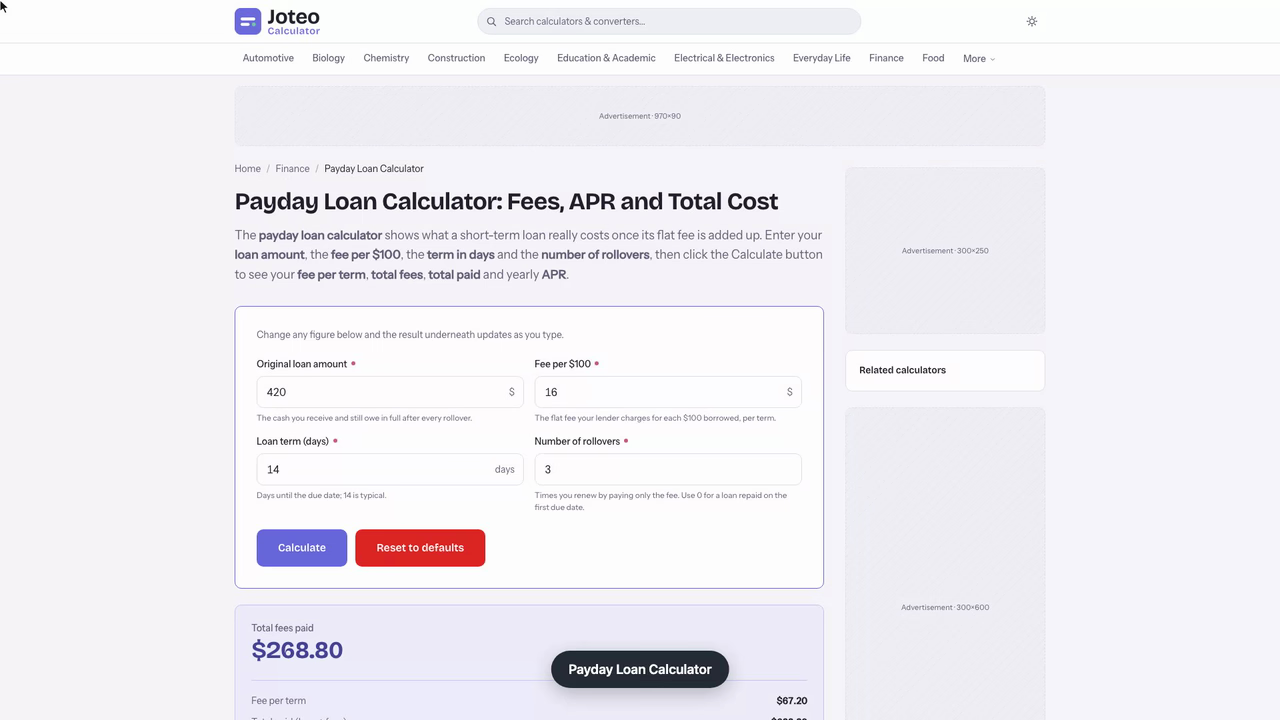
Payday Loan Calculator: Inputs and Results
Every result comes from four inputs that you can copy straight from your loan agreement. The calculator returns the fee for one term, the cost of every extra term, your full repayment and the yearly cost. There is no stated interest rate on these products, only a flat charge, which is why a sound financial decision needs the converted figure.
Loan Amount and Fee per $100
Start with the loan amount you will receive, for example $420. Add the fee per $100 the company charges, such as $16. The fee per term is the loan divided by 100, times that fee: \(F = \frac{L}{100} \times r\), so $4.20 × $16 = $67.20. The principal stays fixed because an extra term pays only the fee, and the funds you received are the figure your borrowing decisions should be judged against.
Number of Rollovers and Term Length
Set the number of rollovers you expect, using 0 for a loan repaid on the first due date, then enter the term in days (14 is typical). A flat fee on a shorter term costs more per year. This works as a payday loan rollover calculator and a yearly-cost tool in one, and the same amount stays owed after each extra term.
Rollover Math: How Total Fees Climb With Each Renewal
When you cannot repay, many offer to roll the debt over: you pay the fee, the debt stays, and a new term begins. Nothing reduces what you owe, so charges stack in a straight line, \(T = F \times (n + 1)\), where \(n\) counts the extra terms. Borrowers who reborrow this way watch the bill grow every two weeks.
| Rollovers | Paid out | Repaid in all | Share of loan |
|---|---|---|---|
| 0 | $67.20 | $487.20 | 16% |
| 1 | $134.40 | $554.40 | 32% |
| 2 | $201.60 | $621.60 | 48% |
| 3 | $268.80 | $688.80 | 64% |
Read the table row by row. By the second extra term, a $67.20 cost has become $201.60, nearly half of the cash you received. Plan your budget for the whole path, not only the first term.

Cumulative Fees Versus What You Borrowed
After three extra terms you have paid $268.80 in cumulative fees and the total owed is still the full $420 on top. At the sixth extra term, fees exceed the original loan amount of $420. The biggest risk is that each charge looks small on its own.
Payday Credit APR: From a Flat Fee to a Yearly Rate
Converting the fee to a yearly rate lets you compare it with any other product. Divide the fee by the loan, then scale the term up to 365 days:
$$A = \frac{F}{L} \times \frac{365}{d} \times 100$$
Here $67.20 ÷ $420 = 0.16, and 0.16 × (365 ÷ 14) × 100 gives a yearly cost of 417.1%. That is the payday loan APR calculator view: a 16% charge on a two-week term behaves like a 417% interest rate. Because the fee is flat, your credit score does not change the price, though it decides which cheaper options you can reach.

Change one input and the picture moves fast. Stretch the same $67.20 over a 28-day term and the yearly cost halves to 215.1%; shorten it to 7 days and it doubles to 860.4%. Only the clock changed, so compare offers on the same term.
Walking Through a $365 Rollover Decision, Step by Step
Marisol, a line cook, needs $365 for a transmission repair, and, as with most payday loans, her lender quotes $17 per $100 for 14 days after a cash advance app asked for a tip she did not want to pay. Before signing, she opens the payday loan calculator and enters a loan amount of 365, a fee of 17, a 14-day term and a number of rollovers of 2, because her next two paychecks are already spoken for.
The result: $62.05 per term ($365 ÷ 100 × 17), $186.15 in fees over three terms and $551.15 total paid. The yearly cost is 443.2% APR, far above the 28% ceiling for a payday alternative loan at a credit union. What stands out to me is that the principal never moves: she would still owe the full $365 after the second renewal.
She cross-checks by hand ($62.05 × 3 = $186.15), then prices the other route. Six months at 28% on $365 is a $65.90 monthly payment and $30.38 in total interest, $395.38 repaid in all, which is $155.77 less than $551.15. Then she reruns the rollover count:
| Rollovers | Fees | Total paid |
|---|---|---|
| 0 | $62.05 | $427.05 |
| 1 | $124.10 | $489.10 |
| 2 | $186.15 | $551.15 |
| 5 | $372.30 | $737.30 |
The number to watch is the rollover count: at five renewals, fees pass the $365 she borrowed. One caveat is that the calculator assumes the same fee every term, while state limits can lower it and a lender can add a new charge at renewal, so the true cost may differ. Marisol does not trust the estimate alone. She asks the lender for an extended payment plan, applies to a credit union, and trims her budget by $40 a week to cover the first monthly payment before the debt snowballs.
Small-Dollar Loans Compared: Cash Advance App or Installment Loan
Run the same $420 through other small-dollar loans. A cash advance app tends to charge tips or a monthly fee rather than a rate, and some deduct an origination fee from your funds before you see them. Banks usually offer the lowest payments, but only to people who qualify.
Installment Loan Repayment With an Amortization Schedule
A six-month loan at 28% APR on $420 costs $75.83 a month. Its amortization schedule shows a monthly payment total of $454.96 and $34.96 in total interest, and prepayment is normally allowed.
Credit Union Payday Alternative Loan
Under the federal program, a payday alternative loan has its rate capped at 28%. Membership and a short wait may apply, the screening is lighter than at a big lender, and the term stretches over months instead of weeks, so each payment is smaller.

Loan Renewal Rules: State Limits and Fee Caps
Rules vary by state. Some ban rollovers, others cap how many you get, and a few require a free payment arrangement. State limits set the largest amount you may borrow, and fee caps set the highest charge allowed per hundred dollars. CFPB research links most fee revenue on these loans to repeat borrowing, so check your state's rules first, then enter the state's cap as your fee and its limit as your rollover count to see the most the law lets you pay. The disclosure box on your agreement must show the finance charge in dollars and the annual percentage rate before you accept.
When the Due Date Arrives: Alternatives to a Loan Extension
Ask for an extended payment plan before the day arrives; some states require one at no new charge. A plain payment plan stops the stacking: set the calculator's rollover count to 0 and its total shows what the plan saves. A one-page budget shows which bill can move to free up the cash.
- Call early and ask for the new schedule in writing.
- List every bill due before your next paycheck and rank them by the risk of a penalty.
Nonprofit Credit Counselor and Debt Help
A nonprofit credit counselor can negotiate a schedule on a short-term balance with each lender, consolidate what you owe into one plan and stop the fee stacking. Free counseling is worth booking early, especially if repeated charges have drained a bank account and put a mortgage payment at risk of foreclosure.
FAQs around Payday Loan Calculator
1. Does a rollover reduce what I owe?
No. A rollover pays only the fee and starts a new term, so the original loan amount stays untouched. That is why total fees keep climbing even though the balance never falls.
2. How is the APR of a payday loan calculated?
Divide the fee by the loan amount, multiply by 365 divided by the term in days, then multiply by 100. A $67.20 fee on a $420 loan for 14 days works out to about 417.1% APR.
3. How many rollovers until fees exceed the loan?
Divide the loan amount by the fee per term and round up. With a $67.20 fee on $420, fees pass the amount borrowed at the sixth rollover.
4. Are payday loan rollovers legal in every state?
No. Some states ban rollovers, others limit how many you can take, and some require a payment plan with no new fee. Check your state's rules and fee caps before you renew.
5. What can I do if I cannot repay by the due date?
Ask your lender for an extended payment plan before the due date, ask a credit union about a payday alternative loan, or speak to a nonprofit credit counselor. Repeated renewals are usually the costliest choice.
6. Does this calculator include state fee caps or origination fees?
No. It assumes the same flat fee every term, as you enter it. If your state caps the fee or your lender adds a new charge at each renewal, change the fee per $100 or expect a different total.
Report an issue with this page
Spotted a wrong result or unclear explanation? Report an issue or read our editorial policy.