

Land Loan Calculator & Farm Loan Payment Calculator
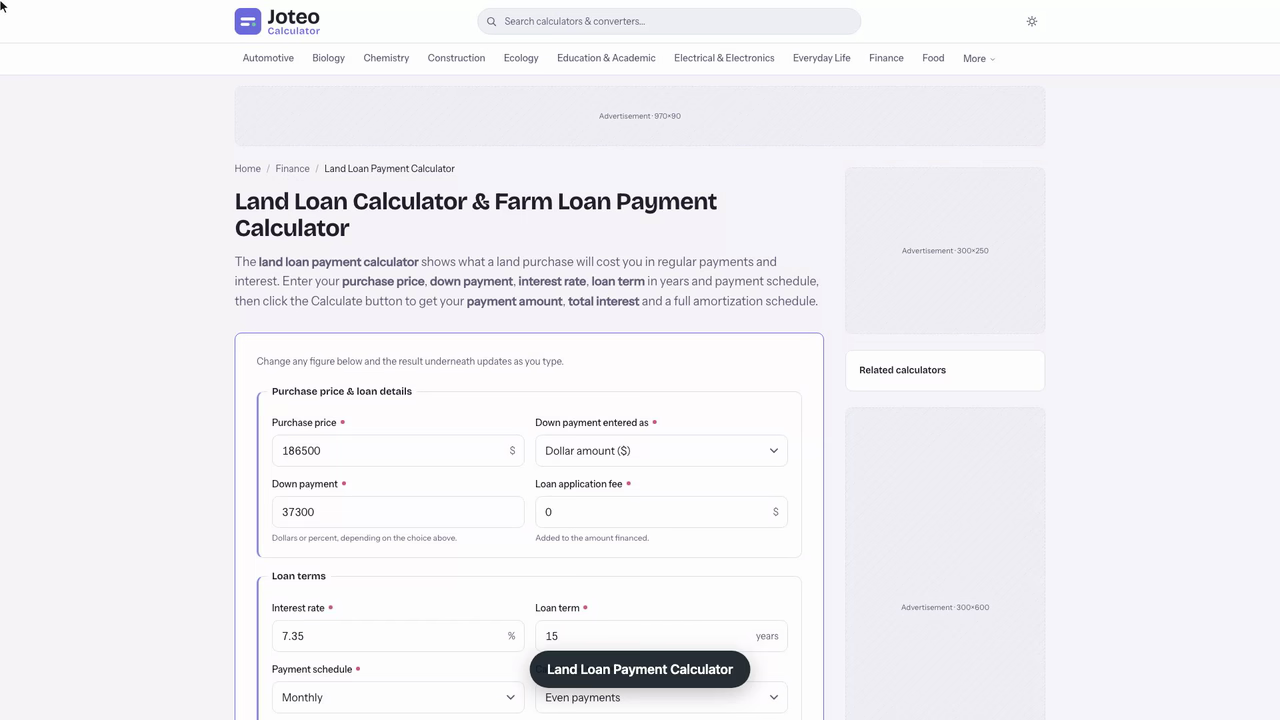
The land loan payment calculator shows what a land purchase will cost you in regular payments and interest. Enter your purchase price, down payment, interest rate, loan term in years and payment schedule, then click the Calculate button to get your payment amount, total interest and a full amortization schedule.
Land Loan Payment Calculator inputs and result
Payment amount
—
- Amount financed
- —
- Total interest paid
- —
- Total cost of financing (interest + fee)
- —
- Total of all payments
- —
- Number of payments
- —
- Average interest per payment
- —
- Final payment
- —
- Principal share of payments
- Interest share of payments
- Second loan payment amount
- —
- Payment change vs. first loan
- —
- Second loan total interest
- —
Results Table
Table of contents
Who wrote and checked this page


Use this land loan payment calculator to turn a parcel's price, your cash down and an expected interest rate into a monthly payment you can fit into your budget. Choose the term lengths and schedule that match your cash flow, then press Calculate to see what the whole loan costs.
How the Land Loan Payment Calculator Works
Whether you need a land loan calculator for a hunting tract or a farm loan payment calculator for crop acres, the inputs are the same, and each one changes your land loan payments or farm loan payments, your monthly payments and your interest.
Loan amount, purchase price and down payment
Enter the purchase price, then your cash down as dollars or a percentage; the gap is the loan amount. A lender typically asks for a larger down payment on raw land than on a home mortgage, so test several levels; a bigger downpayment also trims interest.
Interest rate, loan term and payment frequency
Add the interest rate your lender quotes and the number of years. Payments can be monthly, quarterly, semiannual or annual. Choose semi-annually or annually only if income, such as row crops or livestock sales, arrives in lumps. Ask about maturity dates and flexible payment options before you compare rates.
Monthly Payment Formula and Amortization Schedule
Every land loan calculator uses the standard amortization formula, where \(P\) is the amount borrowed, \(r\) the periodic rate and \(n\) the number of payments:
$$M = P \times \frac{r(1+r)^{n}}{(1+r)^{n} - 1}$$
Take a $186,500 parcel with $37,300 down, leaving $149,200 financed at 7.35% for 15 years. Here \(r = 0.0735 \div 12 = 0.006125\) and \(n = 180\), so the payment is $1,370.42. Over the life of the loan you repay $246,674.76, and the average interest per payment is $541.53. The first rows of the schedule show how each payment splits:
| Payment # | Payment amount | Interest | Principal | Balance |
|---|---|---|---|---|
| 1 | $1,370.42 | $913.85 | $456.57 | $148,743.43 |
| 2 | $1,370.42 | $911.05 | $459.36 | $148,284.07 |
| 3 | $1,370.42 | $908.24 | $462.18 | $147,821.90 |

Total interest and principal payments over time
Your total interest comes to $97,474.76. In year one, interest payments take $10,777.81 of the $16,445 you pay, so the balance falls only to $143,532.83. Later payments shift toward paying the balance down.

| Payment frequency | Payment amount | Payments | Total interest |
|---|---|---|---|
| Monthly | $1,370.42 | 180 | $97,474.76 |
| Quarterly | $4,124.98 | 60 | $98,299.06 |
| Annual | $16,745.34 | 15 | $101,980.11 |
Pricing a Horse Pasture With the Loan Calculator
Dana wants a 12.4-acre pasture listed at $94,750 and has decided her land loan payments can't pass $600 a month. Her credit union asks for at least 15% down on unimproved ground and quotes 7.82% over 20 years.
She enters the price, then 15% ($14,212.50) as the cash down, then the rate and term, and leaves the frequency on monthly. The calculator finances $80,537.50 and returns $664.65 a month, $159,516.93 repaid and $78,979.43 of interest. That is $64.65 over her ceiling, so the answer is no, as quoted.
Next she reruns one input at a time, which is the step I'd never skip:
| Change | Payment | Interest over 20 years |
|---|---|---|
| Quoted: 15% down | $664.65 | $78,979.43 |
| 25% down ($23,687.50) | $586.46 | $69,687.73 |
| Rate 7.32% instead | $639.97 | $73,055.13 |
| 15-year term | $761.31 | $56,498.80 |
Solving backwards, $600 supports at most $72,703.25 of borrowing, so she needs $22,046.75 down, about 23.3%. She checks it by hand: \(r = 0.0782 \div 12\), \(n = 240\), and $72,703.25 times that factor gives $600.00. A half-point rate cut barely helps; the down payment decides this deal, and the number to watch is the 23.3% threshold, not the rate.
One caveat: the calculator returns principal and interest only. Property tax and fencing aren't in the result, and a lender that offers a 5-year balloon on a 20-year schedule would leave about $70,300 still owed at the end, which this calculator won't show. She asks for the full amortization schedule before signing.
Farm Loan Types, Rates and Financing Options
Lenders sort land by how developed it is. Raw land has no roads, water or sewer, so it carries the most risk and may fall under commercial lending, with higher loan rates and tougher repayment terms. Improved land with utilities and road access is easier to finance.
- Rural real estate loans: acreage or a tract where you plan to build a home.
- Agricultural loans: farmland, ranch pasture, timber, row crops, livestock or any agribusiness.
- Land improvement loans: wells, fences or barns on land you already own.
- Recreational land loans: hunting parcels, getaway acres and a weekend ranch.
Land loan versus a traditional mortgage
A bank sees a vacant parcel as riskier than a house, because buyers walk away more easily and the collateral is only dirt. If you default, the lender must resell it. So a land loan usually costs more and runs shorter. Lenders underwrite on location, zoning and whether the parcel works as an investment property, since land values and land appreciation protect their position.
Fixed-rate or variable-rate loans
Your rate moves cost more than anything else. At 6.35%, the payment drops to $1,287.42, a payment change of $83.00, and total cost falls by $14,939.04. At 8.35% it rises to $1,456.14. Stretching to 20 years cuts the payment to $1,188.30 but adds interest of $135,991.44. Federal Reserve decisions feed through to bank pricing, so check current quotes first.

A fixed-rate loan holds one rate for the term, while a variable-rate loan floats with the market. Ask about long-term fixed rates if you want predictable payments.
How to qualify for a land loan
Lenders want collateral, a clear plan for the parcel and proof you can afford the payment. Bring tax returns and a cash flow forecast to your loan officer, and get pre-approved before you make an offer. Lenders test whether the payment from your calculator run fits that cash flow.
Owner financing, home equity and credit union options
Besides a bank, you can borrow through owner financing from the seller, a credit union, or home equity on a property you own. A construction-to-permanent loan covers both the lot and the build. You can refinance later if rates fall. Run each quote through the land loan calculator to compare payments.
FAQs around Land Loan Payment Calculator
1. What is a land loan and how is it different from a mortgage?
A land loan is money borrowed to buy a parcel such as raw acreage, a farm tract or a recreational lot. Lenders treat undeveloped land as riskier than a home, so land loans often come with a larger down payment, a higher interest rate and a shorter term than a standard mortgage.
2. How is a land loan payment calculated?
The calculator subtracts your down payment from the purchase price, adds any application fee, and spreads that balance over the number of payments at the periodic interest rate. Each payment covers that period's interest first and reduces the principal with what is left.
3. Does the payment schedule change how much interest I pay?
Yes. With the same rate and term, paying monthly, quarterly, semiannually or annually changes how often interest is applied and how fast the balance drops, so total interest differs slightly. Pick the schedule that matches when your income arrives.
4. What is the difference between even and decreasing payments?
Even payments stay the same for the whole term. Decreasing payments repay an equal slice of principal each period plus interest on the remaining balance, so the first payment is the largest and later ones shrink.
5. How much down payment do I need to buy land?
It depends on the lender and on whether the land is raw or improved. Undeveloped parcels usually need more cash down than a home, so try several down payment amounts or percentages in the calculator to see how the payment and total interest move.
6. Does the result include property taxes and insurance?
No. The result shows principal and interest, plus the application fee if you enter one. Property taxes, insurance and other carrying costs are separate and should be added to your budget.
7. Should I choose a fixed-rate or a variable-rate land loan?
A fixed-rate loan keeps the same interest rate for the term, so the payment is predictable. A variable-rate loan moves with the market, so the payment can change. Enter each quoted rate in the calculator to compare.
8. Can I compare two land loan offers side by side?
Yes. Set Compare with a second loan to Yes, enter the second loan's amount, rate, term and schedule, and the calculator shows its payment, the payment change and its total interest.
Report an issue with this page
Spotted a wrong result or unclear explanation? Report an issue or read our editorial policy.