

Mortgage Acceleration Calculator – Mortgage Payoff Calculator
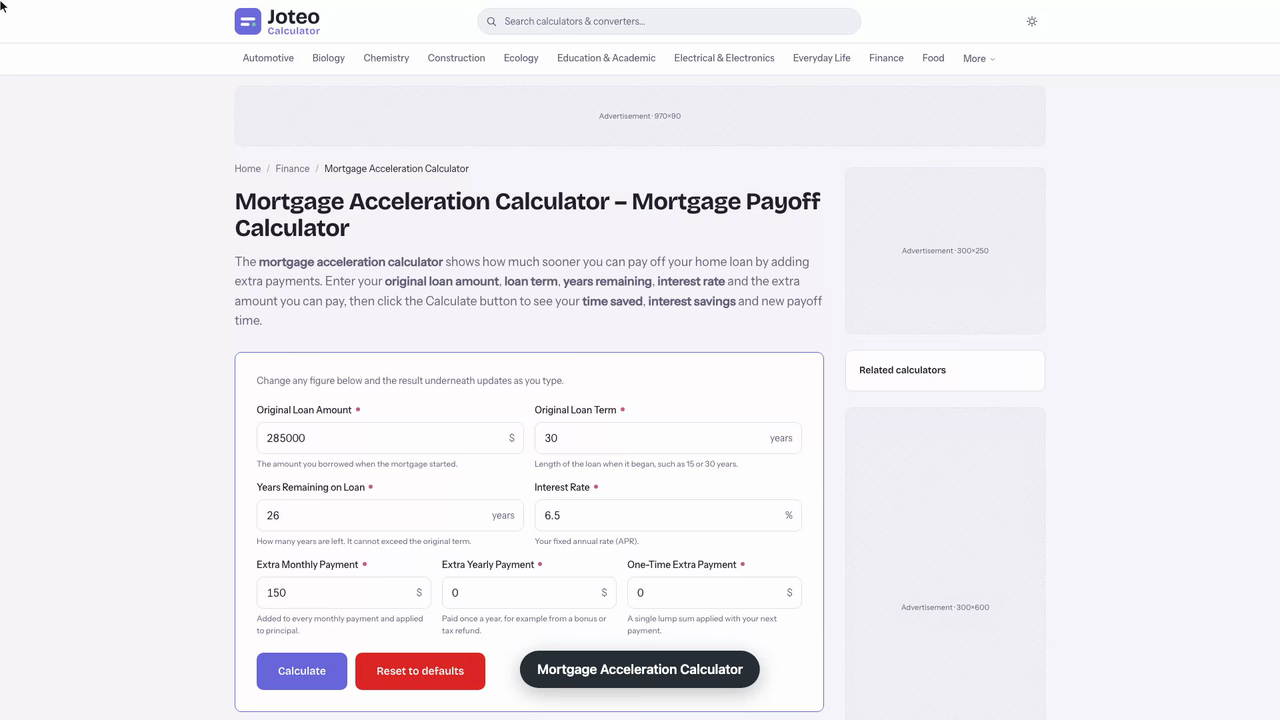
The mortgage acceleration calculator shows how much sooner you can pay off your home loan by adding extra payments. Enter your original loan amount, loan term, years remaining, interest rate and the extra amount you can pay, then click the Calculate button to see your time saved, interest savings and new payoff time. Also try the Occupancy Rate Calculator.
Mortgage Acceleration Calculator inputs and result
Time Saved
—
- Total Interest Savings
- —
- New Payoff Time
- —
- Original Payoff Time
- —
- New Monthly Payment
- —
- Original Monthly Payment
- —
- Remaining Balance
- —
- Interest Without Extra Payments
- —
- Interest With Extra Payments
- —
Table of contents
Who wrote and checked this page


Wondering how much sooner your home could be yours? The mortgage acceleration calculator shows how adding extra payments to your monthly payment brings your mortgage end date forward, and it totals the interest you keep. Making extra payments of $275 on a $243,800 mortgage at a 6.35% rate cuts the term from 25 years to 18, so your home loan costs far less.
How the Mortgage Acceleration Calculator Works
The tool needs four numbers: your remaining loan balance, your interest rate, the years remaining on the loan term, and the extra payments you plan to add to each monthly payment. You can also enter a one-time lump sum. It compares the mortgage schedule you have now with the faster one and reports the new end date, the months saved and the interest you avoid. Most people remember the original loan amount from closing day, but the remaining balance on your latest mortgage statement is the figure that matters here, because that is what your monthly payment has left to cover.
Keep in mind what the tool counts. It uses principal and interest only, so property taxes, homeowners insurance and private mortgage insurance (PMI) stay outside the result. Your lender collects them with the home loan payment, but they do not shrink as you pay down the principal, so your whole monthly payment is bigger than the figure the tool shows, with one exception: PMI usually ends once your equity reaches 20%. The calculator assumes a fixed rate, such as a 30-year fixed-rate mortgage, and the standard amortization schedule. An adjustable loan needs a fresh run whenever the APR resets, and your monthly payments will move with it.
The Formula Behind Your Monthly Payment
Amortization splits each payment between interest charges and principal. On a 30-year mortgage the split starts heavily toward interest, which is why a 30-year loan feels slow to pay down and why your home equity builds slowly at first. The required payment follows this formula, where B is the loan balance, i is the APR divided by 12 and n is the number of payments left:
$$M = B \times \frac{i(1+i)^{n}}{(1+i)^{n}-1}$$
For a 30-year loan with 25 years left, n is 300. At a 6.35% rate, the first month's interest on $243,800 is $1,290.11 and only $333.27 of your payment reduces the principal balance. Every dollar you add on top goes straight to the principal balance, so each later month's interest is a little lower and the next payment does more work.

Pay Off Your Mortgage Faster: A Worked Example With Extra Payments
Take a remaining mortgage balance of $243,800 at 6.35% with 300 payments left. The required principal and interest payment works out to $1,623.38 a month, and over 25 years you would pay $243,213 in total interest. We ran three levels of extra payments through the formula, and the table shows each result.
| Extra payment | New monthly payment | Pay off time | Total interest | Interest savings |
|---|---|---|---|---|
| $0 | $1,623.38 | 25.0 years | $243,213 | $0 |
| $100 | $1,723.38 | 21.8 years | $207,047 | $36,166 |
| $275 | $1,898.38 | 18.0 years | $165,586 | $77,628 |
| $500 | $2,123.38 | 14.8 years | $132,542 | $110,671 |
The middle row is the one to remember: $275 a month saves $77,628 in interest and ends the loan 84 months early. The first $100 buys 38 months, while the next $175 buys another 46, so the savings per dollar slow a little as you go. An early mortgage payoff calculator makes that trade-off visible before you commit, and an extra mortgage payment calculator lets you test a smaller amount first. Think of it as personal finance with a clear return: you decide whether becoming debt-free sooner is worth a tighter monthly budget, and you save money either way. The interest savings are guaranteed at your mortgage rate, unlike an investment return, and the larger your monthly payment, the faster your principal balance shrinks.

Make Extra Payments Early in the Loan Term
Timing matters as much as the amount. In the early years most of each payment is interest charges, so the principal balance barely moves. Extra payments made in year two cut a balance that still has 20-plus years of interest ahead of it. The same $275 added in year twenty has far less time to work on the home loan. If you cannot make large extra payments today, start small and raise them when your income rises, because every extra payment shrinks the principal balance for the rest of the term.
Always tell your lender to apply additional payments to the principal. Some servicers hold an unmarked overpayment and apply it to next month's bill, which does nothing for your finish date. Check the next statement to confirm the loan balance fell by the full amount of your extra payment, and look for a clear "principal only" line.
A Homeowner Runs the Extra Mortgage Payment Calculator on $162,340
The decision on the table: should my $5,200 work bonus and a spare $190 a month go at the mortgage, or sit in savings? I enter a $162,340 balance at 5.875% with 252 payments left. The required payment is $1,122.71, and the schedule shows $120,582 of interest still to come, with $794.79 of the first month's payment going to interest.
I run three cases, changing one input at a time:
| Case | Payoff time | Interest saved |
|---|---|---|
| Current schedule | 21.0 years | $0 |
| $190 extra monthly | 15.9 years | $32,944 |
| $250 extra monthly | 14.8 years | $39,766 |
| $5,200 bonus each December | 12.5 years | $52,664 |
The $190 plan ends the loan 61 months early and saves $32,944. Going to $250 adds only 13 more months, so I treat $190 as the sweet spot, and the number to watch is the bonus, which does the most work per dollar. Annual lump sums get larger savings than monthly extras because each one hits a still-large balance. I cross-check the $190 case by hand: the lower balance after year one trims the second year's interest, which is the same compounding the formula shows.
Before committing I check two outside limits. My home is worth about $228,000, so the balance is a 71.2% loan-to-value ratio and I already have more than the 20% equity lenders use to drop PMI, so extra payments will not unlock an insurance saving. And $5,200 is only 3.2% of the balance, well under the 20%-a-year allowance some loans with a prepayment penalty use, though I still confirm my note says none applies.
One edge case changes the answer: the calculator assumes every extra dollar lands on the due date. A payment sent after the due date can sit as unapplied cash for a month, and a card at 22.9% APR makes paying the card off first worth far more than any mortgage payoff. My next action is a $190 autopay flagged "principal only", with the bonus split between an emergency fund and the loan.
Biweekly Payment Plans That Accelerate Your Payoff
A biweekly payment splits the monthly payment in half and sends it every two weeks. Because a year has 26 two-week periods, you make 26 half payments, which equals 13 full monthly payments instead of 12. An accelerated biweekly payment is the same plan priced so that the extra month is built in. On our example mortgage, each half payment is $811.69.
| Plan | Payment | Pay off time | Total interest |
|---|---|---|---|
| Monthly payment | $1,623.38 every month | 25.0 years | $243,213 |
| Biweekly payment | $811.69 every two weeks | 20.9 years | $196,944 |
The biweekly plan finishes about 4 years sooner and saves roughly $46,270 in interest. Ask your loan servicer whether it applies each half payment on receipt. Some only post them monthly, and those plans save almost nothing. You can also skip the program and add one-twelfth of your payment, $135.28, to every one of your monthly payments, which gets the same result with no fee and keeps your home loan on a single monthly payment date.
Use a Lump Sum Payment for Additional Payments
A lump sum payment attacks the principal in one move. Tax refunds, work bonuses, a windfall from selling a car and cash gifts all qualify. A $6,000 lump sum paid in month 12 trims our example mortgage to 23.7 years and saves $20,344 in interest, without raising your monthly payment or changing your monthly cash flow.

Pair the lump sum with steady extra payments and the effects stack. Adding $6,000 in month 12 to the $275 plan ends the loan in 17.3 years. Keep an emergency fund in place first, because you cannot take money back out of your home loan, and put the rest toward your budget goals before the mortgage, since a mortgage is a low-rate debt for many home buyers.
Refinancing and Recasting to Pay Off Your Mortgage Early
Two other levers change the loan itself instead of your habits: you can refinance into a new mortgage, or ask your lender to recast the current one. Both can help you reach a 15-year finish, but they work very differently and carry different fees. Refinancing is a new loan with new closing costs, so you only refinance when the saving beats the fees, while recasting is a re-amortization of the mortgage you already have. Either way, enter the new rate, term or balance into the calculator to see the new end date before you commit.
When Refinancing at a Lower Interest Rate Makes Sense
Refinancing replaces your mortgage with a new one, often on a shorter term or at a lower interest rate. It makes sense when your credit score is strong, the new interest rate is meaningfully below your current one, and you can absorb closing costs of 2% to 5% of the balance. A common move is to refinance from a 30-year loan into a 15-year loan, which raises the monthly payment but cuts the interest sharply: on our $243,800 example, a term of 15 years at the same rate would end the loan 10 years sooner than 25, and you can enter that shorter term to see the interest saved. An adjustable-rate mortgage may lower the starting payment, but a fixed rate keeps the schedule predictable and easy to compare in the calculator. A borrower with a weak credit score should compare every offer to refinance carefully, because a higher interest rate can erase the saving.
When Loan Recasting Fits
Recasting keeps your mortgage and rate, but the lender re-amortizes the balance after you make a large lump sum. If you pay $40,000 at month 24, the balance drops from $235,295 to $195,295 and your payment falls from $1,623.38 to $1,347.40. Recasting usually costs a small fee instead of closing costs, and unlike refinancing it needs no new credit check. It does not shorten the term unless you keep paying the old amount, so many borrowers recast for cash flow and then keep sending the old payment. Ask your lender whether recasting is offered, since some servicers do not recast government-backed loans.
Refinancing From an FHA Loan to a Conventional Loan
An FHA loan charges a mortgage insurance premium that can last for the life of the loan when your down payment was under 10%. If your home equity has grown past 20%, refinancing to a conventional loan can drop that cost, and you can enter the monthly saving as extra payments in the calculator to see how much sooner the new loan ends.
Early Repayment: Prepayment Penalty Checks
Before you begin early repayment, read your note for a prepayment penalty. Most modern mortgages have none, but a few charge a fee when you pay off a large share of the mortgage principal in the first three to five years, and the fee can wipe out a year of savings. Ask your lender whether it allows a fixed share, often up to 20% of the balance, each year without a charge.
Check your loan term and note any rate step-ups. A homeowner with an original loan term of 15 years has far less interest to save than one on a 30-year schedule, so the same plan yields smaller dollars. Review your finances too: if you carry credit card debt at a higher interest rate, paying that first beats any extra mortgage payment.
Using a Mortgage Payoff Calculator Wisely
Run a mortgage payoff calculator with a few different extra payments, then pick the one you can keep paying through a bad month. A small payment you sustain beats a big one you abandon, and a steady monthly payment is easier to protect than a promise to pay later. Rerun the mortgage acceleration calculator after every refinance, recast or rate change, since each one resets the schedule for your home loan.
FAQs around Mortgage Acceleration Calculator
1. How does a mortgage acceleration calculator work?
It rebuilds your amortization schedule twice: once with your required payment and once with the extra payments you enter. The gap between the two schedules is the time and interest you save.
2. Do extra payments go to principal or interest?
They only help if applied to principal. Tell your servicer to apply any additional amount to principal, and check your next statement to confirm the balance dropped by the full amount.
3. Is a biweekly payment plan better than adding extra to each month?
A biweekly plan makes 26 half payments a year, which equals 13 monthly payments. Adding one-twelfth of your payment to each monthly payment gives a similar result without any program fee.
4. Will I owe a prepayment penalty if I pay my mortgage off early?
Most modern mortgages have none, but some charge a fee for paying off a large share of the balance in the first few years. Check your loan note or ask your lender before making large payments.
5. Should I refinance or make extra payments to pay off my loan sooner?
Extra payments cost nothing and can be stopped at any time. Refinancing to a shorter term or lower rate makes sense only when the savings outweigh closing costs, usually 2% to 5% of the balance.
6. Does this calculator include taxes and insurance?
No. It uses principal and interest only. Property taxes, homeowners insurance and any private mortgage insurance are paid on top and do not change with these results.
7. When do extra payments save the most interest?
Early in the loan, because most of each payment is interest and the balance is still large. The same extra amount saves noticeably less when added in the final years.
Report an issue with this page
Spotted a wrong result or unclear explanation? Report an issue or read our editorial policy.