

Margin Interest Calculator: Daily Cost of Borrowing
The margin interest calculator shows how much interest your broker will charge on money you borrow to invest. Enter the amount borrowed, the annual interest rate and the number of days you will hold the margin loan, then click the Calculate button to see your total margin interest, the cost of borrowing for that period. Also try the Calendar Spread Calculator.
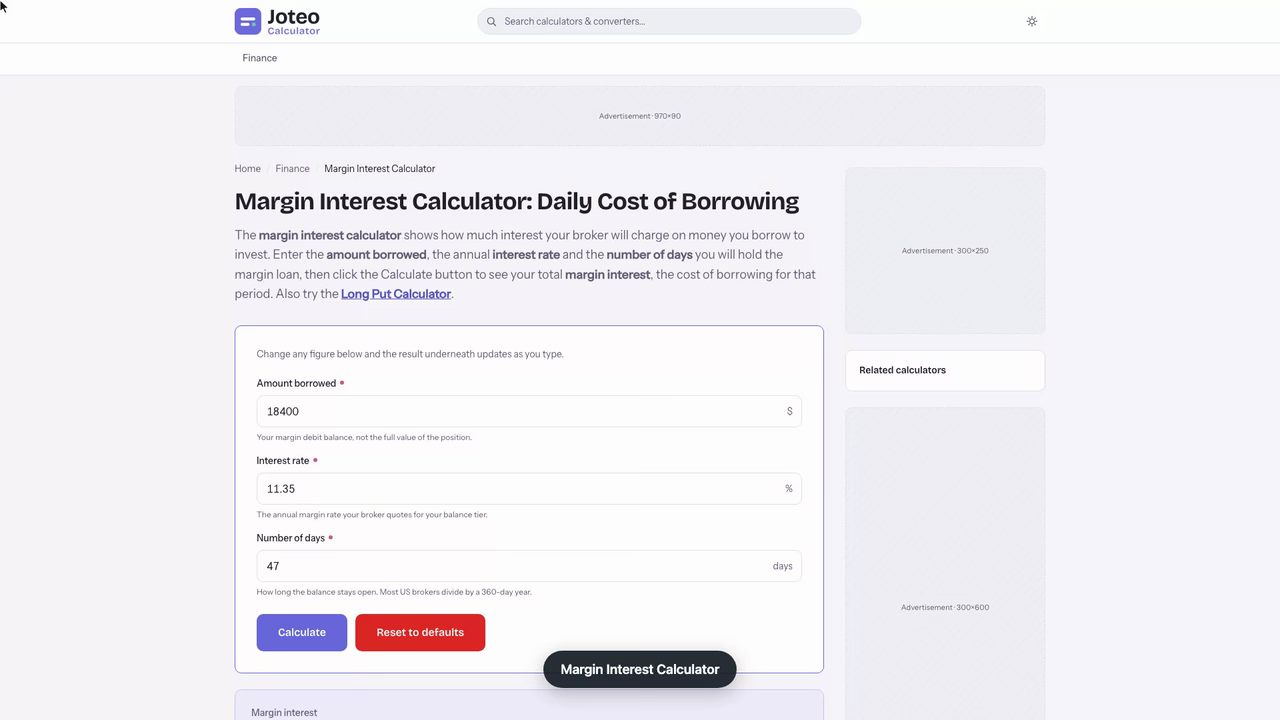
Margin Interest Calculator inputs and result
Margin interest
—
Table of contents
Who wrote and checked this page


Borrowing from your broker to buy more than your own money allows feels cheap until the first statement arrives. The margin interest calculator turns three numbers you already know into the exact cost of borrowing for any holding period, so you can see whether the extra buying power is worth what it charges before you place the trade.
How the Margin Interest Calculator Works
Every firm that offers a margin account charges simple interest on the money it advances. Your debit balance (the borrowed amount still outstanding) accrues a small charge every night, and those nightly charges are added up and posted to your account once a month. The tool reproduces that arithmetic: it takes the annual interest rate you are quoted, converts it to a daily rate, and multiplies by the balance and the holding period.
Because the rate is quoted per year but charged per night, the result scales in a straight line with time. Holding the same balance twice as long costs twice as much, which is why the holding period matters as much as the rate itself.
Inputs the Margin Interest Calculator Needs
- Amount borrowed: the portion of the purchase funded on credit, not the full position size.
- Interest rate: the annual rate for your balance tier, taken from the current rate schedule.
- Number of days: how long you expect to keep the balance open, from settlement until you repay it.
The output is the total dollar charge for that period, plus the charge per day, which is the figure you will actually see accruing on your account screen.
Purchased Amount vs. Amount Borrowed
A common mix-up is entering the full purchased amount instead of the debit. If you buy $36,800 of shares and put in $18,400 of your own money, only the other $18,400 is principal that accrues a charge. Under the Federal Reserve's Regulation T, you can generally borrow up to 50% of the purchase price of marginable shares, so the borrowed portion is often half the position, not all of it. Some margin trading tools first ask for your account's securities value to estimate how much you could borrow; this one starts from what you actually borrow.
The Formula Behind Daily Interest on Margin Loans
Lenders compute the charge on margin loans with one short equation. This is the margin interest formula the tool applies: See also our Wheel Strategy Calculator.
$$\text{Interest} = \text{Borrowed amount} \times \text{Annual rate} \times \frac{\text{Days held}}{360}$$
Split into its daily form, the same equation reads \(\text{Daily charge} = \text{Balance} \times \frac{\text{Annual rate}}{360}\), and the total is simply that daily figure multiplied by the days the balance stays open.
Why Brokers Divide by 360
Most US firms use a 360-day banking year, a money-market convention inherited from commercial lending. Dividing by a smaller number makes each day slightly more expensive than a 365-day year would, so an identical rate costs you about 1.4% more over a full year. When you compare quotes, check which day-count basis each firm states in its margin agreement.
Calculated Daily, Billed Monthly
Interest is calculated daily on your settled debit, then billed monthly. Some firms post the charge on a fixed calendar date; others post it every 30 days from when you first borrowed. Either way, the unpaid charge is added to what you owe, so from the next billing cycle onward you pay interest on the interest. The formula above ignores that small compounding effect, which is why the calculator's figure is a close estimate for holds under a few months and slightly low for long ones.
Worked Example: Pricing 47 Days of Margin Debt
Suppose you want to add to a position ahead of an earnings season you expect to play out over roughly seven weeks. You put in $18,400 of your own money and borrow another $18,400, giving you $36,800 of shares. Your broker's rate for that balance tier is 11.35%, and you plan to hold for 47 days.
$$18{,}400 \times 0.1135 \times \frac{47}{360} = \$272.65$$
That works out to $5.80 of daily interest, or $272.65 in total for the hold. On a 365-day basis the same balance would cost $268.92, a gap of just $3.73, so the day-count convention matters far less than the rate or the time you keep the balance open.

How Duration Changes the Total
The table below keeps the $18,400 debit and the 11.35% interest rate fixed and changes only the duration of the hold. This is the margin interest calculation repeated for common holding periods:
| Days held | Interest at 11.35% | Share of $36,800 position |
|---|---|---|
| 7 | $40.61 | 0.11% |
| 15 | $87.02 | 0.24% |
| 30 | $174.03 | 0.47% |
| 47 | $272.65 | 0.74% |
| 90 | $522.10 | 1.42% |
| 180 | $1,044.20 | 2.84% |
| 365 | $2,117.41 | 5.75% |
If you let twelve 30-day bills roll onto the balance unpaid, the compounded total over that year climbs to about $2,200.54, against $2,088.40 of simple interest. That extra amount is the cost of treating margin as long-term financing.
How Brokers Set Margin Rates
Unlike a fixed-rate mortgage, the margin interest rate you pay is variable. Most firms publish a base rate and then add or subtract a spread depending on how large your balance is. The base itself usually tracks the Federal Funds target rate set by the Federal Reserve, so when the central bank moves, your cost moves with it, often within days and without a separate notice. You might also find our Beta Stock Calculator useful.
Tiered Rates and Your Margin Balance
Nearly every firm uses tiered rates: the larger your margin balance, the lower the rate. Small accounts sit in the most expensive tier, often several percentage points above what a seven-figure borrower pays. Some brokers apply the tier rate to the entire balance, while others blend rates across tiers, so read the schedule rather than assuming. Your creditworthiness in the lending sense matters less here than it would for a personal loan, since the shares themselves back the credit.
Comparing Margin Interest Rates Across Brokers
Published margin interest rates range widely: at the same balance, a discount app and a full-service firm can differ by more than five percentage points. On the 47-day example above, that spread is the difference between these outcomes:
- At 6.25%, the same borrowed funds cost $150.14.
- At 8.75%, the charge rises to $210.19.
- At 11.35%, you pay $272.65.
- At 13.25%, the bill reaches $318.29, more than double the cheapest quote.
Comparing margin rates before you open or fund an account is often worth more than any single trade decision you make on borrowed money.

Break-Even Math for Your Interest Cost
The number the tool gives you is most useful when you compare it to the gain you need. Your interest cost has to be covered by the position's price move before any of the extra exposure pays you anything. In the example, $272.65 divided by the $36,800 position means the shares must rise about 0.74% in 47 days just to cover the loan.
How Leverage Changes the Math
Borrowing lets you amplify gains, but it will just as readily magnify losses. With 2-to-1 leverage, a 5% rise in the shares becomes roughly a 10% gain on your own capital before costs, and a 5% fall becomes a 10% loss plus the interest. The charge accrues whatever the price does, so it quietly lowers the profitability of winning trades and deepens the hole on losing ones. When you size leveraged investments, compare the expected move against the break-even percentage and ask whether the potential returns still justify the risk after costs.
Interest Obligations and Cash Flow
Monthly charges are due whether or not you sell, which means your interest obligations need a source. Run the calculator with 30 days to get the bill you are budgeting for: $174.03 a month on the example's $18,400 balance. If dividends or deposits don't cover it, the charge is added to your debit, and a year of rolled bills costs about $112 more than paying each one. Planning your cash flow around that 30-day figure keeps the result the tool shows you close to what you actually pay.
A 23-Day Margin Interest Check Before Selling Shares
A freelance sound engineer has a roofing invoice of $9,763.40 due Friday and a client payment expected in 23 days. The only liquid money is a taxable brokerage account holding $64,200 of an index fund, bought four years ago. Selling enough to cover the invoice would realise $2,186.55 of gains, and at the 15% long-term capital gains rate that is a $327.98 tax bill on money needed for barely three weeks.
The alternative is to draw the invoice amount on margin. The broker's schedule lists 9.85% for balances under $25,000, so the engineer enters three values: $9,763.40 borrowed, 9.85% annual rate, 23 days. The calculator returns $61.44 of margin interest, accruing at $2.67 a day.
That number only means something next to the tax, so the engineer reruns it with one input changed. The client has paid late before, so the days go from 23 to 41, the length of a net-30 invoice plus a slow two weeks. The total rises to $109.53, still about a third of the $327.98 that selling would cost.
- Borrowing for 23 days: $61.44
- Borrowing for 41 days: $109.53
- Selling and paying capital gains tax: $327.98
Before committing, the engineer checks the account's cushion. A $9,763.40 debit against $64,200 of holdings leaves equity at 84.8% of the account, far above FINRA's 25% maintenance floor, so the fund would have to fall by roughly 80% before a call arrived.
The decision follows from the figures: draw the $9,763.40 on margin, pay the roofer, and set a transfer to clear the debit the day the client's payment lands. If that payment slips past day 41, the plan is to rerun the calculation that week, since each additional day adds another $2.67 and the gap to the tax bill keeps narrowing.
Risk Management When Margin Debt Grows
A larger loan raises more than your bill. Your equity, the value of your holdings minus what you owe, is what protects the account, and it shrinks faster on a leveraged account when prices fall. Good risk management on margin means treating the interest charge and the margin call threshold as two costs of the same decision. Check out our Black Scholes Calculator as well.
Margin Requirements and the Maintenance Requirement
Margin requirements come in two stages. The initial requirement limits how much you can borrow to open a position. After that, FINRA rules set a minimum maintenance margin of 25% equity for most long positions, and many firms set a house maintenance requirement of 30% or more. Every dollar added to the debit raises the daily charge the calculator shows and thins that cushion at the same time, so rerun it with the larger balance whenever your account drifts toward the house minimum. Fall below it and you receive a call:
- You can meet a margin call by depositing money or additional collateral, which restores your equity.
- You can sell some positions yourself to pay down the debit and cut the daily charge at the same time.
- If you do nothing, the firm can liquidate your holdings without asking first, a forced liquidation that often happens at the worst price.
- Stop-loss orders placed in advance cap how far a losing position can fall, and an early exit also stops the daily charge; rerun the numbers with fewer days to see what closing now saves compared with holding on.
Short Selling and Other Uses of Margin
The same account is used for short selling and some options strategies, and firms also let you draw on it for non-investment needs, much like a line of credit secured by your securities. Whatever the purpose, the charge runs on the same debit balance, so the tool works for all of them. Before you use margin for any of these, weigh it against your investment objectives and risk tolerance, not just the rate.
Habits That Shrink Your Cost of Borrowing
Most of the saving comes from a few simple habits, and you can test each one by rerunning the numbers with a single input changed. The investment thesis stays the same; only what you pay for it moves.
- Shorten the hold: the charge is linear in days, so repaying in 30 days instead of 47 cuts the example cost from $272.65 to $174.03.
- Pay down the principal early with sale proceeds or deposits, so less of the balance accrues margin interest overnight.
- Pay each monthly bill instead of letting it roll into the debit, which stops the compounding.
- Ask about rate discounts for larger balances; firms negotiate with active traders more often than their public schedule suggests.
- Use your cash value first, since some firms don't start charging until your free balance is used up.
- Only interest on settled margin accrues, so time purchases and sales around settlement rather than assuming trade date.
When to Calculate Margin Interest Again
Recheck your figures whenever something in the formula changes. That means after a Fed rate move, after your balance crosses into a new tier, or when you extend a hold you planned to close. It takes seconds to calculate margin interest again, and doing it before you roll a position forward shows the true cost of waiting for a recovery. Investors who hold stocks or bonds on margin for months should also track the annual interest charged against dividends or coupon income, since that comparison decides whether the loan is paying its way in the portfolio.
FAQs around Margin Interest Calculator
1. How do I calculate margin interest?
Multiply the amount borrowed by the annual interest rate, then by the number of days the balance is open divided by 360. For example, $18,400 at 11.35% for 47 days costs $18,400 × 0.1135 × 47 ÷ 360 = $272.65.
2. How often is margin interest charged?
Most brokers calculate margin interest daily on your settled debit balance and bill it monthly. Unpaid interest is added to your balance, so from the next billing cycle you also pay interest on it.
3. Why do brokers divide by 360 instead of 365?
Many US brokers use a 360-day banking year, a money-market convention. It makes each day slightly more expensive than a 365-day year would, about 1.4% more over a full year at the same rate.
4. What happens if I can't pay the margin interest?
The charge is added to your margin debt. If your equity then falls below the maintenance requirement, you get a margin call, and your broker can sell your securities to cover it without asking first.
5. Why is my margin interest rate different from someone else's?
Brokers use tiered rates: larger margin balances get lower rates. The base rate usually follows the Federal Funds target rate, so every broker's rates change when the Federal Reserve moves.
6. Should I enter the full purchase amount or only what I borrowed?
Only what you borrowed. If you buy $36,800 of shares with $18,400 of your own money, the amount borrowed, and the figure interest is charged on, is the other $18,400.
Report an issue with this page
Spotted a wrong result or unclear explanation? Report an issue or read our editorial policy.