

Margin Calculator: Find Your Margin Call Price
The margin call calculator finds the share price at which your broker would ask for more money on a stock you bought, or sold short, on margin. Choose long or short, enter your shares and price (or position value), your margin loan and maintenance margin, then click the Calculate button to see your margin call price, equity cushion and the cash needed to restore maintenance. Also try the Rsi Calculator.
Margin Call Calculator inputs and result
Position value at the margin call
—
- Margin call price per share
- —
- Price move to trigger
- —
- Current equity
- —
- Current margin
- —
- Stressed position value
- —
- Stressed margin
- —
- Cash needed to restore maintenance
- —
- Account status
- —
Table of contents
Who wrote and checked this page


Your margin call calculator answers one question before your broker asks it for you: how far can a stock fall before your margin account is called? Enter the borrowed funds, the share count and your maintenance rate, and you get an exact trigger price. For any investor trading on margin, that one number turns vague worry into a level you can plan around, with your portfolio and collateral behind it.
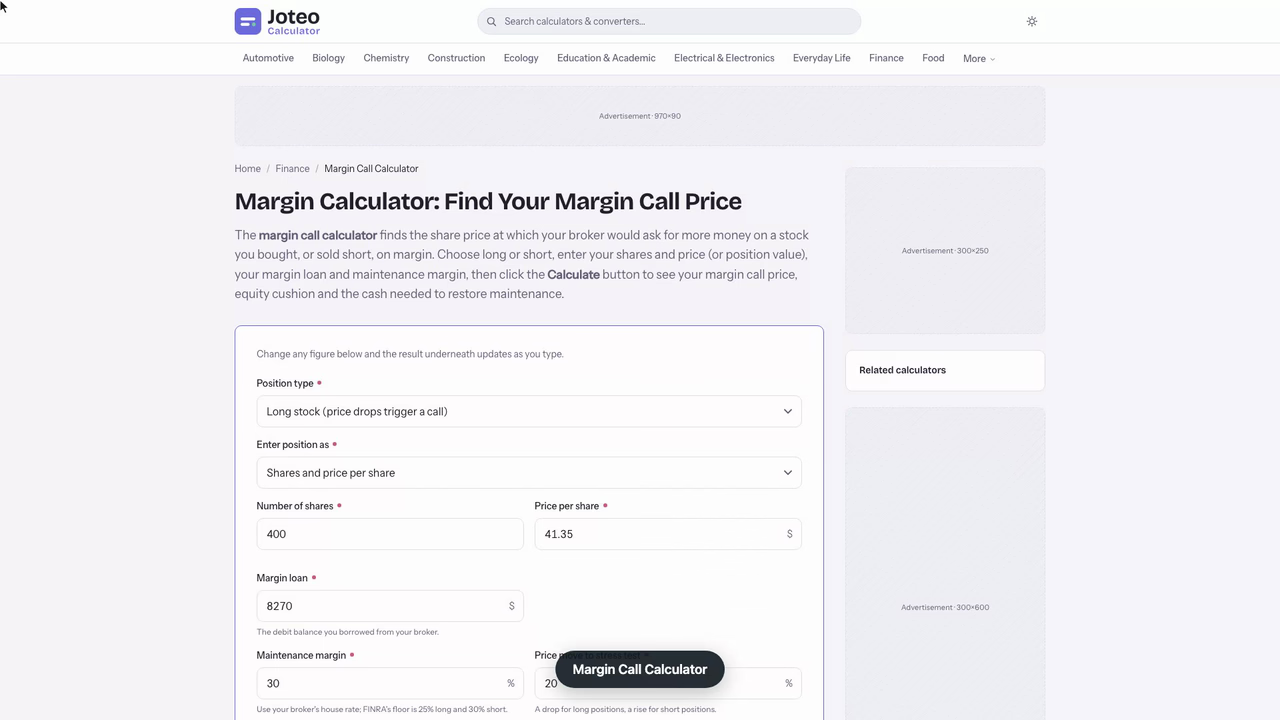
Margin Call Calculator: Find Your Trigger Price
A margin calculator needs only figures you already see on a brokerage statement. It returns the trigger price, the price at which your equity shrinks to the minimum your broker requires, and it shows how much of your loan the position still covers. The inputs below suit a trading account holding whole shares and stocks long, with a margin requirement set as a percentage, and they show how much you borrow against your portfolio.
Enter Your Margin Account Details
- Type the purchase price per share and the number of shares you bought.
- Enter the margin loan, or the initial purchase price split into your cash and the debit balance.
- Add your broker's maintenance rate, because the loan per share depends on it.
- Click Calculate, then review the portfolio value, securities held and the trigger.
Read Position Value and Account Equity
Position value is shares times the current price, and account equity is that value minus the loan. Divide equity by position value and you get your equity as a percentage. The key takeaway is simple: a falling position value shrinks equity faster than it shrinks the stock, because the loan stays fixed. These margin requirements decide how much room remains.
Margin Call Price Formula for Long and Short Stock
The margin call price formula finds the price where equity equals the maintenance share of the position. Your margin call price therefore depends on exactly two ratios, the initial and the maintenance rate, and on nothing else. Past that price, the threshold is crossed and a margin call follows.
Long Position and Initial Margin
For a long position, the long margin call price uses the cash you put in at purchase, the initial margin set by Regulation T at 50% for most stock:
$$\text{Call price} = \text{Purchase price} \times \frac{1 - \text{Initial margin}}{1 - \text{Maintenance margin}}$$
An equivalent form divides the loan per share by one minus the maintenance rate.
Short Position and Maintenance Margin
For a short position the risk reverses, because a rising price hurts you. The short margin call price divides the short sale proceeds, including your deposit, by one plus the maintenance rate:
$$\text{Call price} = \text{Short price} \times \frac{1 + \text{Initial margin}}{1 + \text{Maintenance margin}}$$
FINRA's Rule 4210 sets the maintenance requirement floor at 25% for long and 30% for short stock, but house rules usually run higher, so check your house requirement before you rely on the minimum.

Worked Example With 400 Shares
Suppose you buy 400 shares at $41.35 with a 50% initial margin and a 30% maintenance rate. Position value is $16,540 and the margin loan is $8,270, which is $20.675 per share. The trigger is $20.675 ÷ 0.70 = $29.54. Run the same stock short with 300 shares and the call price becomes $41.35 × 1.5 ÷ 1.3 = $47.71. Any margin call price calculator should reproduce both figures.
| Share price | Position value | Equity | Equity % | Cash needed |
|---|---|---|---|---|
| $41.35 | $16,540 | $8,270 | 50.0% | $0 |
| $36.00 | $14,400 | $6,130 | 42.6% | $0 |
| $29.54 | $11,816 | $3,546 | 30.0% | $0 |
| $28.00 | $11,200 | $2,930 | 26.2% | $430 |
| $25.00 | $10,000 | $1,730 | 17.3% | $1,270 |

Testing a Margin Call Price With a Margin Calculator
Dana holds 650 shares bought at $23.18 and wants to know whether to add to the position before earnings. The broker's house rule is a 35% maintenance margin, not the 25% FINRA floor, and the stock now trades at $19.40. The decision is whether the margin account can absorb another drop. See also our Put Backspread Calculator.
In the margin call calculator Dana enters 650 shares, $23.18, a 50% initial margin and 35% maintenance. Position value at purchase was $15,067, so the margin loan is $7,533.50. The trigger price comes back as $17.83, from $23.18 × 0.50 ÷ 0.65. Dana checks it by hand: $11.59 loan per share ÷ 0.65 gives the same $17.83.
At $19.40 equity is $5,076.50, or 40.3% of position value, so the cushion above the 35% requirement is only 5.3 points. The stock sits just 8.1% above the margin call price, which is the number to watch, because a routine earnings gap can cover that distance in one session.
| Maintenance rate | Trigger price | Cash needed at $16.00 |
|---|---|---|
| 30% | $16.56 | $253.50 |
| 35% | $17.83 | $773.50 |
| 40% | $19.32 | $1,293.50 |
The sensitivity rerun shows why the house rate matters more than the stock's story: moving from 30% to 35% lifts the trigger by $1.27. One edge case misleads here: the estimate ignores margin interest, which grows the loan each month and nudges the trigger upward, so a position held for a year needs a wider buffer than the calculator shows.
Dana decides against adding shares. Instead Dana sets aside $1,400 in cash to cover the deficit if the price reaches $16.00, and checks the margin requirement again after earnings.
Margin Level and Equity Cushion Explained
The margin level compares equity to the margin your open trades tie up, so it shows how much capital stands between you and a call. Your equity cushion is the gap between today's equity percentage and the maintenance rate. In the 400-share example the cushion at $36.00 is 12.6 points (42.6% against 30%), so risk builds as exposure to a sharp move grows, and an investor with a wide cushion can ride out normal swings in a portfolio.
Margin Call Triggers and Stop Out
A margin call is your broker's demand for more equity. Forex-style accounts define it with the formula equity ÷ used margin × 100, so $6,400 of equity against $3,200 used is a 200% level. When it keeps falling, a stop out follows, and the broker may liquidate positions without waiting, which is forced liquidation. For a stock account the matching threshold is the trigger price: at $29.54 your equity percentage equals the 30% rate. Plan for volatility, not a polite phone call.
Required Margin and Buying Power
Required margin is the collateral a trade locks, and what is left is your buying power. In the 400-share example the $8,270 loan already funds half of the $16,540 position, so each added share pulls the trigger price closer. Leverage sets how much each trade locks: higher leverage means less required margin per trade but more risk. On leveraged pairs the amount scales with lot size, while for an ETF or stock it scales with position size.
Margin Calculator Stress Test and Cash Deposit
A stress test applies a price drop to the stressed position and checks the equity left. The table above is one: at $28.00 your equity percentage is 26.2%, and the price sensitivity is steep, because every dollar of decline removes $400 of equity. A deposit is the main repair, and a cash deposit beats guessing. You might also find our Black Scholes Calculator useful.
Restore Equity With a Cash Deposit
The cash needed equals the loan minus stressed value × (1 − maintenance rate). At $28.00 that is $8,270 − $11,200 × 0.70 = $430, the deficit to restore maintenance. To deposit more cash usually works better than selling, because selling shrinks the position as the trigger price keeps moving. After a deep drawdown, size the cash before the broker does.

Margin Interest and Dividends
Your margin interest is added to the margin loan each month, which lifts the trigger price slowly: a month at 8% adds about $55 to the $8,270 loan and moves $29.54 to $29.73. Dividends credited to the account trim it. Neither shows in a basic estimate.
Leverage and Free Margin Safeguards
Higher leverage cuts your free margin and tightens maintenance margin buffers, because leverage multiplies every loss. A cautious investor keeps a cash buffer in the account so the price stays well above the $29.54 trigger and uses stop losses that exit before the call, not after it.
FAQs around Margin Call Calculator
1. How do you calculate the margin call price for a long position?
Divide your loan per share by one minus the maintenance margin. The same price comes from the purchase price times (1 - initial margin) divided by (1 - maintenance margin). A stock bought at $41.35 with a 50% initial margin and a 30% maintenance margin triggers at about $29.54.
2. How is a short position's margin call price different?
A short is called when the price rises. The trigger is the short sale proceeds, including your initial margin deposit, divided by one plus the maintenance margin.
3. What is the maintenance margin minimum?
FINRA Rule 4210 sets 25% for long stock and 30% for short stock, but brokers often apply a higher house rate, so use your broker's number.
4. Can my broker sell my shares without warning?
Yes. Margin agreements generally let brokers liquidate positions right away, without a call or a waiting period, when equity drops too far.
5. Is depositing cash better than selling shares to meet a call?
Usually. Cash cuts the shortfall dollar for dollar, while a sale frees only your maintenance share of the proceeds, so you must sell more than the deficit.
6. Do margin interest and dividends change my margin call price?
Yes. Accrued margin interest raises your loan and lifts the trigger price, while dividends credited to the account reduce the loan. This calculator treats the loan as fixed.
Report an issue with this page
Spotted a wrong result or unclear explanation? Report an issue or read our editorial policy.