

Graham Number Calculator: Find a Stock's Fair Value
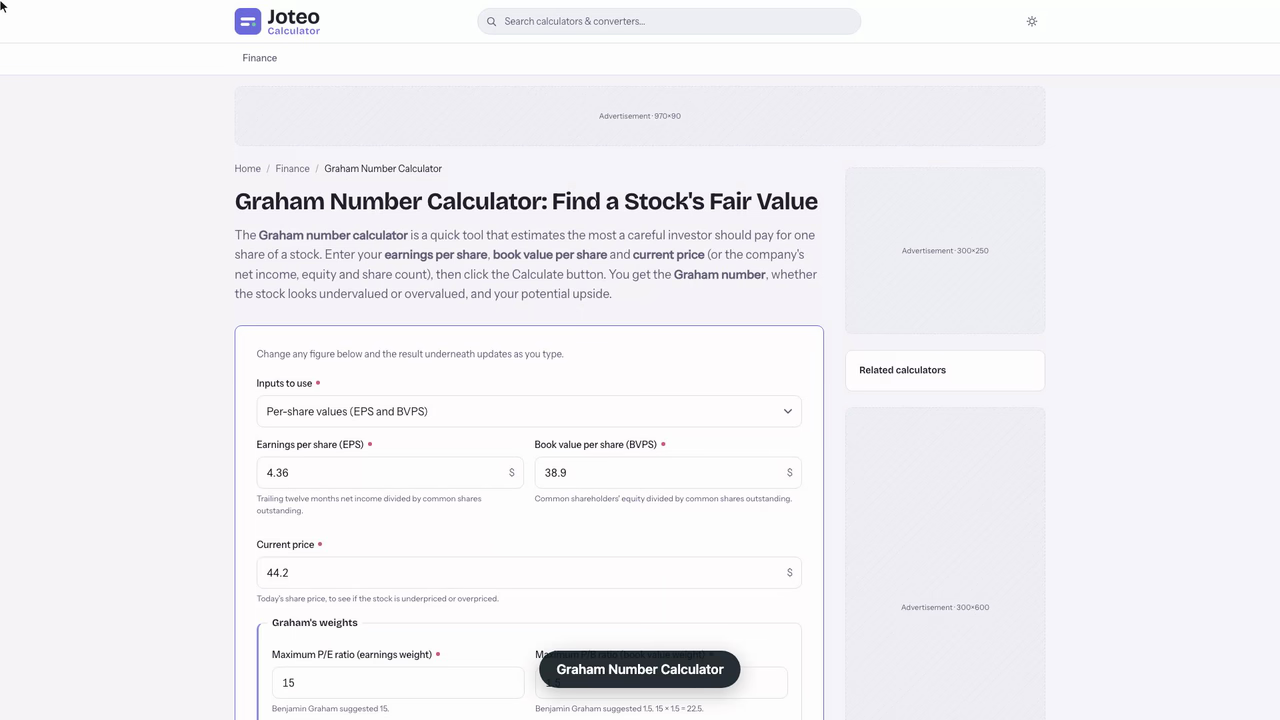
The Graham number calculator is a quick tool that estimates the most a careful investor should pay for one share of a stock. Enter your earnings per share, book value per share and current price (or the company's net income, equity and share count), then click the Calculate button. You get the Graham number, whether the stock looks undervalued or overvalued, and your potential upside. Also try the Black Scholes Calculator.
Graham Number Calculator inputs and result
Graham number
—
- Is it underpriced or overpriced?
- —
- Potential upside (+) or downside (-) vs current price
- —
- Earnings per share used
- —
- Book value per share used
- —
Table of contents
Who wrote and checked this page


Before you pay for a share, it helps to know the most a cautious buyer would pay. The Graham Number Calculator takes two inputs, earnings per share and book value per share, and runs them through the Graham formula that Benjamin Graham built for investors who hate overpaying. You get back one dollar figure per share, a conservative intrinsic value ceiling you can set against today's quote.
What the Graham Number Measures
The Graham Number is the maximum price a defensive investor should pay for a share, based only on what the business earns today and what it owns on paper. Graham described this style of fundamental value check in Security Analysis and later in The Intelligent Investor.
Benjamin Graham's Ceiling for the Defensive Investor
Benjamin Graham, often called the father of value investing, wrote for people who wanted steady results without guessing about the future. His answer was a conservative cap on price: pay modest multiples of current profit and current net assets, and you leave little room for disappointment. Warren Buffett has credited that discipline as the base of his own approach to picking stocks.
Why the Graham Number Matters for Value Investing
Value investing rests on buying a share for less than it is worth. When a stock trades below its Graham Number, the formula marks it as possibly undervalued; when it trades above, it looks overvalued by Graham's standard. The test is quick, so you can run it across many names before the market moves and before you spend hours on any one of them.
How to Calculate the Graham Number
You only need two per-share figures and one root step, which is why investors can check dozens of stocks in an afternoon. Here is Graham's formula and where each input comes from. See also our Box Spread Yield Calculator.
Graham Number Formula Explained
The Graham Number formula multiplies 22.5 by earnings per share (EPS) and book value per share (BVPS), then takes the square root of the product:
$$\text{Graham Number} = \sqrt{22.5 \times \text{EPS} \times \text{BVPS}}$$
- EPS: profit for the last year divided by the share count
- BVPS: equity on the books divided by the same share count
- The constant: Graham's fixed weight that turns both figures into a price
The square root brings the result back to dollars per share, so the Benjamin Graham formula gives you a reasonable valuation you can read straight against a quote.

Why 22.5 Joins the PE Ratio and PB Ratio
Graham wanted a price to earnings ratio no higher than 15 and a price to book ratio no higher than 1.5. Multiply the two limits and you get the 22.5 multiplier. That means the formula also works as a single test: a stock passes when its PE ratio times its PB ratio stays within that same limit, even if one ratio is a little above its own limit.
Finding EPS and Book Value Per Share
Both inputs come from a company's financial statements:
- Net income for the trailing twelve months (TTM) is on the income statement, and most filings also print earnings per share there
- Shareholders' equity, the book value of the business, is on the balance sheet
- Divide each one by the outstanding shares to get the per share figures
Use the same share count for both, and use common equity only, leaving out preferred stock.
Worked Example: A Mid-Cap Packaging Company
Say a packaging company reported $218 million of earnings over the last four quarters, holds $1,945 million of common equity and has 50 million shares outstanding. The current stock price is $44.20.
| Input or result | Value |
|---|---|
| EPS ($218M ÷ 50M shares) | $4.36 |
| Book value per share ($1,945M ÷ 50M shares) | $38.90 |
| 22.5 × 4.36 × 38.90 | 3,816.09 |
| Graham Number (square root) | $61.77 |
| Share price | $44.20 |
$$\sqrt{22.5 \times 4.36 \times 38.90} = \sqrt{3{,}816.09} \approx 61.77$$
The stock's fair value by this measure is $61.77, so the $44.20 price leaves a potential upside of about 39.8%. The ratio check agrees: a PE of 10.1 times a PB of 1.14 gives 11.5, well under the limit.

Reading Your Graham Number Calculator Result
The Graham Number Calculator gives you a fair value per share. What matters is the gap between that figure and the stock price you would actually pay.
What a Good Graham Number Looks Like
A good Graham Number sits above the price you can buy at, because that gap is your cushion. There is no "bad" result as such, only a bad price to pay for it. Two cases deserve care:
- The formula needs positive net income and positive equity, or there is nothing to take the root of
- A result just above the price leaves almost no room if a bear market or a sharp drawdown arrives
Treat the result as a first estimate of the fair value of a stock, not a target price.
Margin of Safety Against the Market Price
Graham's margin of safety is the discount between value and price. In the example, ($61.77 − $44.20) ÷ $61.77 gives a margin of about 28.4%. Many value buyers want at least 20 to 33% before they commit. If a stock you like trades above its figure, you can wait, or dollar cost average into a smaller investment over time.

Running Graham's Formula on a Regional Insurer Before Buying
I'm deciding whether a small regional property insurer at $26.35 clears Graham's one-third margin of safety. The short answer: on reported numbers it clears easily, but once I clean up the inputs it only just scrapes past, at 33.4%. You might also find our Beta Stock Calculator useful.
The annual report gives reported earnings of $2.87 a share and book value per share of $31.46. I enter those two figures first. The Graham number comes back at $45.07, a 41.5% discount, and the ratio check passes too: 9.18 times earnings and 0.84 times book multiply to 7.69, far under Graham's limit.
That looked too easy, so I read the notes. $0.41 of those earnings came from selling the old head office, which won't happen again. I rerun with normalized earnings of $2.46 and the value drops to $41.73. Then I stress the other input. An insurer's book value includes its bond portfolio at current prices, and my own estimate is that a one-point rise in yields would cut about $3.18 a share from equity. With book at $28.28, the third run gives $39.56.
| Run | Earnings a share | Book a share | Graham number | Discount at $26.35 |
|---|---|---|---|---|
| Reported | $2.87 | $31.46 | $45.07 | 41.5% |
| One-off gain removed | $2.46 | $31.46 | $41.73 | 36.9% |
| Plus bond stress | $2.46 | $28.28 | $39.56 | 33.4% |
I check the last line by hand: 22.5 × 2.46 × 28.28 = 1,565.30, and its root is 39.56. Two-thirds of that is $26.38, so the stock sits just three cents under the price where Graham's one-third cushion runs out.
What stands out is that the two adjustments together moved the answer more than any change in the share price would. For an insurer or a bank, the book value input swings with bond yields, so I wouldn't trust a single run here. I place a limit order at $26.35 for half a position and plan to rerun the numbers after the next quarterly filing, when the bond marks update.
Using the Graham Number in Stock Valuation
Most investors use the Graham Number for stocks as a first filter, then do full stock due diligence on whatever passes. It should never be the only reason to buy.
Screening for Undervalued Stocks
As a screening tool, it works well in bulk. Many a stock screener lets you list companies trading below their Graham value, which turns thousands of stocks into a short list worth reading in detail.
Pairing It With Other Valuation Methods
The formula ignores cash generation, so check it against other valuation methods. A discounted cash flow model looks at free cash flow, an EBITDA multiple suits firms with heavy depreciation, and dividend yield shows what you are paid to wait. When several approaches point to a similar valuation, you can trust it more.
Graham's Other Criteria and Asset Heavy Industries
Graham paired the price test with others: adequate size, a strong balance of debt and assets, earnings stability, a long dividend record and some earnings growth. The number fits asset heavy, mature businesses such as utilities, insurers and industrial firms best.
Where an Intrinsic Value Shortcut Falls Short
The Graham's number test is a heuristic, not a full model, and the ben graham number shares the blind spots of its two inputs.
Built for an Era of Higher Interest Rates
Graham set his limits when interest rates and bond yields were higher and stock multiples lower. Today fewer quality firms clear them, partly because companies reinvest retained earnings in ways a balance sheet does not fully show.
Growth Companies and Intangible Assets
Growth companies earn most of their value in the future, and software or brand-driven firms hold intangible assets that barely show up in book value. The formula will flag many of these stocks as expensive even when they are sound, so investors in tech and biotech rarely lean on it.
Accounting Choices and Value Traps
A one-time gain can inflate earnings per share, and a write-down can cut book value. Use normalized earnings where you can, and remember that value traps stay cheap because the business is shrinking.
FAQs around Graham Number Calculator
1. How do I calculate the Graham number for a stock?
Divide the company's net income by its outstanding shares to get earnings per share, and divide common shareholders' equity by the same share count to get book value per share. Multiply 22.5 by both figures and take the square root of the result.
2. Why does the Graham number formula use 22.5?
Benjamin Graham wanted a defensive investor to pay no more than 15 times earnings and 1.5 times book value. Multiplying those two limits gives 22.5.
3. What is a good Graham number?
A Graham number above the current share price is the good case, because the gap suggests the stock may be undervalued. There is no bad Graham number as such, only a price that is too high to pay for it.
4. Can the Graham number be negative?
No. If earnings per share or book value per share is zero or negative, the formula has no meaningful answer, so the Graham number does not apply to loss-making companies or companies with negative equity.
5. Is the Graham number still useful today?
It still works as a quick screen for mature, asset-heavy businesses with steady earnings. Graham set his limits when interest rates were higher and valuations lower, so fewer stocks pass today, and it tends to undervalue growth companies with large intangible assets.
6. Can I change the 15 and 1.5 limits?
Yes. This calculator lets you adjust the maximum P/E and P/B weights. Raising them gives a higher fair value, so keep in mind that you are loosening Graham's original, conservative standard.
7. Should I buy a stock just because it trades below its Graham number?
No. The Graham number ignores cash flow, debt, business quality and growth, and some cheap stocks are value traps. Use it as a first filter, then check the company with other valuation methods.
Report an issue with this page
Spotted a wrong result or unclear explanation? Report an issue or read our editorial policy.