

Double Discount Calculator: Final Price After Two Discounts
The double discount calculator shows what you really pay when two percentage discounts are applied one after the other. Enter the original price, the 1st discount and the 2nd discount, then click the Calculate button to see your final price, your total savings and the effective discount, the single rate your stacked deal adds up to. Also try the Markdown Calculator.
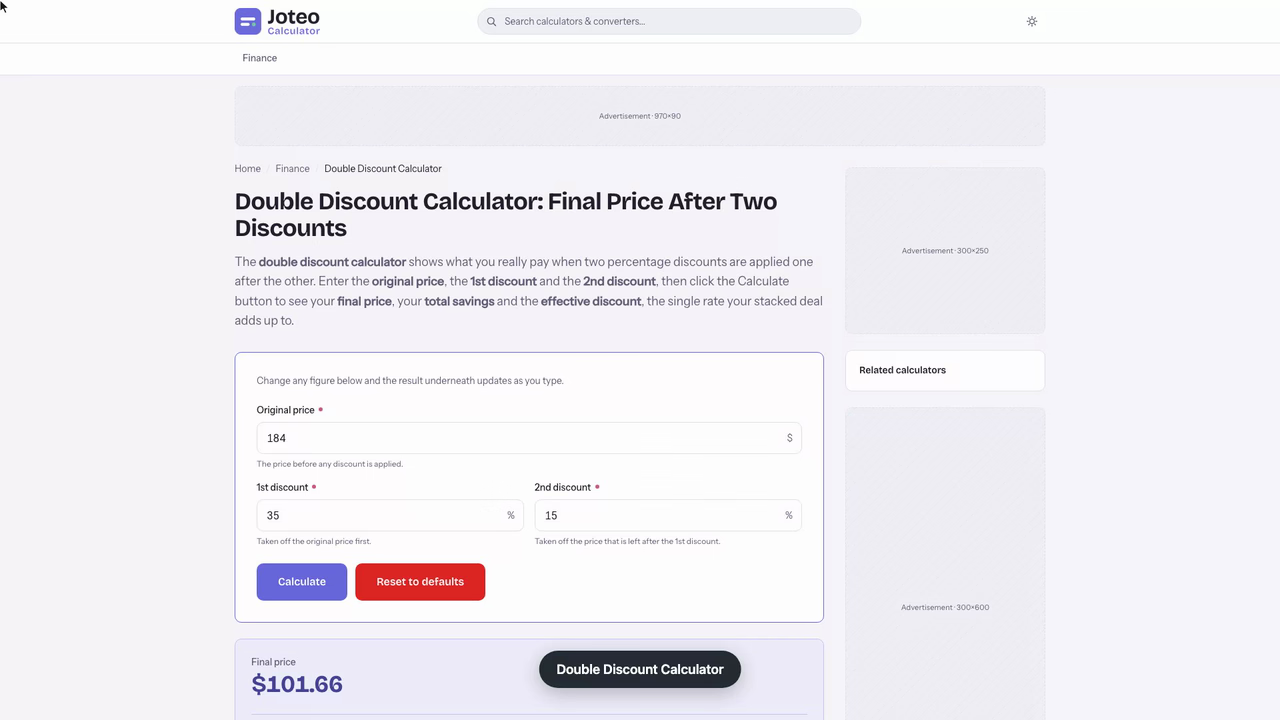
Double Discount Calculator inputs and result
Final price
—
- Total savings
- —
- Effective discount
- —
Table of contents
Who wrote and checked this page


A sign that says "35% off, then an extra 15% at the register" sounds like half off, but it isn't. This double discount calculator takes the original price and both markdowns, applies them one after the other, and shows you the final price, the dollar amount you keep, and the single discount percentage the stacked deal really adds up to. It's the quickest way to see the true reduction in the price before your next shopping trip, so you never mistake a stacked promotion for a bigger one.
How the Double Discount Formula Works
The double discount formula treats each markdown as a multiplier rather than an amount to subtract from the tag. The second cut is taken from the already-reduced amount, not from the starting figure, which is why the combined effect is always smaller than the two rates added up.
$$\text{new price} = \text{initial price} \times (1 - r) \times (1 - q)$$- r is the first discount, written as a decimal (35% becomes 0.35)
- q is the second discount, also as a decimal (15% becomes 0.15)
- \((1 - r)\) and \((1 - q)\) are the shares of the tag you still pay at each stage
Because the two factors are multiplied, you can think of the whole offer as one combined factor. Multiply \((1 - r)\) by \((1 - q)\), and the result tells you what fraction of the initial price lands on your bill. Take the difference between 1 and that factor and you have the real combined rate.
Why Two Discounts Are Not Added Together
Stacked percentages are applied sequentially, so they are not added together. After the first cut, the second rate works on a smaller base, and every point of it is worth less in dollars. Adding 35% and 15% gives 50%, yet the true reduction is 44.75%. On a big-ticket purchase that gap is real money, and it's the most common mistake shoppers make when reading store promotions.
Stackable Discounts on a $184 Jacket: A Worked Example
Say a winter jacket is tagged at $184.00. The store runs a 35% markdown on outerwear, and your loyalty email adds 15% off at the till. Here's how the numbers move through each stage:
- Convert both percentages to decimals: 0.35 and 0.15.
- Find the difference between 1 and each rate: 0.65 and 0.85.
- Multiply those two figures together: 0.65 × 0.85 = 0.5525.
- Multiply the original price by 0.5525: $184.00 × 0.5525 = $101.66, the final price you pay.
- Subtract the result from the tag to find the dollar amount saved: $184.00 − $101.66 = $82.34.
Stage by stage, the first cut removes $64.40 and leaves $119.60, and the second removes another $17.94. Your total savings come to $82.34, and the effective rate is 44.75%, not the 50% the sign implies. Had the markdowns really been a flat 50%, the jacket would cost $92.00, so the price difference between the two readings is $9.66.

Does the Order of Multiple Discounts Matter?
For multiple discounts that are all percentages, no. Multiplication doesn't care about order: $184.00 × 0.85 gives $156.40, and $156.40 × 0.65 lands on the same $101.66. Order only matters when one of the reductions is a fixed amount off. Take a $129.90 item with 20% off and a $15 discount coupon. Applying the 20% first and the $15 second leaves $88.92; applying the $15 first leaves $91.92. Taking the percentage first is $3.00 better for you, so check which order the store uses at checkout.
Cumulative Discount vs. the Headline Percent Off
The cumulative discount is the one rate that would produce the same result as the stacked pair. It's always lower than the sum of the parts, and two pairs that add up to the same headline number can land in different places. The table compares combinations on the same $184.00 tag.
| First cut | Second cut | Sum of the two | Real combined discount | You pay on $184.00 |
|---|---|---|---|---|
| 40% | 10% | 50% | 46.00% | $99.36 |
| 35% | 15% | 50% | 44.75% | $101.66 |
| 30% | 20% | 50% | 44.00% | $103.04 |
| 25% | 25% | 50% | 43.75% | $103.50 |
| 15% | 25% | 40% | 36.25% | $117.30 |
| 50% | 30% | 80% | 65.00% | $64.40 |
The pattern is worth remembering: when two offers share the same headline percent off, the more lopsided pair (one big cut, one small) always wins. An even 25% + 25% split is the weakest way to reach 50%.

Finding the Total Discount From the Combined Factor
To turn any pair into its total discount, multiply the two remaining shares, then subtract that from 1. For 40% and 10%, 0.60 × 0.90 = 0.54, and 1 − 0.54 = 0.46, or 46%. The same rate applies to every item in the promotion, so you can work it out once and read every tag in the aisle at a glance.
Checking a Double Discount on a $1,347.50 Mixer Quote
Marisol runs a small bakery and needs a 20-quart planetary mixer before the holiday orders start. The restaurant-supply dealer's quote lists the mixer at $1,347.50, with a 12% trade rate for registered businesses and a further 3.5% if the invoice is paid within 10 days. A second dealer has offered the same model at a flat 15% off. Both quotes land in her inbox on the same morning, and she has until Friday to commit.
She types $1,347.50 into the calculator as the tag, 12 as the first rate and 3.5 as the second, because the dealer applies the trade rate before the payment-terms cut. The 12% comes off first, taking the figure to $1,185.80. The 3.5% early-payment cut then applies to that reduced amount, removing $41.50 rather than the $47.16 it would take from the full tag.
- Amount due: $1,144.30
- Saved against the tag: $203.20
- Combined rate: 15.08%
That combined 15.08% is the one number the calculator gives her that the quote itself doesn't: a single rate she can set directly against the rival's flat 15%. At the other dealer, the mixer would cost $1,145.38, so the stacked quote wins, but only by $1.08. Without the calculation she would have read "12% plus 3.5%" as 15.5% and expected a much wider gap.
Next she reruns the calculation with the second rate set to 0 to see what happens if the invoice is paid late. The amount due goes back to $1,185.80, a flat 12%, and the rival dealer's flat 15% now beats it by $40.42. The stacked quote is only the better buy if she pays inside the 10-day window, so she accepts it and schedules the transfer for Thursday.
Work Backwards to the Original Price with the Double Discount Calculator
Sometimes all you have is the receipt. If you know the discounted price and both rates, divide by the combined factor to recover the starting tag:
$$\text{original price} = \frac{\text{final price}}{(1 - r) \times (1 - q)}$$With the jacket, $101.66 ÷ 0.5525 = $184.00. This check is handy when a store's paperwork only prints the new price, or when you want to confirm that the advertised "was" figure matches what you were charged. The discount amount is then the original minus the final, and dividing that by the original gives back the effective rate.
Sales Tax and VAT After the Discounted Amount
In most places, sales tax is charged after every markdown has been taken off, so it's added to the reduced figure, not to the original tag. At a 7.25% rate, the $101.66 jacket rings up at $109.03. The same logic generally holds for VAT on prices shown before tax, though rules differ by country and product, so check your receipt when the exact tax matters.
Triple Discount and Two Levels of Discounts in Real Sales
Stacked offers turn up everywhere: a clearance markdown plus a member code, a seasonal sale plus a store-card bonus, or a Black Friday deal that layers a sitewide rate on top of an already reduced item. Stores like two levels of discounts because the headline number looks generous while the real reduction stays smaller, which protects their margin. The same rule stretches to a triple discount: multiply by a third \((1 - r_3)\) factor, and the combined rate shrinks further again compared with the simple sum.
- Stackable discounts are applied one after the other, never summed.
- A half price offer is only exactly 50% when it's a single cut, not a stacked pair.
- Store-wide codes often exclude items that already carry a markdown, so read the terms before you count on the second cut.
- An online double discount calculator removes guesswork when you compare prices across stores.
When a Percent Off Calculator or Regular Discount Calculator Fits Better
If there's only one markdown, a regular discount calculator or a percent off calculator is all you need. For three layers, the triple discount calculator uses the same multiply-the-shares method with one extra rate. For two percentage cuts on one product or service, stick with this tool: enter the tag and both rates, and it handles the math so each offer can be judged on what it's truly worth before you buy.
FAQs around Double Discount Calculator
1. What is the double discount formula?
New price = original price × (1 − r) × (1 − q), where r is the first discount and q is the second discount, both written as decimals. Each discount is applied to the price left after the one before it.
2. Can I add two discounts together to get the total?
No. Stacked discounts are applied one after the other, so the second rate works on a smaller amount. 35% followed by 15% takes 44.75% off in total, not 50%.
3. How do I find the total discount after two discounts?
Multiply the shares you still pay, (1 − r) × (1 − q), and subtract the result from 1. For 40% and 10%, 0.60 × 0.90 = 0.54, so the total discount is 46%.
4. Does the order of the two discounts change the final price?
Not when both are percentages, because multiplication gives the same result in any order. Order does matter when one of the reductions is a fixed amount off, such as a $15 coupon: taking the percentage first usually leaves you with the lower price.
5. How do I work out the original price from the final price?
Divide the final price by (1 − r) × (1 − q). For example, $101.66 ÷ (0.65 × 0.85) = $184.00.
6. Is sales tax calculated before or after the discounts?
In most checkouts, tax is added after every discount has been taken off, so it's charged on the reduced price. Rules vary by location and product, so check your receipt when the exact tax matters.
7. What about three discounts in a row?
The same method works: multiply the original price by one more (1 − r) factor for the third discount. The total saving grows with each extra discount, but it always stays below the simple sum of the rates.
Report an issue with this page
Spotted a wrong result or unclear explanation? Report an issue or read our editorial policy.