

Coupon Rate Calculator: Coupon Payment and Bond Pricing Calculator
The coupon rate calculator shows how much interest a bond pays you each period. Enter your bond's face value, the annual coupon rate and the payments per year, then add the years to maturity and the market rate to price it. Click the Calculate button to get your coupon payment, yearly interest, total interest, bond price and current yield. Also try the Coupon Payment Calculator.
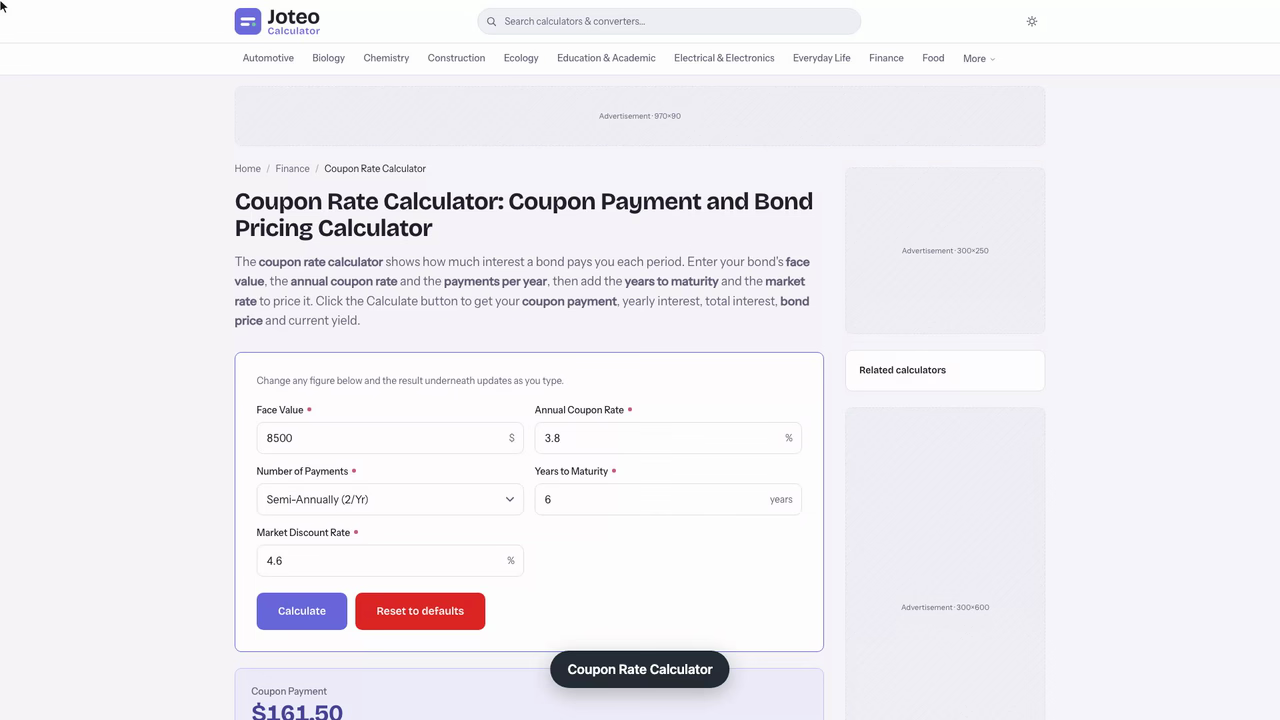
Coupon Rate Calculator inputs and result
Coupon Payment
—
- Annual Coupon Income
- —
- Total Interest to Maturity
- —
- Bond Price
- —
- Price vs Face Value
- —
- Current Yield
- —
Table of contents
Who wrote and checked this page


Use this coupon rate calculator to turn a bond's face value and interest rate into a clear coupon payment, or work backwards from a known payment to the rate. Enter the face value, the rate and the number of payments per annum, and you see what your bond pays each period until maturity, so you can compare it with what the wider market offers.
Coupon Rate Calculator Formula
Every bond states its annual coupon rate as a percentage of its face value. To find each payment, multiply the face value by that rate and divide by how many times a year the bond pays:
$$CP = F \times \frac{r}{m}$$
Here \(CP\) is the payment per period, \(F\) is the face value, \(r\) is the rate as a decimal and \(m\) is the number of payments per annum. To go the other way, rearrange it into \(r = \frac{CP \times m}{F}\). Most corporate bonds pay twice a year, so \(m = 2\), while many bonds issued in Europe pay once.
Coupon Payment Meaning for Bondholders
A bond is a financial instrument that represents a debt obligation: a loan from you to the issuer. In return, the issuer sends payments to every one of its bondholders over the bond's lifetime and repays the principal at the end. These periodic interest payments are the coupon payment, and they are why bonds are grouped under fixed income.
Governments and corporations both borrow this way to raise capital, and investors accept a modest, predictable payment instead of the uncertain upside of stocks, which is why the rate you enter fixes the payment you receive. Many investors buy bonds for steady income, and other investors hold bonds as a lower risk counterweight to stocks. A coupon payment does not change after issue, even when prices move.
Interest Payments Example: Face Value and Maturity
Say you hold a bond with a face value of $8,500 and a 3.8% annual rate, paid twice a year, with six years left to maturity. The semiannual payment is \(8{,}500 \times 0.038 \div 2 = \$161.50\), or $323.00 a year. Check it in reverse: \(323 \div 8{,}500 = 3.80\%\).
| Input | Value |
|---|---|
| Face value | $8,500 |
| Coupon value per payment | $161.50 |
| Payments per year | 2 |
| Total interest to maturity | $1,938.00 |
Over twelve payments, this investment returns $1,938.00 in interest, and the bond itself returns $8,500 at maturity. Bonds with the same rate but a longer term simply pay more times.

Checking Periodic Interest Payments on a $6,250 Bond
I'm deciding whether a nine-year corporate bond with a $6,250 face value is worth buying. The listing shows only a semiannual payment of $117.19, not the rate, so I run the calculator's formula backwards: \(117.19 \times 2 \div 6{,}250 = 3.75\%\). That is the number to compare against the roughly 4.35% I assume similar bonds pay today (a figure I picked for this walkthrough, not a quote).
Once the 3.75% rate is confirmed, the next question is price: with the rate below the market, the price must fall below face value. Entering 4.35% as the discount rate with 18 half-year periods gives $5,973.21, or 95.6% of face value. Recomputing by hand, 18 payments of $117.19 total $2,109.42, and discounting each one agrees with the calculator to the cent.
| Market rate | Price | Versus face value |
|---|---|---|
| 4.00% | $6,132.91 | -$117.09 |
| 4.35% | $5,973.21 | -$276.79 |
| 4.85% | $5,753.43 | -$496.57 |
The sensitivity rerun is the useful part: half a point of extra market rate takes $219.78 off the price. For me the number to watch is the market rate, not the payment, because the payment never moves. My decision is to bid no more than $5,973.21, and to walk away if quotes need me to pay above $6,132.91, where the bond's return falls under 4%.
One caveat the formula hides: if I buy 74 days into a 182-day payment period, the seller keeps 74/182 of that $117.19 payment, about $47.65, and I owe it on top of the price. The calculator's answer is a clean price, so I budget for that extra amount before wiring funds.
Bond Pricing Calculator Logic: Discount Rate and Bond Price
The coupon fixes your cash flow, but the price you pay depends on the discount rate. A bond pricing calculator takes the present value of every payment plus the face value, discounted at today's market interest rates, because waiting for future cash flows has an opportunity cost:
$$P = CP \times \frac{1-(1+i)^{-n}}{i} + \frac{F}{(1+i)^{n}}$$
With \(i = 2.3\%\) per half-year and \(n = 12\), our bond has a bond price of $8,146.97, about 95.8% of face value. Investors demand more than the coupon, so they pay less.

Par, Premium and Discount Bonds
A bond priced at its nominal value sits at par. Sold below it, the bond is sub-par and trades at a discount, which gives you a capital gain if you hold to maturity. Above par means a premium, which happens when the coupon beats the market. Our example trades at a discount since the 4.6% rate is above its 3.8% rate, so the rate you enter decides whether a bond sits at, above or below face value.
Yield to Maturity and Zero-Coupon Bond Differences
The yield to maturity is the discount rate that equates price and cash flows, and it is the figure bonds are compared on. A zero-coupon bond pays no interest, so the payment this tool shows is $0 and its whole return is the gap between price and face value. Longer maturity raises duration, which makes bonds more sensitive to interest rates.
Coupon Value Risks: Credit Rating and Interest Rates
A fixed payment cannot protect you from every risk, though the rate you enter stays the same throughout. When interest rates rise, price volatility pushes the market value of existing bonds down while your payment stays put, and the longer the duration, the larger that fall. The issuer's credit rating matters too: a downgrade raises the chance of default, which puts the payment itself at risk, a lesson sovereign debt crises have repeated.
- Call provision: the issuer may repay early, ending your payments.
- Supply and demand: heavy demand lifts a bond's price above face value, though the payment you collect is unchanged.
- Reinvestment: payments must be put to work at the current market rate.
FAQs around Coupon Rate Calculator
1. How do I calculate a bond's coupon payment?
Multiply the face value by the annual coupon rate, then divide by the number of payments per year. An $8,500 bond at 3.8% paid twice a year pays $161.50 each time.
2. How do I find the coupon rate from a payment?
Multiply one payment by the number of payments per year and divide by the face value. A $161.50 semiannual payment on $8,500 gives 3.80%.
3. What is the difference between coupon rate and yield?
The coupon rate is fixed against face value when the bond is issued. Yield depends on the price you pay, so it moves as the bond's market price changes.
4. Why does the bond price differ from the face value?
Price is the present value of every future payment at the current market rate. A market rate above the coupon rate pushes the price below face value, and a lower one pushes it above.
5. Does the coupon payment change when interest rates change?
No. The payment is set at issue and stays the same until maturity. Only the bond's market price and your yield on a new purchase change.
6. What does a zero-coupon bond pay?
It pays no periodic interest. You buy it at a discount to face value and your whole return is the difference when it matures.
Report an issue with this page
Spotted a wrong result or unclear explanation? Report an issue or read our editorial policy.