

Coupon Payment Calculator: Bond Coupon Rate & Payments
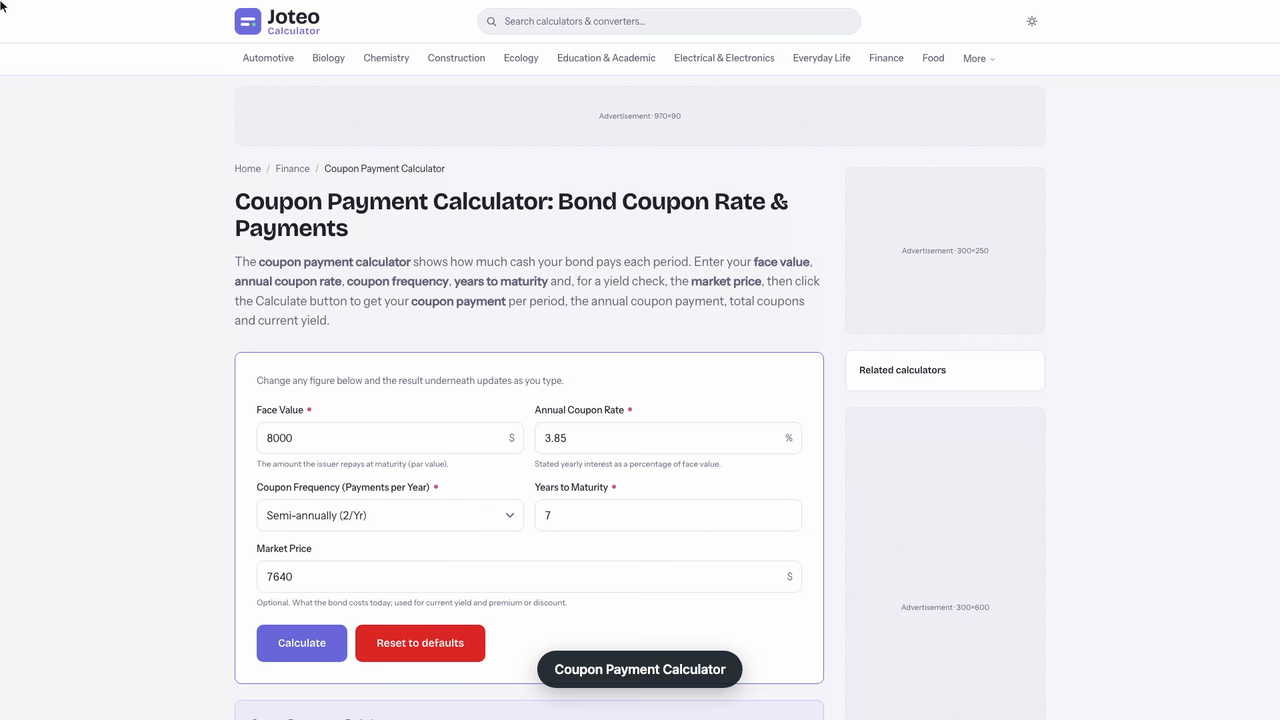
The coupon payment calculator shows how much cash your bond pays each period. Enter your face value, annual coupon rate, coupon frequency, years to maturity and, for a yield check, the market price, then click the Calculate button to get your coupon payment per period, the annual coupon payment, total coupons and current yield. Also try the Coupon Rate Calculator.
Coupon Payment Calculator inputs and result
Coupon Payment per Period
—
- Annual Coupon Payment
- —
- Number of Coupon Payments to Maturity
- —
- Total Coupons to Maturity
- —
- Current Yield
- —
- Price Relative to Par
- —
- Trades at
- —
Table of contents
Who wrote and checked this page


Use the coupon payment calculator to see how much cash a bond pays you each period, based on its face value and coupon rate. Enter both, choose how often the bond pays, and you get the amount per period and per year. This guide shows the math behind every bond investment payout, so you can confirm the answer yourself and judge whether the income fits your plan.
How the Coupon Payment Calculator Works
The coupon payment (CP) calculator needs three entries: the face value, the coupon rate and the number of payments per annum. It multiplies the first two, divides by the third, and shows what each coupon puts in your account. Investors usually run it before buying, because the payout schedule affects how soon your cash arrives.
Face Value and Annual Coupon Rate
Type the face value first, the amount repaid at the end. Then add the coupon rate; your face value turns that rate into a dollar amount, so a bigger bond earns more from the same rate.
Coupon Frequency and Payment Schedule
Choose the coupon frequency next: annually, quarterly or monthly. A bond labelled semi-annual pays twice a year, so each cheque is half the yearly total. The payment frequency never changes the yearly sum, only how it is split.
What Is the Coupon Rate in a Bond Investment?
The coupon rate is the fixed interest a bond pays each year, stated as a percentage of its face value. The issuer promises it in the bond indenture, the contract behind the loan. Companies use bonds for debt financing, so every coupon is interest on money you lent. Investors treat the rate as a quick gauge of income, and because it is set at issue, it does not move when markets do. Your principal returns separately as a balloon payment at maturity.
Par Value and Maturity Date
A bond's par value is the amount it is worth at the end; a bond sold at par costs exactly that, while one sold below par costs less. The maturity date is when the issuer repays it, and the years to maturity decide how many coupons you still have left to collect. Enter that par amount as the face value in the calculator, and the time left sets how many payments its schedule holds.
Annual Coupon Rate Formula and Calculation
Every result comes from one line, where \(F\) is the face value, \(r\) the coupon rate as a decimal and \(n\) the payments each year:
$$C = \frac{F \times r}{n}$$Here C is the coupon payment per period. Multiply it by \(n\) and you get the annual coupon payment, \(F \times r\), which is the coupon per period added up over twelve months. Divide that yearly figure by the face value and you recover the rate, which is how any coupon rate calculator works backwards from a known payment.
Worked Example With a Bond Calculator
Say you buy a bond with an $8,000 face value, a 3.85% rate and 7 years to maturity, paid semiannually. The calculator multiplies 8,000 × 0.0385 and returns $308.00 a year. Split in two, each payment is $154.00. Over 14 periods you collect $2,156.00 in coupons, and the $8,000 comes back at the end, which makes the total return easy to see. Run the bond calculator again with a 4.10% rate and the yearly figure becomes $328.00, so each extra quarter point adds $20.00 to a bond of this size.
| Payments per year | Schedule | Each payment | Yearly total |
|---|---|---|---|
| 1 | Annually | $308.00 | $308.00 |
| 2 | Semiannually | $154.00 | $308.00 |
| 4 | Quarterly | $77.00 | $308.00 |
| 12 | Monthly | $25.67 | $308.00 |
A Retiree Checks the Coupon Per Period on a $12,500 Bond
Marguerite wants her bond income to cover a $600 yearly insurance premium, so she opens the coupon payment calculator before buying. She enters a face value of $12,500, a coupon rate of 4.35% and four payments a year. The tool returns a yearly coupon of 12,500 × 0.0435 = $543.75, or $135.94 each quarter. That is $56.25 short of her $600 goal.
Her first move is to solve for the size she needs: 600 ÷ 0.0435 = $13,793.10. Bonds come in $1,000 steps, so she reruns the numbers at $14,000 and gets $609.00 a year, or $152.25 a quarter, which clears the premium with $9.00 to spare. At $13,000 the result is only $565.50, so the bigger bond is the one to buy.
Next she checks the price. The dealer quotes $12,060 for the $12,500 bond, which scales to about $13,507 for the $14,000 one. Its current yield is then 609 ÷ 13,507 = 4.51%, above her own 4.50% minimum. The number to watch here is that gap: it is only 0.01 of a point, and the price ceiling where the yield falls to 4.50% is $13,533, so a slightly higher quote sinks the deal.
She also compares offers. If the same $14,000 bond carried a 4.10% rate instead, the yearly coupon would be $574.00, which is why she checks rates across dealers before choosing.
One caution she notes: choosing twelve payments a year gives $45.31 each time, and twelve of those add up to $543.72, three cents under the yearly figure, because each payment is rounded. For a larger bond the rounding grows, so she trusts the annual figure for planning and the per-period figure only for her budget calendar.
Reading Your Interest Payment Against Current Yield and Yield to Maturity
A payment alone does not say whether a bond is a good buy, so compare it with the price. The current yield divides the yearly coupon by the market price. If your bond trades at $7,640, that is 308 ÷ 7,640 = 4.03%, above the 3.85% rate, because it sells at a discount. At a market price of $8,420, a premium, the current yield drops to 3.66%.
The yield to maturity goes further. It adds the gain or loss between price and face value across the remaining years, so it captures your full annual return. Treat the current yield as a snapshot of the income potential, and the longer-horizon measure as the bigger picture, keeping risk and the rest of your portfolio in mind.
Market Yield, Bond Price and the Interest Earned
The calculator's payment stays at $308.00 a year, but what the bond sells for does not. When the interest rate climbs, prices fall. A fixed coupon is worth less once new bonds pay more, so buyers demand a lower price until the market yield matches the required return. That yield is the rate used to discount every future coupon into present value. Rising market interest rates therefore cut the bond price, while your annual interest payment stays the same. What changes is the interest earned relative to what you paid, and the interest-rate risk you carry. If a bond like yours were priced to give a market yield of 4.60%, buyers would pay less than $8,000 for it, because its $308.00 payment is smaller than the $368.00 a new bond of equal size would pay.
Limits of a Bond Calculator
Treat this tool as a planning check for plain fixed-rate bonds. It does not read live prices, and it ignores the flat price, the quote that leaves out the accrued coupon, so the cash you settle with can differ.
A bond calculator also assumes the borrower pays every coupon on time. It cannot price default risk, and a callable bond can be redeemed early, which cuts off the remaining coupons. Before you rely on any bond calculator figure, compare it with the prospectus and with the market yield on similar bonds.
Accrued Interest Between Coupon Dates
Buy between payment dates and you owe the seller the accrued interest that has built up since the last coupon. The tool does not add it, so check your broker's confirmation.
Zero-Coupon Bond and T-Bill Cases
A zero-coupon bond pays nothing along the way, so the result is zero, and a T-bill is quoted at a discount instead of paying a coupon.
FAQs around Coupon Payment Calculator
1. How do you calculate a bond's coupon payment?
Multiply the face value by the annual coupon rate, then divide by the number of payments per year. A bond with an $8,000 face value and a 3.85% rate pays $308.00 a year, or $154.00 twice a year.
2. What is the difference between the coupon rate and the current yield?
The coupon rate is fixed at issue and applies to the face value. The current yield divides the annual coupon by today's market price, so it moves whenever the price moves.
3. How does coupon frequency change the payments?
It changes how the yearly coupon is split, not the yearly total. Semi-annual bonds pay half the annual coupon twice a year, quarterly bonds pay a quarter four times a year.
4. What is a bond's face value or par value?
It is the amount the issuer repays at maturity and the base on which every coupon is calculated. A bond that trades at par costs exactly its face value.
5. Does the calculator include accrued interest?
No. It shows the coupon for a full period. If you buy between payment dates you also pay the seller the interest that has built up since the last coupon.
6. Can I use it for a zero-coupon bond or a T-bill?
A zero-coupon bond has a 0% rate, so the result is zero because the whole return comes from buying below face value. T-bills are quoted at a discount instead of paying a coupon.
7. Why is the current yield different from the coupon rate?
When a bond sells at a discount the current yield is above the coupon rate, and at a premium it is below it, because the same coupon is divided by a different price.
Report an issue with this page
Spotted a wrong result or unclear explanation? Report an issue or read our editorial policy.