

Lifetime Earnings Calculator: Total Pay Until Retirement
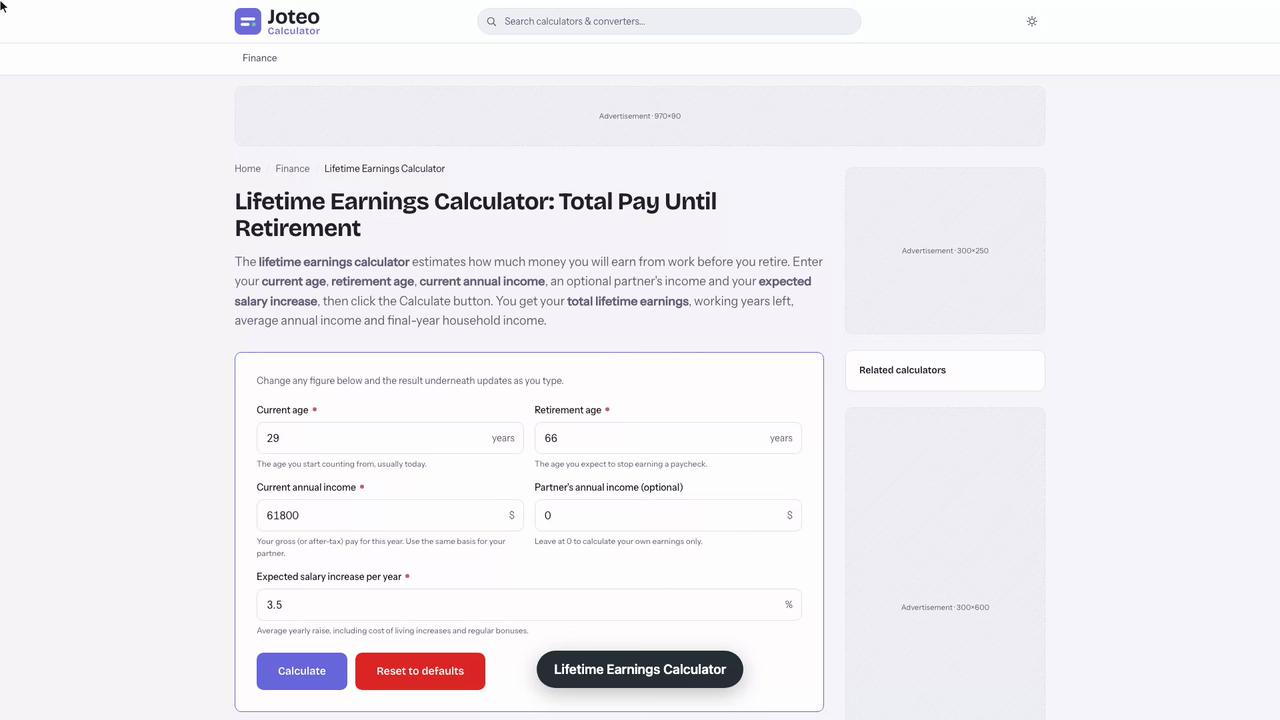
The lifetime earnings calculator estimates how much money you will earn from work before you retire. Enter your current age, retirement age, current annual income, an optional partner's income and your expected salary increase, then click the Calculate button. You get your total lifetime earnings, working years left, average annual income and final-year household income.
Lifetime Earnings Calculator inputs and result
Total lifetime earnings
—
- Working years left
- —
- Average annual income during working life
- —
- Household annual income in the final working year
- —
Table of contents
Who wrote and checked this page


Most people never add up their paychecks from first job to last, and the total is usually far larger than they expect. This lifetime earnings calculator takes your age, your salary and your expected yearly pay increase and shows how much income you will earn before retirement, plus your average lifetime earnings per year. Seeing your full earning capacity over your working life puts every spending and savings choice in context and leads to better financial decisions.
What Lifetime Income Means Across Your Working Life
Your earnings from work are the sum of every annual paycheck from today until the day you stop working. It is not your net worth and it is not what you will have saved; it is the gross amount of salary and wages that passes through your hands over your career. Seeing your lifespan wages as one number turns a vague idea, your life's work, into a figure you can plan around. Lifetime earnings from an employer are only one part of the picture, but for most households they are the largest part.
Internal and External Factors Behind Earning Potential
Your earning potential depends on two groups of forces. Internal factors are personal: your education level, skills, job performance and the hours you choose to work. External factors sit outside your control: economic development, the state of the economy, your region and the pay norms in your industry. The calculator cannot predict either group, so the growth rate you enter is where you build them in.
How the Lifetime Earnings Calculator Works
Every lifetime earnings calculation needs only four inputs. The results are estimates that assume your pay grows by the same percentage every year.
Current Age, Retirement Age and Years Left
- Current age: the age you start counting from, usually today.
- Retirement age: the age you expect to retire and stop drawing a paycheck.
- Years left: your remaining working years, found as \(n = \text{retirement age} - \text{current age}\). This is the same as your years to retirement.
Lifetime Earnings Formula and Expected Salary Increase Per Year
Because each year's pay is last year's pay plus a raise, your salaries form a geometric series. The lifetime earnings formula adds that series in one step:
$$L = S \times \frac{(1+g)^{n}-1}{g}$$
Here \(S\) is your current salary, \(g\) is the expected salary increase per year as a decimal and \(n\) is your years left. If \(g = 0\), the formula reduces to \(L = S \times n\). The salary increase per year is compounded, so a small change in \(g\) has a large effect on annual growth in the final decade. A good starting point is the typical wage increase in your field, or the national average if you have no better figure.
Worked Example: A $61,800 Current Salary
Say you are 29, earn a current salary of $61,800 and plan to retire at 66, which gives 37 working years. With 3.5% yearly pay growth, your total cumulative earnings come to $4,539,696. That works out to an average annual salary of $122,694, and your pay in the final year reaches $213,226. Without any raises you would earn $2,286,600; pay growth adds the other $2,253,096, and your yearly pay only passes its average at age 49. You may never be a millionaire in the bank, but you will earn several million over your career. The table shows how much your cumulative earnings depend on the growth rate:
| Pay growth per year | Total over 37 years |
|---|---|
| 2% | $3,339,317 |
| 3% | $4,089,567 |
| 3.5% | $4,539,696 |
| 4% | $5,049,199 |
| 5% | $6,280,619 |

Turning a Part-Time Hourly Wage Into a Yearly Salary
If you work part-time, convert your hourly wage first. Multiply your rate per hour by your hours per week, then by 52. At 24 hours per week and $27.50 an hour, that is $660 a week, or $34,320 a year. Divide by 12 for a monthly salary of $2,860. Enter the yearly figure as your salary.
Weighing Two Job Offers by Earning Potential
I am 41 and deciding whether to leave a $78,450 role with steady 2.8% raises for an offer paying $71,900 on a pay scale that has averaged 4.6% a year. The pay cut is what I notice first; the question is whether it pays back before I stop working. Answer: the lower offer comes out $526,822 ahead over my career, but only if its raises hold.
I enter my age, 41, and a retirement age of 67, the Social Security full retirement age for anyone born in 1960 or later, which gives 26 years. Then I run each job separately:
| Scenario | Total to 67 | Pay at 66 |
|---|---|---|
| Stay: $78,450 at 2.8% | $2,942,763 | $156,466 |
| Move: $71,900 at 4.6% | $3,469,585 | $221,320 |
| Move, raises slow to 3.6% | $3,012,112 | - |
To check the tool, I add the yearly salaries in a spreadsheet; both totals match to the dollar. The new job's yearly pay passes the old one at 47, but the cumulative lifetime earnings gap does not close until the end of year 11, at 52. That second date matters more: for the first decade I am behind in actual cash.
Next I solve for the break-even raise. The offer only wins if its pay grows faster than 3.43% a year. Slowing it to 3.6% leaves a margin of just $69,349, so the growth assumption, not the starting pay, decides this. If I plan to stop at 60, the edge shrinks to $177,356, since the late, high-pay years are where the faster raises pay off.
The caveat a quick search won't give you: this is pre-tax pay only. A 1-point difference in employer 401(k) match or a weaker pension can erase a gap this size, so my next step is to ask HR for the last five years of actual scale increases and compare benefits before I sign.
Ways to Grow Your Earning Power
Three levers move your lifetime earning total: a higher starting salary, faster pay growth and more years of work. Overtime counts too if it is regular enough to include in your yearly pay. In the example, retiring at 69 instead of 66 lifts the total to $5,225,207, while stopping at 63 cuts it to $3,921,405.

Cost of Living Increases, Raises and Bonuses
Treat the growth rate as all your expected pay growth combined: cost of living increases, merit raises and bonuses you can count on. In the example above, a $3,000 raise today lifts the total from $4,539,696 to $4,760,070, an extra $220,374, because every later increase compounds on the higher base. That is the get-rich-slow effect: a pay bump you negotiate early is worth far more than the same bump at 60.
Partner's Annual Income and Household Income
To plan as a couple, add your partner's annual income or your spouse's pay as a second line. If your partner earns $48,200 with the same 3.5% growth, their share is $3,540,669 and your combined household income over 37 years reaches $8,080,366. Use gross annual income for both people, or after-tax income for both, but never mix the two.
Total Earnings in Today's Dollars
The lifetime earnings calculator reports future, nominal dollars. To see your total earnings in today's dollars, strip out rising prices by using a real growth rate: \((1+g)/(1+i) - 1\). At 2.5% inflation, the $4,539,696 shrinks to about $2,737,902 of today's buying power. Choose that rate with the same care as your pay growth rate; conservative safe harbor figures, such as the U.S. Department of Labor's 3% inflation, 3% contribution growth and 7% investment returns, make a sensible default.
Don't confuse this earnings total with a retirement projection. That kind of tool starts from a 401(k) account balance, grows it with each annual contribution into a projected account balance, and converts the result into lifetime income streams paid monthly, much like a pension. A monthly lifetime income figure answers "what will my savings pay?" Your earnings total answers "how much will pass through my hands?", and the share of it you save is what builds that account balance.

Why Lifelong Earnings Shape Retirement Planning
Knowing your lifelong earnings changes how you see everyday choices in personal finance:
- Saving a share: setting aside 10% of $4.5 million is about $454,000 before any growth, a concrete target for retirement planning.
- Spending and budget: a lifestyle that absorbs every pay increase leaves little disposable income for your financial goals.
- Insurance: the earnings your family would lose if you died early help you size life insurance.
Re-run the calculator after every pay rise or job change; the updated total resets the amount you aim to set aside in the first bullet.
FAQs around Lifetime Earnings Calculator
1. How is lifetime earnings calculated?
Subtract your current age from your retirement age to get the years left, n. Then add up your salary for each of those years, raising it by your expected increase every year. In one step: lifetime earnings = salary × ((1 + g)^n − 1) ÷ g, where g is the yearly increase as a decimal. With no raises it is simply salary × n.
2. What factors affect my lifetime earnings?
Internal factors such as your education level, skills, job performance and hours worked, and external factors such as the economy, your industry and where you live. In the calculator they all show up through your starting salary, your raise rate and how long you keep working.
3. Should I enter gross or after-tax income?
Either works, as long as you use the same basis for you and your partner. Gross income shows the full amount you earn; after-tax income gives a closer picture of what you can actually spend or save.
4. How do I find my annual salary if I work part-time or by the hour?
Multiply your hourly rate by your hours per week, then by 52. For example, 24 hours a week at $27.50 an hour is $660 a week, or $34,320 a year. Enter that yearly figure as your income.
5. Can lifetime earnings be negative?
No. The lowest possible result is zero, which is what you get if you earn nothing or are already at your retirement age.
6. Is the result in today's dollars?
No, it is in future (nominal) dollars, because each year's pay includes the raises you entered. To estimate the total in today's dollars, enter a real raise rate instead: (1 + raise) ÷ (1 + inflation) − 1, for example about 0.98% for 3.5% raises and 2.5% inflation.
7. Does the calculator include investment returns or savings?
No. It adds up the pay you earn from work only. How much of that you save and invest, and what it grows to, is a separate retirement savings calculation.
Report an issue with this page
Spotted a wrong result or unclear explanation? Report an issue or read our editorial policy.