

Impermanent Loss Calculator: Estimate IL vs Holding
Use this impermanent loss calculator to see how much a liquidity pool position trails simply holding your tokens. You enter the initial price and new price of each token, your initial investment and the pool type, then click the Calculate button to get your impermanent loss %, dollar loss, HODL value and LP value.
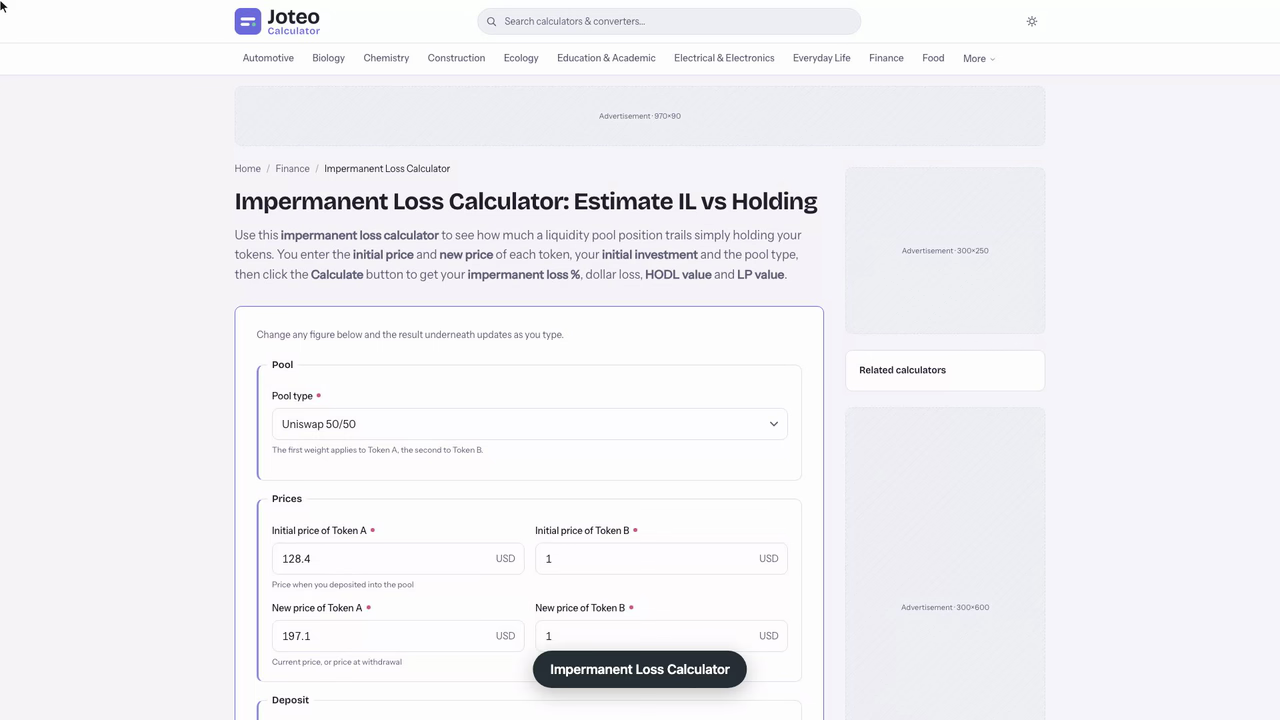
Impermanent Loss Calculator inputs and result
Impermanent loss
—
- Impermanent loss (USD)
- —
- HODL value (just holding)
- —
- LP value (without fees)
- —
- Relative price ratio
- —
- Token A in pool (change)
- —
- Token B in pool (change)
- —
- Estimated fees earned
- —
- Net return vs initial investment (LP value + fees)
- —
Table of contents
Who wrote and checked this page


Use this impermanent loss calculator to see how far a liquidity pool position falls behind a plan to simply hold the tokens. Enter your deposit price and today's price, and you get your IL percentage, dollar gap and pool value. The maths follows Uniswap, so only the token price move drives the answer, because fees are left out.
What Is Impermanent Loss in a Liquidity Pool?
Impermanent loss is the value gap between your pool position and the same assets left in your wallet. Each liquidity provider makes a deposit of two crypto tokens and receives LP tokens as a receipt. When one token moves against the other, the DeFi pool shifts your mix and the position ends up worth less than holding. Other liquidity providers face the same shift.
How an Automated Market Maker Rebalances Your Tokens
An automated market maker (AMM) such as SushiSwap or PancakeSwap has no order book. Traders swap against the pool, and arbitrageurs buy whichever token looks cheap until the pool matches the wider market. That forces the pool to rebalance: it sells the token that is rising and collects more of the one that lags. That forced rebalancing creates the gap this calculator measures against holding.
Using the Impermanent Loss Calculator
Enter the initial price and current price of Token A, then your initial investment. Token B is treated as a stablecoin worth $1. Click Calculate and the results show IL as a percentage change against holding, plus your net return. The Holdings Comparison block lists the HODL value beside the pool value, and Token Rebalancing shows how many of each token you now own.
Token Price Inputs and Pool Settings
Each token price you type captures the market at two moments: deposit and now. Under Pool Settings, choose the pool weighting. A 50/50 split is standard, while Balancer also offers 80/20, where a lower weightage on a token trims its exposure. A fee tier such as 0.3% only matters once you add fees back.

The Impermanent Loss Formula for a 50/50 Pool
For a 50/50 pool priced against a stablecoin, the maths collapses into one equation, where r is the price ratio, today's price divided by your deposit price:
$$IL = \frac{2\sqrt{r}}{1 + r} - 1$$
A negative answer means the pool trails holding. Only the size of the move matters, so a price ratio of 2 and one of 0.5 both give −5.72%.
Constant Product Formula and the Price Ratio
Behind that equation sits the constant product formula, \(x \times y = k\). Because the constant product k never changes, a rising token price forces the pool to hold fewer units of that token. The price ratio tells you how far the pool has drifted from your deposit.
How to Calculate Impermanent Loss Step by Step
Say you deposit $8,600 while Token A trades at $128.40 and Token B is USDC at $1. Half goes to each side: 33.489 Token A and 4,300 USDC. Token A later reaches $197.10, the same maths works for ETH, and you want your dollar loss:
- Price ratio: r = 197.10 ÷ 128.40 = 1.535
- Hold the tokens: 33.489 × $197.10 + $4,300 = $10,900.70
- IL = 2√1.535 ÷ 2.535 − 1 = −2.25%
- Pool value: $10,900.70 × 0.9775 = $10,655.14, a gap of $245.56
The pool now holds 27.030 Token A and 5,327.57 USDC. Fees worth about $246 would close that gap, so your investment breaks even on returns only past that mark.

IL at Each Price Change: Price Divergence Table
This table shows how fast divergence loss builds with each price change in a 50/50 pool. Volatile pairs reach the lower rows more often than calm ones, so volatility does most of the damage.
| Price change | Price ratio (r) | IL |
|---|---|---|
| −30% | 0.7 | −1.57% |
| −10% | 0.9 | −0.14% |
| +10% | 1.1 | −0.11% |
| +30% | 1.3 | −0.85% |
| +60% | 1.6 | −2.70% |
| +150% | 2.5 | −9.65% |
| +500% | 6.0 | −30.01% |

Is Impermanent Loss the Same When Price Rises or Falls?
Nearly. Whether a token climbs or sinks by the same ratio, the gap matches, so the size of the move counts, not its direction. Your withdrawal timing then decides whether that gap is locked in.
Checking IL for a 41-Day ETH/USDC Pool Position
I'm deciding whether to leave $15,230 in an ETH/USDC pool or pull it out after 41 days. The answer I need first: IL is −0.83%, or $145.72, so fees must beat that gap before I can call the position a win.
I enter ETH's deposit price, $2,614.80, then today's price, $3,388.25, then $15,230. The calculator returns a price ratio of 1.2958, a HODL value of $17,482.49 and a pool value of $17,336.78. By hand: 2 × √1.2958 ÷ 2.2958 − 1 = −0.0083, so the match holds.
The reference I compare against is the 0.30% Uniswap v2 swap fee. To cover $145.72 on $15,230 in 41 days, the pool must earn about 8.5% annualised in fees, so I check the pool's trailing fee APR against that line. If it sits above 8.5%, I stay; below it, I withdraw.
Then I rerun the calculator with one input changed, ETH's current price:
| ETH price today | Price ratio | IL | Dollar gap |
|---|---|---|---|
| $2,090.00 | 0.799 | −0.62% | $85.51 |
| $3,388.25 | 1.296 | −0.83% | $145.72 |
| $4,000.00 | 1.530 | −2.22% | $427.12 |
What stands out is the price ratio, not my gain: ETH falling 20% costs less than ETH rising 30%, because a ratio of 0.799 is the same distance from 1 as 1.25, which is closer than 1.296. My opinion: the number to watch is the price ratio, since it decides the percentage, while fees decide whether it matters.
One caveat: this model assumes a 50/50 constant-product pool and ignores gas. If I had added through a v3 range, the answer here would understate my exposure, so I would not trust it on its own. In that case I would compare the range's own fee history before choosing.
When Divergence Loss Becomes Permanent
Your loss stays unrealized while the tokens sit in the pool. Once you withdraw your liquidity at a different ratio, it is realized and permanent. If the ratio returns to your deposit level first, the gap closes to zero. Many volatile tokens, even a Bitcoin pair, never return, so treat the unrealized figure as a real cost.
Fee Income vs IL: Trading Fees and APY
Fee income decides whether a position profits. Pools pay out trading fees, usually quoted as an APY with compounding or an APR without it, and heavier trading volume lifts the yield. An APY helps only if it beats the dollar gap above, otherwise your net return stays negative.
Does Impermanent Loss Apply to Stablecoin Pools?
Barely. In stablecoin pools both tokens sit near $1, so r stays close to 1 and IL almost vanishes. That is why you should pair stable assets when protecting capital matters most.
Uniswap v3 and Concentrated Liquidity
Uniswap v2 spreads liquidity across every price, as modelled here. Uniswap v3 lets you place concentrated liquidity in a range, which earns more fees per dollar but magnifies IL when the price leaves that range. This calculator does not model ranges.
How to Reduce Impermanent Loss
To reduce impermanent loss, pick pools whose tokens move together, lower your risk with low-volatility pairs, and avoid withdrawing during violent swings. Weigh each pool's fee income against its IL before adding liquidity.
Impermanent Loss Protection, Yield Farming and Pool Choice
Some platforms sell impermanent loss protection, and yield farming or staking rewards can offset the gap, though those rewards carry their own protocol risk. Treat any reward as a bonus and rerun the calculator before you commit more.
FAQs around Impermanent Loss Calculator
1. What is impermanent loss?
Impermanent loss is the gap between what your tokens are worth inside a liquidity pool and what the same tokens would be worth if you had simply held them in your wallet. It appears when the price ratio of the pooled tokens moves away from the ratio at deposit.
2. How do you calculate impermanent loss?
For a 50/50 constant-product pool, divide the new price ratio by the starting one to get r, then use IL = 2 × √r ÷ (1 + r) − 1. This calculator also handles weighted pools by comparing the pool's geometric value to your hold value.
3. Is impermanent loss the same if the price goes up or down?
Only the size of the price ratio change matters in a 50/50 pool. A token that doubles and one that halves both produce the same loss, about 5.72%.
4. Does this calculator include trading fees?
The impermanent loss and LP value figures exclude fees. The estimated fees and net return use your pool fee and days in the pool with a simple assumption that daily volume equals 0.1% of your deposit, so treat them as a rough guide.
5. When does impermanent loss become permanent?
The loss stays unrealized while your tokens remain in the pool. It becomes permanent when you withdraw at a price ratio different from the one at deposit; if the ratio returns first, the loss disappears.
6. Do stablecoin pools have impermanent loss?
Very little. When both tokens hold near the same price, the price ratio stays close to 1 and the loss is almost zero, which is why stablecoin pairs are popular for reducing IL.
7. Does a weighted pool like Balancer 80/20 reduce impermanent loss?
Usually yes for the same price move, because a lopsided pool keeps more of its value in the heavier token. Choose the Balancer presets or a custom weightage to compare.
Report an issue with this page
Spotted a wrong result or unclear explanation? Report an issue or read our editorial policy.