

Forward Premium Calculator: Spot vs Forward Rate %
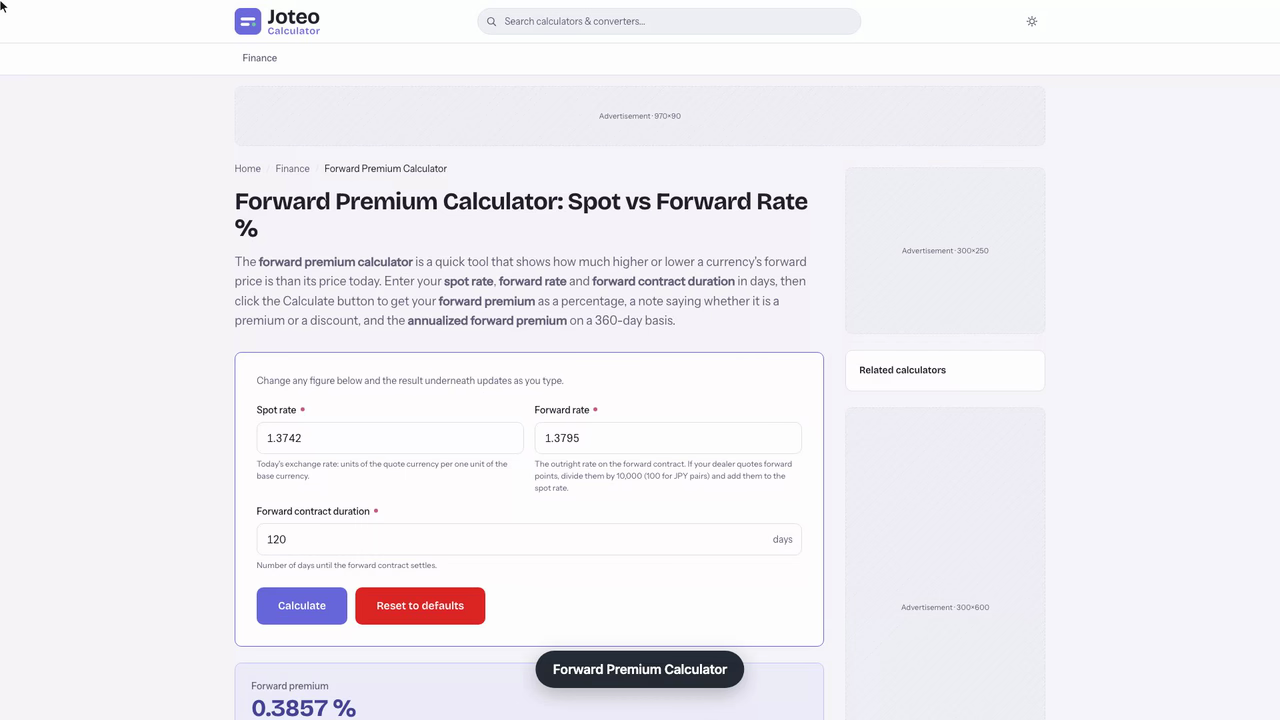
The forward premium calculator is a quick tool that shows how much higher or lower a currency's forward price is than its price today. Enter your spot rate, forward rate and forward contract duration in days, then click the Calculate button to get your forward premium as a percentage, a note saying whether it is a premium or a discount, and the annualized forward premium on a 360-day basis.
Forward Premium Calculator inputs and result
Forward premium
—
- Premium or discount
- —
- Annualized forward premium
Who wrote and checked this page


Before you book a currency hedge or quote a price to an overseas buyer, you need to know whether the market is pricing future money above or below today's. This forward premium calculator takes the spot rate, the forward rate and the number of days in the deal, and returns the period premium and its yearly equivalent in one pass, so you can see how much of the gap between two currencies is simply their interest rates at work.
What the Forward Premium Calculator Shows You
Enter the current spot price, the forward price your bank or broker quotes, and the contract length in days. The forward premium calculator then reports the percentage gap between those two prices over the life of the deal, plus an annualized figure you can compare across different tenors.
A currency forward is a private, over-the-counter agreement to exchange a set amount of one currency for another at a predetermined exchange rate on a future date. Nothing changes hands until settlement, which is why businesses use forwards to lock in costs and revenues months ahead.
Spot Rate vs Forward Rate in Forex
The spot rate is the price for delivery now (in practice, two business days out for most pairs in the forex market). The forward rate is the price agreed today for a later delivery date. The two almost never match, because holding one currency instead of the other for 30, 90 or 180 days earns a different amount of interest.
Both prices are quoted the same way: units of the quote currency per one unit of the base currency. In USD/CAD, the US dollar is the base and the Canadian dollar is the quote, so a spot exchange rate of 1.3742 means one US dollar costs 1.3742 Canadian dollars.
Forward Premium or Discount: Reading the Sign
When the forward price sits above spot, the base is trading at a premium and the result is positive. When it sits below, the base trades at a forward discount and the result is negative. A negative premium and a discount are the same thing described from opposite sides of the pair.
Textbooks often read the sign as what the market expects: a premium is taken as a hint that the future spot rate will be higher, so the base should appreciate toward the forward price, while a discount hints that it will depreciate. Treat that as a reading of the pricing, not a forecast. The puzzle section further down shows why.
How to Calculate Forward Premium with the Forward Premium Formula
The math takes three short steps. You only need the first one if your dealer quotes points instead of an outright price.
- Get the outright price. Divide the forward points by 10,000 (or 100 for yen pairs) and add them to the spot rate of the currency pair.
- Measure the gap. Subtract the spot rate from the forward rate and divide by the spot rate. The result is the forward premium for the length of the forward contract, the percentage the exchange rate moves between today and delivery. Positive means the base currency is at a premium; negative means a discount.
- Annualize it. Multiply by the day-count basis and divide by the days to maturity. That gives the annualized forward premium, the annual equivalent of step two, so you can compare contracts on any currency and any tenor.
Written out, the three steps look like this:
$$F = S + \frac{\text{points}}{\text{scale}}$$
$$\text{Premium}_{\text{term}} = \frac{F - S}{S} \times 100$$
$$\text{Premium}_{\text{annual}} = \text{Premium}_{\text{term}} \times \frac{\text{basis}}{\text{days}}$$
Here \(F\) is the forward price, \(S\) is spot, the scale is 10,000 for most pairs and 100 for yen pairs, and the basis is 360 or 365 depending on the market convention for that pair.
Step 1: Turn Forward Points into an Outright Forward Rate
Forex dealers rarely quote a full forward price. They quote forward points, also called swap points: the small number you add to or subtract from spot. Points move slowly while spot moves every second, so quoting them keeps the forward stable on the screen. Divide the points by the scale to convert them into rate units, then add them to spot.
Step 2: Find the Period Premium
The raw percentage covers only the contract term. A 0.39% result on a 120-day deal is not the same size as 0.39% on a 30-day deal, so on its own it can mislead you when you compare quotes of different lengths. That is why the tool always shows the annualized figure next to it.
Step 3: Annualize with the Day-Count Basis
Scaling to a year uses simple interest, not compounding: you multiply by basis over days. Most money markets use a 360-day basis; sterling and a handful of others use 365. The annualized premium lets you line a 30-day quote up against a 180-day quote, and against the gap between the two interest rates behind the pair.
Worked Example: Annualized Forward Premium on USD/CAD
Suppose your company in Toronto owes a US supplier in 120 days and wants to know what locking the dollar price will cost. Your bank shows these numbers:
The Inputs You Enter
- Spot USD/CAD: 1.3742
- Forward points for 120 days: +53
- Contract term: 120 days, 360-day year
The outright price is 1.3742 + 53 ÷ 10,000 = 1.3795. The gap for the term, and then its yearly equivalent, are:
$$\frac{1.3795 - 1.3742}{1.3742} \times 100 = 0.3857\%$$
$$0.3857\% \times \frac{360}{120} = 1.1570\%$$
Because the result is positive, the US dollar is at a premium against the Canadian dollar: you pay 5,300 more Canadian dollars for every US$1,000,000 you buy forward instead of at spot. On a 365-day year the annualized figure would be 1.1731%, so always check which basis your bank uses before you compare two quotes.

Checking the Quote with Covered Interest Parity
Covered interest parity says the forward price should equal spot adjusted for the two deposit rates over the term:
$$F = S \times \frac{1 + r_{q} \times t}{1 + r_{b} \times t}$$
With a US dollar deposit rate of 3.25%, a Canadian dollar rate of 4.41% and \(t = 120 \div 360\), the parity price is 1.3742 × 1.01470 ÷ 1.01083 = 1.3795, the same as the dealer's quote. The annualized result of 1.157% is also close to the 1.16-point interest rate differential, which is the quick sanity check: the annualized figure should sit near the rate gap. A large mismatch usually points to bid/ask spreads, the cross-currency basis, or a typo in your inputs.
| Days to maturity | Forward points | Outright forward | Premium for the term | Annualized (360-day) |
|---|---|---|---|---|
| 30 | +13 | 1.3755 | 0.0946% | 1.1352% |
| 60 | +26 | 1.3768 | 0.1892% | 1.1352% |
| 90 | +40 | 1.3782 | 0.2911% | 1.1643% |
| 120 | +53 | 1.3795 | 0.3857% | 1.1570% |
| 180 | +78 | 1.3820 | 0.5676% | 1.1352% |
| 360 | +154 | 1.3896 | 1.1207% | 1.1207% |
Points grow with time, but the annualized column barely moves, because it is the same rate gap applied over a longer stretch. The small wobble comes from rounding each forward to four decimal places and from the compounding built into the parity formula.

Forward Premium in Practice: A Winery Prices a 93-Day US Dollar Receipt
A Barossa Valley winery has just invoiced a Californian distributor US$486,250 for a container of shiraz, payable in 93 days. The finance manager wants the Australian dollar amount fixed now, so she asks two banks for AUD/USD forwards against a spot of 0.6584.
Bank A quotes −14.3 points; Bank B quotes −16.1 points. She runs each quote through the calculator with the same spot, 93 days and a 365-day basis, because Australian dollar money markets count actual days over 365. The calculator returns a forward premium of −0.2172% for Bank A and −0.2445% for Bank B over the 93 days: the Australian dollar trades at a forward discount in both quotes.
| Quote | Outright | 93-day result | Annualized | AUD received |
|---|---|---|---|---|
| Bank A, −14.3 | 0.65697 | −0.2172% | −0.8524% | 740,140.34 |
| Bank B, −16.1 | 0.65679 | −0.2445% | −0.9597% | 740,343.18 |
Both results are negative, so the Australian dollar sits at a discount, which suits her: a lower forward price means more Australian dollars for each US dollar she sells. Before choosing, she checks both against parity using the 3-month BBSW rate of 4.18% and a 3-month term SOFR of 3.36% from her bank's rate sheet. Parity puts the outright at 0.65704, or −0.8107% a year. Bank A sits about 4 basis points from that line; Bank B is about 15 away, in her favour.
A deviation in her favour costs her nothing, so she books with Bank B. The receipt is now fixed at A$740,343.18, which is A$1,810.37 more than converting at spot today and A$202.84 more than Bank A offered. She files the parity figure with the trade ticket so the auditor can see why the quote furthest from parity was the one taken.
Why Interest Rates Drive the Currency Forward Premium
Picture two deposits. If you could borrow the lower-yielding currency, convert into the higher-yielding one, earn the extra interest and fix the conversion back at today's forward, you would pocket a risk-free profit. Currency trading desks close that gap instantly by pricing the higher-yielding side at a discount in the forward market.
Interest Rate Parity and the No-Arbitrage Link
That is interest rate parity: the forward price keeps the two deposits in equilibrium over the investment horizon, whichever side you call your domestic currency. The domestic interest rate and the foreign interest rate enter the formula directly, which is why the premium tracks the interest rate gap so closely and why a quote far from parity rarely survives for long.

Which Currency Trades at a Forward Discount
The rule is short: the currency with the higher interest rate trades at a discount forward, and the one with the lower rate is trading at a premium. In the example above, the Canadian dollar pays more, so the US dollar is at a premium in the USD/CAD forward. Flip the pair around to CAD/USD and the same quote shows the Canadian dollar at a discount instead.
The Forward Premium Puzzle and What It Means for You
If a forward premium were an unbiased forecast, a high-yield currency should fall by roughly the rate gap over the contract. Research by Eugene Fama and others found the opposite tends to happen: high-yield currencies often hold steady or even rise. This is the FAMA puzzle, and it is one reason carry trades exist. The practical lesson for you is that the premium measures funding cost, not where the price will end up.
Forward Points and the Point Scale Behind the Forward Premium
The calculator divides the forward points you enter by the point scale before it computes the premium, so picking the right scale for your pair is the one input that can shift the result by a factor of 100. A pip is the smallest standard price step in a forex quote. On most pairs that is the fourth decimal, so one pip equals 0.0001 and forward points are counted in the same units. On yen pairs it is the second decimal. The divisor you use depends on the pair:
- EUR/USD: US dollars per euro, quoted to four decimal places, so the point scale is 10,000.
- GBP/EUR: euros per pound, also divided by 10,000.
- USD/CAD: Canadian dollars per US dollar, divided by 10,000.
- USD/JPY: yen per dollar, quoted to two decimals, so JPY pairs are divided by 100.
Handling JPY Pairs
Take USD/JPY at 147.62 with a 60-day quote of −71 points. Divide by 100, not 10,000: the forward is 147.62 − 0.71 = 146.91. The result is −0.4810% for the term, or −2.8858% annualized on 360 days. The dollar sits at a discount here because US rates are well above Japanese rates. Using the wrong divisor would make the answer 100 times too small, which is the most common input slip on yen crosses.
Points Versus Percentage Terms
Some study guides call the gap measured in points the forward trading premium: for the USD/CAD case it is 53 points. Others express the percentage in basis points instead, so 0.3857% becomes about 38.6. Keep the units straight: pips measure price, while basis points measure a percentage of that price.
Who Uses a Forward Premium or Discount Calculation
Anyone who has to pay or receive another currency weeks from now works with these numbers, from corporate treasurers and fund investors to CFA candidates checking exam answers. Any financial instrument priced abroad, such as a foreign bond or an overseas stock, raises the same question about what the forward is charging you. A forward rate calculator, sometimes sold as a forex forward rates calculator, works in the opposite direction: it starts from spot and the two deposit rates and builds the forward price, while this tool starts from a quoted forward and tells you what premium it implies.
Importers, Exporters and Foreign Currency Exposure
Importers paying suppliers in dollars and exporters paid in euros both carry currency risk from the day they sign until the cash arrives. Most choose to hedge by booking a forward, and the annualized figure tells them the cost of that hedging in terms they can compare with their borrowing rate or profit margin. It is a core piece of risk management for international transactions, because it turns open exchange rate fluctuations into a known, budgeted number.
Forex Traders, Speculating and Carry Trades
For traders who take a view on a pair rather than cover a real payment, the premium is the cost or income of holding a position. Speculating on a currency that sits at a forward discount earns the interest gap, and that is the income a carry position relies on. A swap calculator shows the same effect as a nightly rollover in forex trading, while this tool shows it for the whole holding period in one figure.
Limits of the Annualized Premium
The forward exchange rate you see on a screen is usually an indicative mid price; financial institutions quote you a slightly worse one once their spread is added. A forward is also a derivatives contract with credit terms, so a bank may require a trading line before it deals with you. Treat the output as a mechanical conversion of a quote, not a forecast of the currency exchange rate you will actually face when the time to maturity runs out, and confirm every live quote with the foreign exchange desk or forex broker that will execute it. If you only have the two deposit rates and no dealer quote yet, run them through a forex forward rates calculator first, then bring the resulting price back here to see the premium it carries.
FAQs around Forward Premium Calculator
1. What is a forward premium?
A forward premium exists when a currency pair's forward rate is higher than its spot rate. The base currency costs more for future delivery than it does today. When the forward rate is lower than spot, the gap is called a forward discount instead.
2. How do I calculate the forward premium?
Subtract the spot rate from the forward rate, divide by the spot rate and multiply by 100. For example, a spot of 1.3742 and a forward of 1.3795 give (1.3795 − 1.3742) ÷ 1.3742 × 100 = 0.3857% for the term of the contract.
3. How is the annualized forward premium calculated?
Multiply the forward premium for the term by 360 and divide by the number of days in the contract. This uses simple interest, not compounding. A 0.3857% premium on a 120-day forward becomes 0.3857% × 360 ÷ 120 = 1.1570% a year. Some markets use a 365-day year, which gives a slightly higher figure.
4. What are forward points and how do I turn them into a forward rate?
Forward points (also called swap points) are the gap between the forward and spot rates, quoted in pips. Divide them by 10,000 for most pairs, or by 100 for JPY pairs, and add the result to the spot rate. Negative points are subtracted, giving a forward rate below spot.
5. Why does a currency trade at a forward premium or discount?
Interest rates drive it. Under interest rate parity, the currency with the higher interest rate trades at a forward discount and the one with the lower rate trades at a premium, so neither side can earn a risk-free profit by borrowing one currency and lending the other.
6. What is covered interest parity?
Covered interest parity is the no-arbitrage rule that the forward rate should equal the spot rate adjusted for the two currencies' interest rates over the contract term: F = S × (1 + r_quote × t) ÷ (1 + r_base × t). Small differences from market quotes can come from bid/ask spreads or the cross-currency basis.
7. Does a forward premium predict where the exchange rate will go?
Not reliably. The premium mainly reflects the interest rate gap between the two currencies. Studies behind the forward premium puzzle found that high-yield currencies often do not fall as much as the forward rate implies, so treat the result as a funding cost, not a forecast.
Report an issue with this page
Spotted a wrong result or unclear explanation? Report an issue or read our editorial policy.