

Alternative Minimum Tax Calculator: Estimate Your 2026 AMT
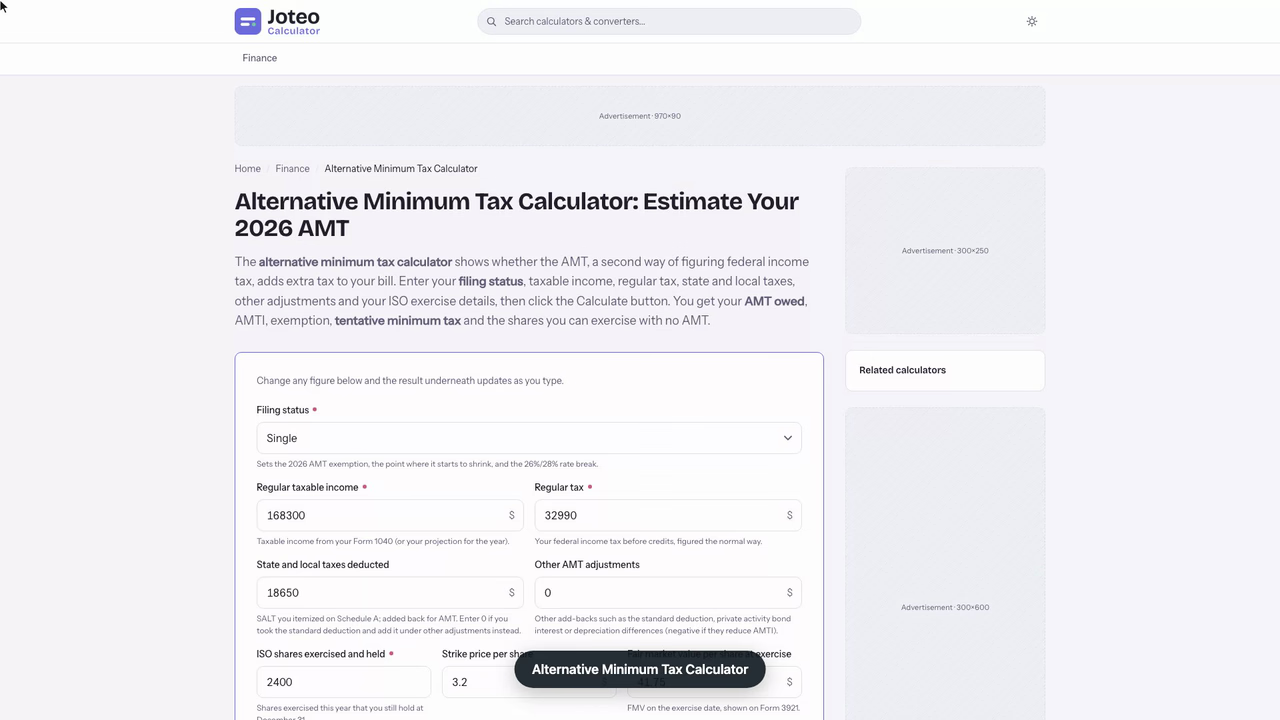
The alternative minimum tax calculator shows whether the AMT, a second way of figuring federal income tax, adds extra tax to your bill. Enter your filing status, taxable income, regular tax, state and local taxes, other adjustments and your ISO exercise details, then click the Calculate button. You get your AMT owed, AMTI, exemption, tentative minimum tax and the shares you can exercise with no AMT.
Alternative Minimum Tax Calculator inputs and result
AMT owed
—
- Tentative minimum tax
- —
- Alternative minimum taxable income (AMTI)
- —
- AMT exemption after phaseout
- —
- ISO shares you can exercise with no AMT
Table of contents
Who wrote and checked this page


Exercised stock options this year, or claimed hefty deductions on your return? This alternative minimum tax calculator reruns your numbers under the AMT rules and tells you whether that second pass costs you anything. You enter your add-backs, your exemption details and the tax you already owe, and you get back your tentative minimum tax plus the extra AMT due, if there is any.
What the Alternative Minimum Tax Calculator Measures
The alternative minimum tax is a parallel tax system that runs beside the regular tax system and the ordinary federal income tax. Under the tax law, a handful of tax benefits (exclusions, preferential deductions and favorable timing rules) can shrink what high earners owe to very little. The AMT puts a tax floor under those taxpayers by limiting the tax breaks they can claim: you figure your tax twice, once the usual way and once under the AMT's own rules, and you pay whichever figure is higher.
The calculator does that second pass for you. It rebuilds your income without the disallowed breaks, subtracts the exemption for your filing situation, applies the two AMT rates and returns the tentative minimum tax (TMT). If the TMT exceeds your regular tax, the difference is the AMT you add to your bill. If it doesn't, you owe nothing extra, and the gap between the two figures tells you how much room you have before the AMT would start to bite. The rules also reach trusts and estates, but this tool is built for individual returns.
Who Has to Calculate AMT
Very few households need to calculate AMT by hand, but the ones who do tend to share a profile. Closing tax loopholes was the original goal, yet the modern AMT mostly catches taxpayers in these situations:
- People with a high income who itemize large state and local taxes, especially in high-tax states
- Startup employees who exercise ISOs and still hold the stock on December 31
- Owners of pass-through businesses (sole-proprietorships, partnerships, LLCs and S corporations) with large depreciation deductions
- Investors who earn interest on certain municipal bonds that the AMT treats as taxable
How the AMT Got Here: 1969 to the OBBBA
Congress created the tax in 1969 after learning that a small group of wealthy households had paid no income tax at all. Because its exemption wasn't indexed for inflation for decades, bracket creep slowly pulled in middle-class filers who were never the target. The American Taxpayer Relief Act of 2012 finally tied the exemption to the price index, and the Tax Cuts and Jobs Act (TCJA) of 2017 sharply raised the exemption amounts, lifted the point where they start shrinking and repealed the corporate version for C corporations from 2018.
The One Big Beautiful Bill Act (OBBBA), signed on July 4, 2025, made the higher exemptions permanent but pulled the phase-out starting points back to $500,000 for single returns and $1,000,000 for joint returns, and doubled the reduction rate to 50 cents per dollar of excess. The result for 2026 is that more upper-middle and high-income households with a large one-time gain will see the AMT again, even though the exemption itself stays generous.
How the AMT Calculation Works, Step by Step
The IRS lays out the method in Tax Topic 556, and every AMT calculator, including this one, follows the same sequence:
- Start with the taxable income from your Form 1040.
- Add back the AMT adjustments and preference items the second system doesn't recognize. The result is your AMTI.
- Subtract your AMT exemption, which shrinks once AMTI passes the starting threshold for your status.
- Apply the 26% and 28% rates to what's left, then subtract any AMT foreign tax credit.
- Compare that figure with your regular tax. Only the excess is owed as AMT.
In formula form, with B as the AMT base, E as the full exemption and P as the point where the exemption starts to shrink:
$$\text{Exemption} = \max\big(0,\ E - 0.5 \times (\text{AMTI} - P)\big)$$ $$B = \text{AMTI} - \text{Exemption}$$ $$\text{TMT} = 0.26 \times \min(B,\ \$244{,}500) + 0.28 \times \max(0,\ B - \$244{,}500) - \text{FTC}$$ $$\text{AMT owed} = \max\big(0,\ \text{TMT} - \text{Tax}_{\text{normal}}\big)$$Alternative Minimum Taxable Income (AMTI)
AMTI is your taxable income rebuilt without the breaks the AMT doesn't allow. The biggest add-backs for most people are the SALT deduction taken on Schedule A, the standard deduction if you didn't itemize, and the bargain element on options you exercised and kept. Smaller items include slower write-offs on business assets, certain bond interest and the AMT version of a business loss. Because every add-back raises AMTI dollar for dollar, the list of items is what really decides whether you're exposed, not your headline salary.
AMT Exemption Amounts and Phaseout Thresholds for 2026
Your AMT exemption amount depends on your filing status and acts like a built-in allowance for the second system. It shrinks by half of every dollar of AMTI above the starting point, so it disappears completely at a fixed level for each status. An AMTI under the exemption threshold produces a TMT of zero.
| Filing status | 2026 exemption | Exemption starts shrinking at AMTI of | Exemption fully gone at | 28% rate applies to AMT base above |
|---|---|---|---|---|
| Single filers | $90,100 | $500,000 | $680,200 | $244,500 |
| Head of household | $90,100 | $500,000 | $680,200 | $244,500 |
| Married filing jointly | $140,200 | $1,000,000 | $1,280,400 | $244,500 |
| Married filing separately | $70,100 | $500,000 | $640,200 | $122,250 |
Once AMTI reaches the full-phaseout figure in the fourth column, there is no exemption left and every dollar of AMTI is taxed. For a married couple filing a joint return with AMTI of $1,146,800, the exemption drops by $73,400 (half of the $146,800 excess) to $66,800, leaving an AMT base of $1,080,000.
AMT Tax Rates: 26% and 28%
The normal system has seven tax brackets; the AMT has two. The first $244,500 of the AMT base is taxed at 26% ($122,250 for separate filers), and everything above it at 28%. Because 2% of $244,500 is $4,890, there's a handy shortcut once the base passes that line: TMT equals 28% of the base minus $4,890. For the joint example above, that's 0.28 × $1,080,000 − $4,890 = $297,510.
One caveat: qualified dividends and long-term capital gains keep their lower 0%, 15% and 20% rates inside the AMT, which Part III of Form 6251 handles. This calculator applies 26% and 28% to the whole base, so it will overstate the TMT for a return heavy in those items.
Worked Example: Calculate Your AMT After an Option Exercise
Suppose you file single and your 2026 Form 1040 shows $168,300 on the taxable line, after itemizing $18,650 of state levies and property tax. In March you exercise 2,400 ISOs at a strike price of $3.20 when the fair market value (FMV) is $41.75, and you keep the shares. Here's how the numbers run:
| Step | Amount |
|---|---|
| Regular taxable income | $168,300.00 |
| + State and local taxes added back | $18,650.00 |
| + ISO bargain element: 2,400 × ($41.75 − $3.20) | $92,520.00 |
| = AMTI | $279,470.00 |
| − Exemption (no reduction below $500,000) | $90,100.00 |
| = AMT base | $189,370.00 |
| TMT at 26% | $49,236.20 |
| Regular tax on $168,300 | $32,990.00 |
| AMT owed | $16,246.20 |

Your normal tax is $32,990, but the TMT comes to $49,236.20, so you'd owe $16,246.20 of AMT on top. That is roughly 49% more federal tax, triggered entirely by stock you haven't sold.

Finding the Break-Even Point
The more useful question is how many options you could have exercised for free. Without the option add-back, AMTI would be $186,950, the base $96,850 and the TMT $25,181, which is $7,809 below your normal tax. That cushion absorbs $7,809 ÷ 0.26 = $30,034.62 of extra AMTI. At a $38.55 per-share spread, that's about 779 shares. Exercising 779 options in 2026 and the other 1,621 in January 2027 keeps this year's AMT at zero and restarts the cushion next year.

Deductions and Exclusions the AMT Rules Disallow
Most of the gap between your two tax bases comes from a short, predictable list of items:
- State and local tax (SALT) deduction: fully added back, property tax included.
- Standard deduction: not allowed at all; the AMT exemption replaces it.
- Miscellaneous itemized deductions: never allowed under the second system.
- Depreciation adjustments: slower schedules on some business assets mean a smaller write-off each year.
- Tax-exempt interest from private activity bonds: becomes taxable for AMT purposes.
- Passive activity losses: recomputed with AMT figures, which often shrinks them.
- Net operating loss: the AMT version is capped at 90% of AMTI.
- ISO exercises you hold: the spread between strike and market value counts as AMTI.
Deductions Still Allowed Under AMT
Several write-offs survive both systems, which matters if you're timing a large gift or a home purchase in the same year as an option purchase:
- Charitable contributions to qualified nonprofits, on the same terms as your normal return
- Home mortgage interest on acquisition debt for a main or second home; interest on a home equity loan spent on anything other than building or improving that home doesn't qualify
- Investment interest expense, up to your net investment income
- Medical expenses above 7.5% of adjusted gross income (AGI), the same floor used on your normal return
Keep in mind that some tax credits that cut your normal bill, such as certain business credits, can't reduce the TMT, so a return with large credits can show AMT even with modest add-backs.
A December Option Decision, Run Through the AMT Calculator
It's the second week of December, and a couple filing jointly is deciding how many of 1,150 vested options to buy before year-end. Their company's latest 409A valuation puts the stock at $58.40, against a $6.85 strike. Their accountant's projection shows $312,480 of taxable earnings for 2026 and $38,900 of state income and property tax already itemized, and a Form 1040 tax of $60,191.20. The question they need answered is narrow: how many options can they buy this year before a second tax calculation overtakes that figure?
They enter those figures one by one: joint status, $312,480, the $38,900 add-back, and a gap of $51.55 per option across all 1,150 options, which comes to $59,282.50. The calculator stacks everything into AMTI of $410,662.50. That's far below the $1,000,000 point where a joint exemption starts shrinking, so the full $140,200 comes off, leaving a base of $270,462.50.
That base crosses the $244,500 line where the 28% rate begins by $25,962.50, so the TMT lands at $70,839.50. Subtract the $60,191.20 they already owe and the alternative minimum tax for buying every option now comes to $10,648.30, cash they would need by April for stock they can't yet sell.
So they rerun it, lowering only the option count. At 394 options the add-back falls to $20,310.70, AMTI to $371,690.70 and the TMT to $60,187.58, which is $3.62 under their Form 1040 figure. The AMT drops to zero.
- Buy 394 options by December 31, with no AMT for 2026.
- Buy the other 756 in the first week of January, with a fresh exemption and a fresh 26% band.
- Rerun the numbers in January with the new 409A price before committing.
Exercising ISOs and Your AMT Liability
Under the normal rules, an incentive stock options exercise creates no taxable event. The AMT disagrees: it counts the gap between your strike price and the market value on exercise day as income, even though it's only a paper gain. That's why people call it phantom income. Form 3921, which your employer sends after you buy the stock, lists the purchase date, the strike and the FMV per share, so it's the document to have open when you use the calculator.
If you sell the stock in the same year you buy it, the AMT add-back disappears, and the profit is taxed as ordinary income through your paycheck reporting instead. That sale is one of the disqualifying dispositions that forfeit the favorable treatment. Hold the stock at least one year after exercise and two years after grant, and the eventual sale triggers capital gains tax on your real cash profit instead.
If your plan allows early exercise, buying unvested stock right after grant and filing an 83(b) election within 30 days locks in a gap near zero before the stock can vest and rise. In the calculator, that shows up as an option add-back of close to $0, so the purchase leaves the result unchanged and produces no extra tax. The trade-off is paying cash up front for stock that could fall in value, so it suits people with strong conviction in their equity. Paying AMT doesn't cost you QSBS eligibility later.
The AMT Credit: Getting the Tax Back
AMT caused by timing items, like an option exercise, isn't lost. It turns into a minimum tax credit that you track on Form 8801 and claim in later years when your regular tax is higher than your TMT. The credit carries forward indefinitely until you can use it, and it usually comes back in the year you sell the stock. In the worked example, all $16,246.20 comes from the option add-back, because the state tax add-back alone wouldn't have pushed the TMT above your normal bill, so the whole amount becomes a credit. AMT caused by permanent items such as that tax add-back never generates a credit.
Using Your AMT Tax Liability Result for Tax Planning
Treat the result as a planning number. If this alternative minimum tax calculator shows AMT due, build the amount into your budget before April, raise your withholding or estimated payments so a surprise tax bill doesn't come with penalties, and decide whether to push part of the exercise into the next tax year. If it shows no AMT, the gap between TMT and your normal tax is your safe room for more add-backs this year.
A free AMT calculator is an estimate, not a filing tool. When you file, the AMT is computed on Form 6251, carried to Schedule 2 and added to your tax return. Good tax software runs the check automatically, and a tax advisor or tax professional can model moves the calculator doesn't, such as bunching deductions, maxing out pre-tax retirement accounts to lower AGI, or splitting exercises across years. If you pay for tax preparation, bring your Form 3921 and your calculator result to the appointment.
FAQs around Alternative Minimum Tax Calculator
1. How do I know if I have to pay AMT?
Figure your tax twice: once the normal way and once with the AMT add-backs, exemption and 26%/28% rates. If the tentative minimum tax is higher than your regular tax, the difference is the AMT you owe. Form 6251 and its instructions walk through the official version, and tax software runs the same check when you file.
2. What happens if I sell ISO shares in the same year I exercise them?
Selling in the same calendar year is a disqualifying disposition. The profit is taxed as ordinary income on your regular return, and there's no AMT add-back for those shares, so enter only the shares you still hold at December 31.
3. What is Form 3921?
It's the form your employer sends after you exercise incentive stock options. It lists the exercise date, the strike price and the fair market value per share, which are the three figures this calculator needs to work out the bargain element.
4. How is the AMT different from capital gains tax?
The AMT on an ISO exercise is based on a paper gain, the gap between fair market value and strike price when you exercise, even if you haven't sold anything. Capital gains tax is charged when you actually sell and is based on the cash profit.
5. Do I get the AMT back later?
AMT caused by timing items such as an ISO exercise becomes a minimum tax credit, tracked on Form 8801. It carries forward indefinitely and can be used in years when your regular tax is higher than your tentative minimum tax, often the year you sell the stock. AMT caused by permanent items such as the state and local tax add-back doesn't create a credit.
6. Does paying AMT affect QSBS treatment?
No. Paying AMT on an ISO exercise doesn't stop the stock from qualifying as qualified small business stock later; the two sets of rules apply separately.
7. How can I reduce or avoid AMT on stock options?
Use the break-even output to see how many shares you can exercise this year with no AMT, and spread larger exercises across tax years so each year gets its own exemption. Lowering AGI with pre-tax retirement contributions and timing large deductions can also help; a tax professional can model the full picture.
Report an issue with this page
Spotted a wrong result or unclear explanation? Report an issue or read our editorial policy.