

Actual Cash Value Calculator: How to Work Out Your ACV
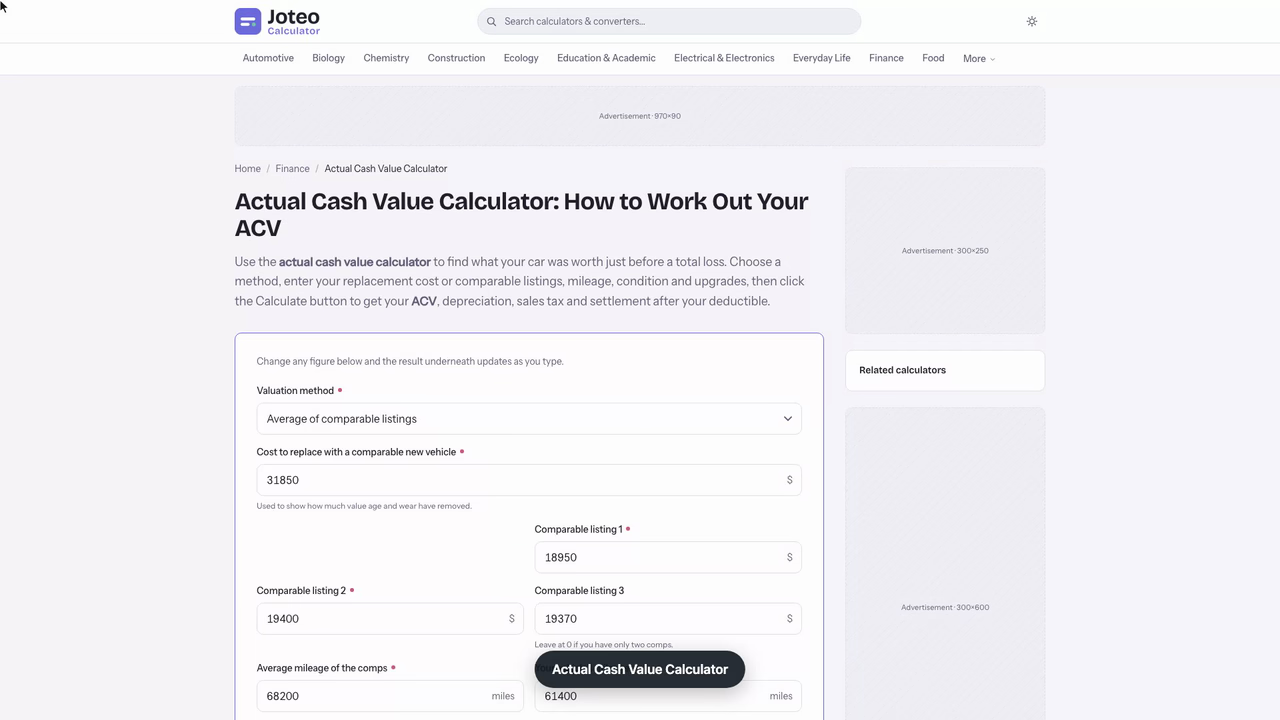
Use the actual cash value calculator to find what your car was worth just before a total loss. Choose a method, enter your replacement cost or comparable listings, mileage, condition and upgrades, then click the Calculate button to get your ACV, depreciation, sales tax and settlement after your deductible.
Actual Cash Value Calculator inputs and result
Actual cash value (ACV)
—
- Base value before adjustments
- —
- Depreciation
- —
- Mileage adjustment
- —
- Sales tax
- —
- Settlement paid to you
- —
- ACV minus insurer's offer
- —
Table of contents
Who wrote and checked this page


Use the actual cash value calculator method below to find what your car was worth the moment before a crash, theft or storm: what it would cost to replace, minus depreciation. Your insurance company uses that figure, known as ACV, to set the payout on a total loss, so knowing how it is built helps you spot a low number before you accept it. This guide walks you through the formula, a worked example and the steps to take when an offer looks wrong.
Actual cash value calculator: what ACV means for your car
The actual cash value of a car is what your specific vehicle would have sold for in your local area just before the loss. It is not what you paid, and it is not what you still owe. Most insurance companies pay a car's actual cash value under actual cash value coverage whenever you file a car insurance claim after an accident under collision coverage or comprehensive coverage, which is why an actual cash value policy pays less than coverage that rebuys a new vehicle.
Under a typical personal auto policy, the insurer starts from the car's resale worth, adjusts it, and then pays you that amount, minus your deductible, when the car is declared a loss. After an accident, the number matters most when the repair cost passes the car's worth. If you owe more on your loan balance than the car is worth, gap insurance covers the difference; the claim itself will not.
The sticker on a replacement car, what you paid and the loan figure are three different numbers. Only the first one, adjusted for age and wear, drives the total loss payout your insurance company calculates.
How to calculate ACV with a worked example
Insurers rarely publish their software, but the logic is the same everywhere: start from what it costs to replace the car, subtract what age and use have taken off, then correct for the details of your vehicle. A fair ACV calculated from three or more similar cars holds up far better than one built from a single listing. Your state may also require sales tax and registration costs on top, so check its rules before you sign off on any valuation.
Replacement cost minus depreciation
The core formula is short:
$$\text{ACV} = \text{Cost to replace} - \text{Depreciation}$$
Say a 2018 mid-size SUV would cost $31,850 to replace with a comparable new one. Three nearby listings ask $18,950, $19,400 and $19,370, which average $19,240. The gap, $12,610, is the amount lost to age (about 39.6%), the wear and tear that age and use have taken off the price.
Mileage and condition adjustments
The average of your three listings is only a starting point. Compare your car with them and adjust line by line, as in this example:
| Step | Amount |
|---|---|
| Average of three comparable listings | $19,240.00 |
| Mileage adjustment (61,400 vs. 68,200 miles on the comps) | +$408.00 |
| Condition adjustment (scuffed rear bumper) | -$350.00 |
| Upgrades and maintenance (new tires) | +$420.00 |
| Adjusted ACV | $19,718.00 |
| Sales tax at 6.5% | +$1,281.67 |
| Title and registration charges | +$145.00 |
| Deductible | -$750.00 |
| Settlement paid to you | $20,394.67 |
The mileage line reflects 6,800 fewer miles at $0.06 per mile, a rate chosen for this example. Your insurer's rate will differ, which is why you should ask for the line-by-line report.
Comparing car value measures
Several terms sound alike and get mixed up in claim letters. Keeping them separate protects you, because each one produces a very different car value. The figure someone quotes you, the amount the insurer pays and the amount a dealer would offer are rarely the same, and the difference comes from which definition is in use.
ACV vs. RCV in plain terms
Replacement cost value pays what it takes to replace the item with new property of like kind and quality, with no deduction for age. ACV deducts that age. Coverage written on an agreed value basis is a third option that skips the ACV calculation: you and the insurer fix the amount when coverage starts, and like kind and quality questions never come up. Read your policy to see which applies, because a standard policy pays ACV and an ACV appraisal is what produces the figure.
ACV vs. fair market value
Fair market value is the amount a willing buyer and seller would agree on, and it can be higher than ACV once you account for the extras your car carries. Insurers treat the two as nearly the same, but it helps to ask which comps they used, because a valuation built on thin local data can land below what buyers actually pay.
What moves your vehicle valuation
Your valuation moves with age, mileage, condition and the local used-car market. The state rules where you live also decide whether taxes are added, so two identical cars can end up with different numbers.
Local market and comparable vehicles
Comparable vehicles should share your car's year, edition, mileage band and region. A car sold two states away is a weak comp, and a base model listed beside your loaded one understates the figure. Collect two or three comparable listings from your own local market so you can compare them with the insurer's list.
Options, trim and prior damage
Leather seats, a sunroof and driver-assist packages raise the value, and a valuation that skipped them is incomplete. Your VIN's build sheet confirms the factory equipment. Prior damage works the other way: a repaired fender can legitimately reduce the number, but it should be documented, not assumed.
Checking a $9,870 offer with the ACV calculation
A reader's 2016 compact sedan, 98,300 miles on the clock, is totaled in a parking-lot collision, and the adjuster offers $9,870. Before replying, I would run the actual cash value calculator steps myself, starting from the valuation report's three comparables: $10,150, $10,480 and $10,630, an average of $10,420. Those cars average 91,500 miles, so the mileage adjustment is 6,800 miles at $0.05, or -$340. Brake pads and rotors installed last spring, backed by a service record, add $260.
That gives $10,340 against the $9,870 offer, a gap of $470, or 4.8%. The NAIC model regulation, which many states follow, asks insurers to base a total-loss figure on comparable vehicles, so a documented gap like this is a fair thing to raise.
| Mileage rate | Adjustment | Your ACV | Gap to offer |
|---|---|---|---|
| $0.05 per mile | -$340 | $10,340 | $470 |
| $0.08 per mile | -$544 | $10,136 | $266 |
The number to watch is the mileage rate. It alone moves the gap by $204, and the insurer's rate is unknown until you ask for its adjustment sheet. One caution: the offer may leave out sales tax. At 7%, tax on $10,340 is $723.80, which dwarfs the $470 gap, so check the tax line before arguing about the base figure. My next step would be a written request for the full adjustment detail, attaching the brake invoice and two local listings.
Why an insurance company's offer can come in too low
After an accident, your insurance company's first offer is an opening bid, not a verdict. The insurance adjuster works from software, and errors creep in at volume, so treat the first offer as a draft. Mismatched comparables, vague deductions and missing line items are the usual problems. Do not accept the figure as final: a low settlement offer is often open to negotiation once you show proof of the real number, and a car insurance claim can be reopened with new evidence.
How valuation software sets the number
Insurers lean on valuation software that blends sales data and dealer listings. The method is proprietary, but the resulting valuation report lists every comparable and adjustment, and that list is what you can check. A "condition adjustment" with no explanation deserves a written question, and an adjuster who cannot explain it should revisit the number.
Missing taxes and diminished value
Check that taxes and replacement fees are present where the rules require them. If your car is repaired instead of totaled after an accident, its worth can still drop because of the accident history. That loss is diminished value, and a repaired car with a clean title can lose thousands in resale appeal. Unlike the ACV payout on a totaled car, diminished value claims run separately from the car's settlement, so ask the insurance company how it treats them, and consider an unfair claims settlement complaint if the insurer misstates the local rules.
How to challenge a low settlement offer
You can negotiate without a fight, and calm, specific replies work best. Respond to the offer with your own evidence instead of emotion, send that evidence in one organized message, and ask the insurance company to revise the figure in writing. A well-documented negotiation often leads to recovery of several hundred dollars or more, and asking costs you nothing; if it does not work, the options below escalate.
Build your documentation
Gather the paperwork that proves your car's condition and value:
- Service records and receipts for recent upgrades
- Photos from before the loss
- A proof of purchase for new tires or major repairs
- Local listings that match your trim and mileage
Get an independent appraisal
An independent appraisal gives the insurer something it can check line by line. Choose an appraiser with credentials and a transparent method, one who knows the local laws and sales data. A trustworthy appraiser explains each adjustment instead of delivering a single number.
Use the appraisal clause
Many policies include an appraisal clause: each side names an appraiser, and an umpire settles any gap between the two. Local rules may add dispute rights, and in rare cases of bad faith handling, an attorney can help.
Depreciated replacement cost value on home and property claims
The ACV formula you just used for a car works the same way for belongings, which is why car owners often meet it again on a home claim. A homeowner whose roof, furniture or other property is damaged by a flood or storm and who holds an ACV policy is paid the depreciated figure, not the price of new items. A roof with years of wear is valued lower, which makes the difference between the two coverage types worth checking before a loss, when you still can change it. If the offer seems too low, an attorney can review it before you sign. As with your car, the collision or repair estimate is only one input; the ACV method decides what you are paid.
FAQs around Actual Cash Value Calculator
1. What is actual cash value (ACV) on a car?
It is what your specific car would have sold for in your local market just before the loss: the cost to replace it minus depreciation for age, mileage and wear. It is not what you paid or what you still owe.
2. How do you calculate ACV?
Start from the average of three or more comparable listings (or replacement cost minus depreciation), then adjust for mileage, condition and upgrades. Many states also add sales tax and fees, and your deductible comes off the payout.
3. What is the difference between ACV and replacement cost value?
Replacement cost value pays to replace the item with new property of like kind and quality without deducting for age. ACV deducts depreciation, so it pays less.
4. Is actual cash value the same as fair market value?
They are close but not identical. Fair market value is what a willing buyer and seller would agree on; ACV is the insurer's figure, which can land lower if built on thin local data.
5. Does the ACV payout include sales tax and fees?
It depends on your state. Many states require sales tax, title and registration fees to be added on a total loss, so check your state's rules before accepting a settlement.
6. What if the insurance company's offer is lower than my ACV?
Ask for the valuation report with its comparable vehicles, compare it with your own listings, document upgrades and maintenance, and consider an independent appraisal or the appraisal clause in your policy.
7. What if I owe more on my loan than the ACV?
ACV does not cover a loan shortfall. Gap insurance, if you have it, pays the difference between the payout and your loan balance.
Report an issue with this page
Spotted a wrong result or unclear explanation? Report an issue or read our editorial policy.